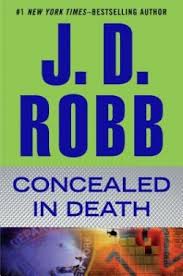
Linda Reads: Concealed In Death by J.D. Robb

conceal inI hesitated to read this book because I was very disappointed in Ms. Robb’s last ‘In Death’ title, Thankless in Death.  There have been rumors that her last few books (as J.D. Robb and Nora Roberts) were ghost written and there are arguments galore debating that topic.   But Concealed In Death was a great story.   It’s true the style of writing is a little different from earlier In Death books.  Many comments have been made about the main characters of Eve and Roarke being different.  But there have been over 50 stories written about Eve and Roarke and readers should expect that they are getting older, settling down, and wouldn’t have the same dynamic as before.

The book does lack the depth, excitement, and suspense of other In Death books.  It’s a quieter suspense, more thoughtful and introspective, with a lot more focus on the victims.  I actually found that a nice change.  There were a few twists in the story that gave the book a jolt when needed.  All in all, it was a very enjoyable read.

Summary of story:

In a decrepit, long-empty New York building, Roarke begins the demolition process by swinging a sledgehammer into a wall. When the dust clears, there are two skeletons wrapped in plastic behind it. He summons his wife, Eve Dallas immediately—and by the time she’s done with the crime scene, there are twelve murders to be solved.

The place once housed a makeshift shelter for troubled teenagers, back in the mid-2040s, and Eve tracks down the people who ran it. Between their recollections and the work of the force’s new forensic anthropologist, Eve begins to put names and faces to the remains. They are all young girls. A tattooed tough girl who dealt in illegal drugs. The runaway daughter of a pair of well-to-do doctors. They all had their stories. And they all lost their chance for a better life.

Then Eve discovers a connection between the victims and someone she knows. And she grows even more determined to reveal the secrets of the place that was called The Sanctuary—and the evil concealed in one human heart.

Jenn Reads: Shinju by Laura Joh Rowland

I’m a voracious reader, but my reading skills lately have been the pits. This cold winter weather getting anyone else down in the dumps?

I finally finished a book last night, from the stack of books that have yet to be finished. This particular one, Shinju, by Laura Joh Rowland, was supposed to be done for mystery book club two weeks ago. Ooops.

195979Shinju follows beginning investigating police office (of sorts, his official title is yoriki) Sano Ichiro in 17th century feudal Japan. Sano, a samurai/school teacher by trade, has been given this position by his supporter, a position he is initially unsuited for. He’s not bad at what he does- no, it’s that he’s a little too good at what he does, especially when things should be better left untouched, as his boss requests.

Sano is supposed to write a closing report on a shinju, or a double romantic suicide. Typically shinjus are when two people of different classes fall in love. Knowing their love will never survive and their families will not accept the relationship, the lovers commit suicide. This shinju looks like a suicide, but Sano is hesitant to close this case- and for good reason. Sano will risk everything: his job, his name, his parent’s reputation, and the lives of others, to solve this case.

The back cover of the book has a quote saying how “exotic” it is, and I suppose for some who are not familiar with the time period, it could be. My senior thesis for my history major in college was on a facet of Japanese history, so this particular era was familiar. For me, reading this book brought me back to my studies and I was thrilled to be immersed in 17th century Edo (now Tokyo). This is a world that is much different than ours, and much different than even 17th century Europe. Led by the Tokugawa regime, the government is a military dictatorship with strict rules. Religion, philosophy, and culture, for the new reader, may seem odd or strange. For several of our book clubbers, how Sano struggles throughout the book to justify his need for revenge and thirst to solve the mystery with his filial piety (extreme devotion to one’s elders, especially parents) and what is expected of him, was weird and unnecessary. But this is something a man of his time would have struggled with, and is realistic.

Many commented that the writing style was a bit elementary, but this is Rowland’s first published work, and will develop further in the series. Is this a masterpiece of mystery writing? No, but it was enjoyable for

what it was. More important to me than the mystery was the setting and time period, which I felt Rowland was spot on with.

Rating: 3 of out 5 stars. Enjoyable, but unnecessarily dense in some places where the plot line could have moved faster. Loved the time period and setting.

See you in the stacks,

Jenn

Jenn Reads: A Tale of Two Cities

In general, I have a rule when it comes to selecting items for our Cheshire Cats Classics Club to read: it has to be something I have never read before.

There are a couple of reasons for this. First, I like to read something fresh and new along with my clubbers. If I selected something that I’ve read in the past, I likely would not take the time to reread it. Second, the classics I have read are likely those my clubbers have already read, and one of my goals is to introduce

A Tale of Two Cities by Charles Dickens

them to titles and authors they may have never read before. It’s a formula that has worked for 3 1/2 years.

For our March pick, I broke that rule.

A Tale of Two Cities by Charles Dickens is a book I was *supposed* to have read as a senior in high school. Let’s rewind 10 years: It’s April, senior year. I’m in my AP English class and we’ve already read at least 10 books this year. The end of this high school experience is near, and simply say to Charles Dickens: “Nah.” Totally not in my nature as a student to do this, but alas, I had had enough (sorry Mr. M.). So I Sparknoted it.

When I put together the set for the first quarter in 2014 for the Classics Club, I looked back at Tale and thought I should give it another shot. At least this time, I could truly say that I read it and if I didn’t like it, well, then I didn’t like it.

A Tale of Two Cities, written in 1859, was serialized from April to November of that year. Dickens was a master at serialization and was one of the few authors of his time to make money off his books in his lifetime. In general, the story deals with the French Revolution through the eyes of both British and French citizens. Just about everyone, even though who have never read the book before, can quote you the opening line, “It was the worst of times, it was the best of times…” Dickens’ friend and biographer, John Forster, wrote that Tale had the least humor and least remarkable characters of all his novels. Well, at least he was honest.

Writing about the French Revolution during Victorian England was a topic writers used often, and readers were likely sick of it by the time Dickens wrote Tale. Dickens specifically chose the French Revolution for the background of his story because  it fit with the overall message he was trying to convey about social justice in England. His initial inspiration came from (or was stolen from, however you see it) his acting experience in friend and fellow author Wilkie Collin’s play The Frozen Deep, which is about two men, one of whom sacrifices his life so the other can be with the woman they both love. Sound familiar?

There are many parallels to Dickens’ own personal life throughout Tale, including the inspiration for Lucie Manet/Darnay. At the time of writing Tale Dickens had begun an affair with actress Nelly Tiernan, who has a strong resemblance to Lucie. As well, it has been hinted that Charles Darnay and Sidney Carton, who are almost the physically the same person, are Dickens himself.

So what did I think about A Tale of Two Cities? I’m glad I finally slogged through it. In typically Victorian fashion, there is too much time spent on the minutiae, with loooonnnnggg descriptions. In the first half there is little movement or action, and dare I say, no character development. When Lucie and Charles get married, the storyline starts to pick up. However, at that point, we’re almost halfway through the novel.

There was a lot I liked about the book: the end (no spoilers here), the villains (loved to hate them), and the setting. This is a book that takes lots of time to get where it’s going, so it’s something that a reader needs to stay with. Dickens writes with purpose, meaning he is one of those authors who inserts definite themes- he wants you to pick them out.

If you get a chance, check out the new movie which highlights this time in Dickens’ life and his affair with Tiernan called The Invisible Woman.

Rating: 3 stars out of 5 (it’s a hearty 3)

See you in the stacks,
Jenn

Linda Reads: Do or Die (Reluctant Heroes) by Suzanne Brockmann

do or dieDo or Die (new series, Reluctant Heroes) by Suzanne Brockmann is a heart pounding, non-stop action, suspenseful, character driven, romantic, passionate, emotional, wonderfully written story that, despite it’s long length, you won’t be able to put down.

It is a spin-off of Ms Brockmann’s very popular Troubleshooters series and I must say, she takes this book to a whole new level.

The story centers around a supposedly dishonored Navy SEAL, Ian Dunn, who is in prison under suspicious circumstances, and his feisty lawyer, Phoebe Kruger, who is determined to get him out.  It’s a complicated story with multiple sub-plots, but told with clarity through Ms Brockmann’s exquisite writing and a cast of interesting, multi-dimensional characters.  The FBI wants Ian to lead a covert operation to rescue some kidnapped children from their ruthless father, but Ian has family issues that cause him to refuse.  Phoebe is determined to find out what Ian’s issues are so they can rescue the children.   Characters from the Troubleshooters series cross over to add support to this story.  There are great surprises when some of the characters’ full stories are finally revealed.  There are multiple love stories, but the book is more suspenseful than romantic.  It’s infused with humor and  the characters are written with such delicious detail, you can imagine yourself inside their heads.

The book is quite lengthy and I was hoping to skip parts here and there, but it was so well written, so entertaining, I just had to read every word!  Great characters were introduced in this book that are going to lead to an exciting series!

Sharon Reads: Will in Scarlet by Matthew Cody

Will in Scarlet by Matthew Cody is a new look at the time of Robin Hood, from a completely new angle. Thirteen year old Will Shakley is the son of a lord, and has led a fairly charmed life. However, when his father is off at war fighting beside King Richard the winds change and treason is in the air. Will ends up in the forest struggling to survive. It is there that we all met up with a group of bandits. Through their trials and adventures young Will is a part of Robin Hood’s rise to power and fame.

This is an exciting tale that will keep boys and girls from around 9 through high school interested. The story follows a thirteen year old struggling with his own identity and values. He faces challenges many of us cannot directly relate too, like fights with wolves, crazy chases through the woods, facing off with a bandit leader, and quite the fire. However the story also brings up things anyone today could face, such as dealing with an over protective mother, coping with an absentee father, and trying to live up with the exceptions others have for him. The adventures of Will and the unlikely crew of comrades he acquires has moments that made me want to hold my breath to see how things turned out, while others just had me reading faster so that I discover how everything would turn out in the end. Cody certainly offered a fan of the Robin Hood legends a fresh look at Rob, Little John, Sir Guy, the Sheriff, and the rest. I also appreciated the addition of Much, who really pulled through and saved the day on more than one occasion. I think readers new to the legend might find this a great motivator to take a look at other versions of the story.

I highly recommend Will in Scarlet to all middle grade readers. The book had serious elements, excitement, and humor. Above all else, Cody does not dumb anything down just because he is writing for children and young adults. It is intelligently written, with a authentic feel in the dialogue. The details and politics of the day are well described, because they are central to the plot, but in a way that might inspire further research or reading more historical fiction rather than feeling educational. I gave this book four stars on Goodreads.  (This review was originally published on Sharon the Librarian.)