I love the Hunger Games series. I love a good action story, and Hunger Games delivers.
Like anything else, I did read the books before seeing the films, and I do feel the films have a slight advantage (except for Mockingjay – it’s nice you made it into two parts, but seriously, you didn’t need to). The films, being visual, cut any bloat that might have been lurking. I love them. I love the casting, I love the cinematography, I love the creative storyline. Any story that can make me love and hate a character at the same time is a pretty good story.
I can’t decide which is my favorite – there’s so much to love about all of them. It’s hard to make a sequel as good as an original – and we can all think of sequels that shouldn’t be spoken of in polite company (ahem, Highlander 2, Frozen 2, Caddyshack 2, Jaws 2, Godfather 3, Star Trek 5, etc) – and few franchises can pull it off – Harry Potter and the Chamber of Secrets and Empire Strikes Back being two of them. Hunger Games does, driving home the horror and mental devastation with unrelenting drumbeats.
Prequels in general are easier to write (we won’t talk about Star Wars), because you generally know what came before and how it winds up. You’re just filling in the details between A and C. I’m sure Collins had a lot of the backstory written – or at least roughed out, before writing the Hunger Games prequel, Ballad of Songbirds and Snakes, a title that works perfectly on many levels. This volume, too, I adored, drawing me into the characters. Even so, I felt this was the most bloated of the series, and I couldn’t always track the action in my head. The movie fixed that gloriously. As always, the original folk music is just the icing on the cake.
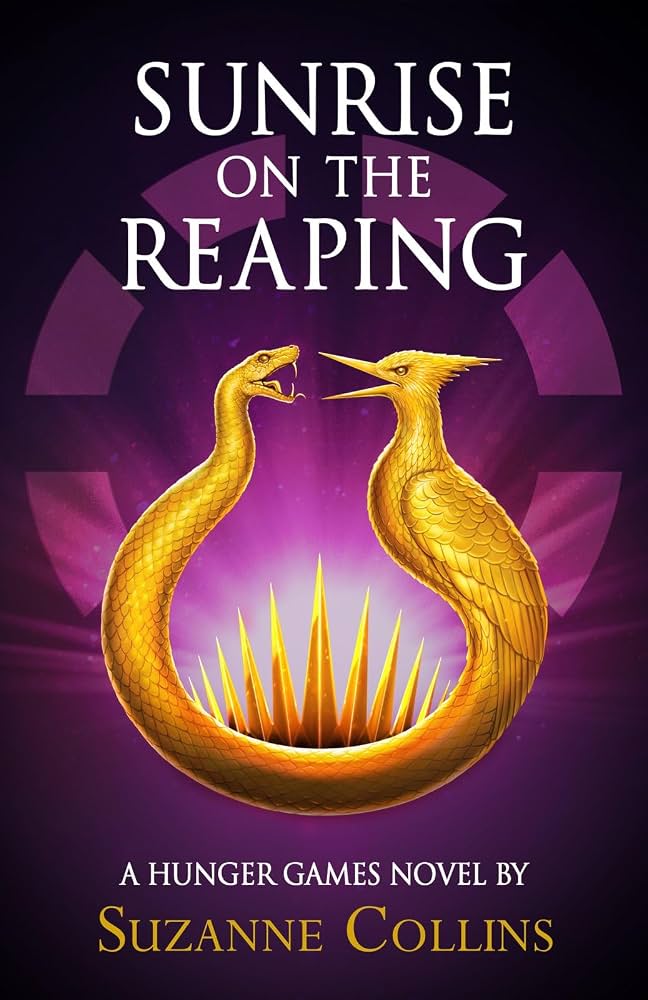
And, okay, I was a year late reading it, but we were gifted with a second prequel, twenty-five years later in the timeline, the 25th games where we first meet the alcoholic mentor Haymitch, Sunrise on the Reaping.
I love Haymitch. I love Woody Harrelson for playing him to perfection. Who the heck wouldn’t be an alcoholic after all that? And to find out you might have to do it again, late in life, when you don’t stand a chance against a 17 year old professional assassin? Yo! Fill my cup!
But for the first time in the series, this book on Haymitch left me wanting.
Sunrise suffers from what I’ve long-called “Muppet Baby Syndrome.” In the original Muppet Show, all the Muppets are adults from different backgrounds, just like people. When the Muppet Movie hit, it explored the origins of all the characters and how they all met and came together to work on The Muppet Show.
Good film. Funny and entertaining for adults, not just kids.
Then came the cartoon Muppet Babies, and suddenly all the Muppets are all together and in the same room as infants (grrr) and no one knows why or how. Many shows have fallen into this trap, where characters are thrown together years before they should be, have always known each other, and everyone who might possibly be a new character knows everyone already, even if the character lines were already set differently. Think of Scooby Doo, with 50 years of genre, and someone now starts a series where the characters were all adopted as newborns in the same family, all at the same time. Star Trek has done this with the Strange New Worlds series. Doesn’t make sense, does it. Sometimes, the stretch is so far, it’s painful.
And that’s what Sunrise on the Reaping does. Districts are districts, large geographic areas, not single towns. It’s like saying all of Appalachia – which spans 13 states – is the size of Bird-In-Hand, Pennsylvania (pop. 537). All of the entire District 12 assembles in one place for the reaping? How do all these poor people get there? Everyone in the village is related, knows everyone, has interbred for generations, even before the war? (Okay, that’s not too far-fetched, very small towns are very like that). Or is only that town lucky enough to be reaped? We really needed to drag in Effie Trinket, 25 years early (she never seemed that old)? Why? Why not someone else? She is the only one who can ever draw names for District 12? They don’t take turns with assignments? And Caesar? Plutarch? Beetee? Mags? It seems suddenly that every character in the last four books is here in this one, too, whether or not they need to belong there, and that hits that painful spot of disbelief. Muppet Baby Syndrome. Instead of introducing us to new characters, and new backgrounds, and new stories, it feels pieced together from all the other bits that we already know. And while I liked some of the new characters, even though you knew they were doomed, I just didn’t have enough feel for Haymitch and his girl to care.
Maybe because the story is tightly locked in by the formula, and “how many ways to kill 24/48 kids can we come up with and still make it fresh?” You can’t. It’s been done. Four times. We know what’s going to happen, and who’s going to live. That’s the way the story must play out. It can’t change, no matter what you try to make different.
Despite it all, I did enjoy it enough. Still love Haymitch. Still love the series. It’s just this book is my least favorite.
Watch for Sunrise on the Reaping in theaters this November 20. View the movie trailer here.
Signing off from District 13.