Louise Reads: The Rosie Project by Graeme Simsion

The Rosie Project by Graeme Simsion

Don Tillman, 39 and a professor of genetics, has never been on a second date. His lifelong difficulty with social rituals has convinced him that he is simply not “wired” for romance. Logically, though, he concedes to the statistical probability that there is someone for everyone, and he embarks upon The Wife Project. In the orderly, evidence-based manner with which he approaches all things, Don sets out to find the perfect partner through an exhaustive 16-page survey he has designed to scientifically eliminate all incompatible candidates.

Rosie Jarman would never make it past page one of Don’s survey. A smoking, drinking, disorganized vegetarian, she is completely unsuitable. Yet Don feels somehow compelled to use his expertise in DNA analysis to assist her with a project of her own – identifying her biological father. An unlikely friendship develops between them as they work together on The Father Project.

In The Rosie Project, Don is our narrator, and seeing the story from his point of view is part of the charm of this book. Similar to The Curious Incident of the Dog in the Night -Time and Silver Linings Playbook, the narrator of this story is wired differently than most people.  To say Don has social difficulties is an understatement.  In an early scene, Don is discussing a lecture he’d recently given at the university:

“Claudia asked whether I’d enjoyed the Asperger’s lecture… [I] told her I had found the subject fascinating. “Did the symptoms remind you of anyone?” she asked.  They certainly did. They were an almost perfect description of Lazlo Hevesi in the Physics department.”
 

Fans of the television series “The Big Bang Theory” may notice some similarities to the character Sheldon Cooper from that show.  For example, in a scene where Don is explaining his scheduled meal system to Rosie after a meeting at a restaurant goes comically awry:

“So you cook this same meal every Tuesday, right?”
“Correct.” I listed the eight major advantages of the Standardized Meal System:
  1. No need to accumulate recipe books.
  2. Standardized shopping list – hence very efficient shopping.
  3. Almost zero waste – nothing in the refrigerator or pantry unless required for one of the recipes.
  4. Diet planned and nutritionally balanced in advance.
  5. No time wasted wondering what to cook.
  6. No mistakes, no unpleasant surprises.
  7. Excellent food, superior to most restaurants at a much lower price (see point 3).
  8. Minimum cognitive load required.

Debut novelist Graeme Simsion has written a warm-hearted, laugh-out-loud funny, and surprisingly poignant story. No huge surprises, The Rosie Project follows many of the tropes that are the stock-in-trade of romantic comedies,  but I was still caught up in the story from the first words and it never lagged or disappointed. A feel-good book that delivered!  Audiobook listeners will enjoy first-time narrator Dan O’Grady’s performance, his Australian accent (the story is set in Melbourne) added an authentic touch.

If you like The Rosie Project, you may also enjoy:

The Big Bang Theory starring Johnny Galecki, Kaley Cuoco, Jim Parsons, Simon Helberg, and Kunal Nayyar

The Silver Linings Playbook by Matthew Quick

The Curious Incident of the Dog in the Night-Time by Mark Haddon
Linda Reads: Let Me Be The One by Bella Andre

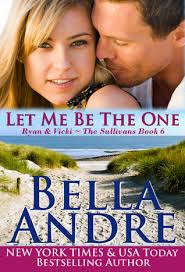
let meLet Me Be The One  is book six in The Sullivans series.  All of the books in this series can be read alone.   This series of books is beautifully written and a joy to read.

Ryan and Vicki were best friends in high school, but have long since gone their separate ways – Vicki to Europe as a sculptor and Ryan as a star baseball pitcher in San Francisco.   After a failed marriage, Vicki finds herself in San Francisco applying for a prestigious position in the art community and finds herself in an awkward position with one of the judges.   Even though she hasn’t seen him in years, her first thought is to call Ryan for help.

Ryan volunteers to be Vicki’s “pretend boyfriend”  to protect her from the unwanted advances of an influential judge.  But both Vicki and Ryan have trouble with the “pretend” part.  Neither wants to ruin their friendship by becoming lovers, but that’s proving to be quite difficult.  No matter how hard they try, their “love” for each other overtakes their “friendship”.

Touching, sweet, romantic and sexy, with likeable characters, this book is my favorite so far of the series.

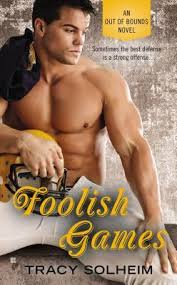
Linda Reads: Foolish Games by Tracy Solheim

foolishFoolish Games  is a wonderfully written sports romance.  The author gives us great insight into the NFL with a believable storyline and a wonderful cast of characters.  This is actually book two in the Out of Bounds series.  Book one is Game On. 

Bridal gown designer Julianne Marchione has an uncharacteristic one night stand at a client’s wedding that results in a surprise pregnancy.  Julianne plans to raise her son, Owen, on her own, until he is born with a life-threatening blood disorder that requires a transfusion—and Julianne is not a match.

Will “William the Conqueror” Connelly is an NFL star that grew up a bastard child born on the wrong side of the tracks.  He is blindsided with the news that he has a son that needs a blood transfusion from him.  He quickly takes charge of the situation, insisting on a marriage of convenience so his son will not have to endure growing up a bastard.

Will has a lot of insecurities stemming from his childhood and he is also dealing with a scandal involving his college coach that could bring an end to Will’s NFL career.  Julianne has had to sell her bridal design company to pay Owen’s medical bills and has lost her ability to design.  She is also struggling with issues from her past.  With so much conflict going on in their lives, they almost miss the fact that they are falling in love with each other.

The book is multilayered with a wonderful cast of supporting characters.  There is a secondary romance between Will’s mom and his boss that intertwines beautifully with the main story.

A realistic storyline told with passion, humor and wit with wonderful interaction between characters and how they grew to be a true family.

Jenn Reads: A Tale For the Time Being by Ruth Ozeki

I love Japanese history. I loved it so much I wrote my senior history thesis in college on the court culture during Lady Murasaki’s time (Lady Murasaki wrote the first ever novel, Tale of Genji in the 900’s).

I was pleased therefore when my friend selected A Tale For the Time Being by Ruth Ozeki as her pick for my girlfriend’s book club. A Tale For the Time Being takes place partially in Tokyo, with a 16 year old narrator named Nao and on a small island off British Columbia, with Ruth.

A Tale For the Time Being, by Ruth Ozeki

A Tale For the Time Being, by Ruth Ozeki

Ruth discovers while walking on the beach, a plastic bag filled a Hello Kitty lunchbox and other seemingly garbage-like items. Upon opening the bag, Ruth finds that these items are from Japan, and likely floated over after the 2011 tsunami. What ensues is a non-climatic story of Nao finding her place in the world, and Ruth figuring out if Nao was a victim of the tsunami.

There is a lot of word manipulation and double meaning in this book. For example, Nao’s name in English would be pronounced now. Time beings all happen in the now. It goes on and on like this, until you’re almost ready to scream at the book, “OK! I get it!”

It should be mentioned that this book was long-listed for the Booker Prize and is very literary. Perhaps almost too literary for the particular stage I was at in my life while reading this book. It should also be mentioned that everyone LOVES this book. I can’t say I loved it, but I didn’t hate it either.

Ozeki, a New Haven native, crams a lot into this book, which is over 400 pages. There is life in modern Tokyo, life on a small Canadian island, Zen buddhism, extreme bullying, Alzheimer’s, kamikaze, physics, time travel, philosophical theory… it just had too much. After a while there were so many issues and concurring themes I wanted to give up. There were several themes I thought could have been saved for another tale, another day.

There were times when I felt Ruth’s storyline was too personal. For me, it was a look into the real life of Ruth Ozeki, without this being an autobiography. Her husband, Oliver, is a secondary, but main character in Ruth’s narrative, and at times I wanted to cringe at the interactions between the two. It was almost a place for her to air her grievances, but not the right forum.

I did however love Nao’s narrative. Being almost the exact same age as her, I could relate to the pop culture references she referred to, and the difficulties of being a teenager in the 2000’s. Nao’s life was not easy, and she had no one, except her Zen Buddhist nun great-grandmother Jiko, who completely understood her. The scenes with Nao and Jiko are the best in the story- Nao is not judged by Jiko, who listens, provides guidance, and parental affection lacking in her life.

If this book had been just Nao’s story, or we found out what happened to Nao, which to me is the great mystery of the book, I would have rated it higher. I partially read and listened to this book, read by Ozeki herself. I enjoyed listening to her inflections and pronunciations, which can be difficult for those not acquainted with the Japanese language.

Rating: 3 stars out of 5

See you in the stacks,
Jenn

Susan Reads: The Year Without Summer: 1816 by William Klingaman

Think winter’s lasting too long?  Imagine 18 straight months of cold and snow.

I’ve always liked books on natural disasters, and exploding volcanoes are about the biggest you can get. They spawn earthquakes and tsunamis, send pyroclastic flows racing down hillsides to poison and bury entire towns (Pele, Vesuvius, Pinatubo), blow entire islands away (Thera, Krakatoa), appear overnight (Parícutin), or ooze for years (Kilauea). They can also create spectacular sunsets for months afterward, or, if they’re really determined and throw huge amounts of ash too high into the air, they can change the climate of the entire Earth in a matter of weeks. This is what happened in 1816, when Mount Tambora, a fiery grumbling volcano, blew up in Indonesia, with the largest volcanic eruption in recorded history. The Year Without Summer: 1816 tells how this single volcanic eruption in the tropics had far-reaching effects around the world.

Mount Tambora didn’t just explode, like Krakatoa. It blew like a fountain, throwing so much ash into the air that it blackened the sky for thousands of miles and created a cloud of dust that blocked out the sun. This just happened to occur while the sun was at its coolest point in its cycle anyway (the Maunder Minimum). The resulting cooling of the ground (a 7-degree difference) brought on dire climate changes (parts of New Hampshire didn’t receive a drop of rain for more than 3 months, while Switzerland experienced horrific flooding), wild swings in temperature (July temps would hit 95 one day and it would snow the next), but mostly an unrelenting cold that prevented seasonal changes and destroyed most crops as far south as the Carolinas. It created dire famines and unrest through most of the British Isles and western and central Europe that lasted through 1818, beginning a wave of immigration that helped spread America westward.

Klingaman explores in great detail the effects of the climate change on political structures  in America and Europe, from the election politics of young America to disruptions in France, England, and Ireland. He spends a great deal of time discussing the travels of  Lord Byron, Percy Bysse Shelley, and Mary Wollstonecraft Shelley through Europe and Switzerland, who all wrote oodles of letters fretting about the weather. The darkness and seclusion caused by the weather gave rise to Mary Shelley’s famous masterpiece, Frankenstein.

Myself, I did not care for the book. Unlike Winchester’s Krakatoa, Klingaman barely discusses the volcano; it’s a cause for the book, not a main character, more like a shadowy villain behind the scenes. Instead, most of the book is about the American and European political fallout because of the climate change. I understand most of the voluminous information comes from primary sources, and because it’s 1816 there is a lot of relevant written information of the time, but I picked up the book wanting to read about a volcano. If you like history and politics, or biographies of Mary Shelley, you might enjoy the book.  If you’re looking for stories of volcanic glory and the birth and death of islands, go read Krakatoa.