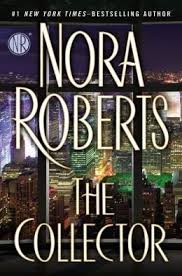
Linda Reads: The Collector by Nora Roberts

collectorAfter being disappointed in Ms. Roberts’  last book Whiskey Beach (reviewed here), I wasn’t sure what to expect from her newest, The Collector.  I’m happy to report I’m very pleased with this one.  It’s a bit different –  an intriguing mix of Ms. Roberts’ writing and J.D. Robb’s – making it an entertaining, edgy, romantic suspense thriller.

Lila Emerson is a quirky professional house-sitter and author of young adult werewolf books.  She enjoys living in other people’s homes and she takes great pleasure in scoping out her surroundings.  With the use of binoculars, she spies on the neighborhood and uses her vivid imagination to create stories about her neighbors.  Unfortunately, one evening she witnesses a murder.  The police conclude a boyfriend murdered his girlfriend and then took his own life.  However the boyfriend’s brother, Ashton, is sure they are wrong and enlists Lila’s help in finding out the truth.

Ashton is a famous artist and comes from a close, loving, somewhat dysfunctional family of considerable wealth – so different from Lila’s life.  Of course it’s predictable that they will fall in love, but that part of the story unfolds slowly, exquisitely, while the hunt for the truth leads to Faberge eggs, and murder.  There is a great supporting cast – Ashton’s best friend and Lila’s best friend turn out to have a history together and a lovely romance blossoms there.  The detectives working the case add some insight into the world of overworked cops with wit and humor.  We get a peak into the world of the rich and into the world of evil.  There are gruesome murders, ruthless assassins, touching love stories, great family interaction, art, antiques, cops, and humor all woven into an entertaining, engaging story.

It was fun to visit the life of a house-sitter, and an artist and learn about Faberge eggs.  Having no interest in those particular subjects, Ms. Roberts was able to keep me entertained, interested and engaged in the characters and story line.


Jenn Reads: Brave New World

Brave New World by Aldous Huxley was our April pick for the Cheshire Cats Classics Book Club.

Before there was The Hunger Games series, Maze Runner series, Legend series there was Brave New World. Huxley was one of the first authors to write a dystopian novel and all others that follow are using him as an example. He did it first and did it best. I marketed this book as the original dystopian novel, because of how popular that genre is right now. And if you want to know where these authors have likely gotten their inspiration, you need to read this book.

A few fast facts about Huxley: he taught French at Eton and George Orwell was one of his students. When Orwell published 1984, he sent a copy to his former teacher, who

Brave New World by Aldous Huxley

basically called the book garbage. Huxley died on the same day as C. S. Lewis and JFK, and both of their deaths were overshadowed by the death of the president. And he was a friend to Igor Stravinsky.

Brave New World is a book that is so similar to our own, it is scary how real this book is.

Published in 1932, Brave New World takes place almost 600 years in the future. This is a world where your future is determined at the moment of your conception. Every single child born in this world is born of the test tube and is “raised” to be one of five classes- Alpha, being the best and highest class, or Epsilon, the lowest class. You have no mother, father, and are engineered for specific tasks. You will never grow old, you will never rise above your class, and you will have no apparent free will. Life will be full of pleasurable things however- sex, drugs, mass consumption, and more.

So what makes a dystopian novel different from an utopian novel? Dystopian novels are characterized by a horrible society headed towards oblivion, while utopian novels have an ideal society. Brave New World is a utopian novel on the surface, and to those living in that society, but it’s really dystopian. There is a huge reliance on technology, instant gratification, and lots of propaganda.

Huxley was disturbed at the path the world was taking: the world had been plunged into a great economic depression, fascism and communism were taking hold across Europe, and the Industrial Revolution was continuing to change the landscape of the world. What would happen to us as a people if all of this continued? Huxley feared that we would become a people slaved to technology, conditioned for pleasure and nothing else, and drugged to reality. If you’re thinking this sounds a lot like today’s society, you would not be that far off. However, lurking on the fringes were Savage Worlds with people who had lived a much different life.

If you read Brave New World today, there are many scenes that will likely make you think twice. One for me was the scene at what I’ll call the children’s center, where children are being conditioned for certain things. This particular set of children is taught to be afraid of loud noises. What is eerie is the level of manipulation that is going on- these children have no free will. Just like our own, the world of Brave New World is a throw-away society. Something breaks, is old, is damaged, is no longer wanted- throw it away!

Huxley had supposed it would take hundreds of years for the things he wrote about to come true, but if you look hard at the world we live in today, it is a lot like the one he envisioned. Hospice, cloning/DNA/biological engineering, helicopters, and e-books were just a few of the things he prophecized for the future.

Brave New World is easy reading, but do not be fooled by the simplicity of the language or writing. Huxley has a lot to say about how we live our lives with each other, with technology, and for the future.

Rating: 3 bookmarks out of 5

See you in the stacks,

Jenn


Jenn Reads: Mr. Penumbra’s 24-Hour Bookstore

Our mystery book club recently read Mr. Penumbra’s 24-Hour Bookstore by Robin Sloan.

A recently unemployed millennial, Clay, wonders into a curious San Francisco bookstore and leaves finding himself employed. It’s a strange bookstore- long with shelves that seem to reach towards the sky and some odd books. His boss, Mr. Penumbra, has just three rules for Clay, the most important of which is to never look inside the books on what Clay calls the “wayback shelves.”

Mr. Penumbra’s 24-Hour Bookstore by Robin Sloan

Clay works the midnight shift and encounters a few characters, all of whom want books from the “wayback shelves.” It does not take Clay long to peek into those books and open the proverbial can of worms. Along with the help of friends, Clay seeks to solve the puzzle of eternal life.

This is a book for anyone who loves to read, loves bookstores or libraries, or ponders what the future will bring. Mr. Penumbra’s 24-Hour Bookstore is a book for today, with its clash of technology and traditional ways and methods. We get asked a lot here at the library what we believe the future of print books will be with the advent of e-books. It is difficult to say for sure (no one has a crystal ball), but I would personally like to hope that print books will always be around. After all, people still use brooms even though they have vacuum cleaners!

This book also raises the question: How do will we solve problems – by using computers or our own brains? How reliant will we become on computers? Clay finds throughout the book that technology can be useful, but it also cannot do the critical and complex thinking our minds can accomplish.

Mr. Penumbra’s 24-Hour Bookstore is an easy to read, engaging, and quirky book. I enjoyed the adventure and the resolution of the puzzle (solved without the help of a computer!). There were times however, when problems were too easily solved with a ready answer or helping hand. So-and-so just happened to have that skill or know a person who could help them. It became a little too predictable. I would not recommend this book to anyone who is not at least familiar with some of the changes in technology – this book is full of 2012 popular jargon and pop culture references, which could be confusing for some.

Rating: 4 bookmarks out of 5

See you in the stacks,
Jenn

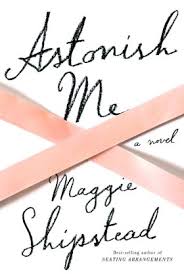
Linda Reads: Astonish Me by Maggie Shipstead

astonish meAfter reading a review, I decided to give Astonish Me a try.  I was not disappointed!  This book takes you into the fascinating world of ballet and into the complicated life of a second string dancer.  The chronological way of telling this story was, at first, awkward.  But as the book progressed, it made a complex story more interesting.  There are several ‘main’ characters, each with their own story to tell.  Ms. Shipstead deftly weaves their stories together.  While the world of dance is foremost,  you don’t have to be a lover of ballet to like this book.  This is a story of love, family, marriage, careers and the struggles of life that many can relate to.

Astonish Me is the irresistible story of Joan, a young American dancer who helps a Soviet ballet star, the great Arslan Rusakov, defect in 1975. A flash of fame and a passionate love affair follow, but Joan knows that, onstage and off, she is destined to remain in the background. She will never possess Arslan, and she will never be a prima ballerina. She will rise no higher than the corps, one dancer among many.
After her relationship with Arslan sours, Joan plots to make a new life for herself. She quits ballet, marries a good man, and settles in California with him and their son, Harry. But as the years pass, Joan comes to understand that ballet isn’t finished with her yet, for there is no mistaking that Harry is a prodigy. Through Harry, Joan is pulled back into a world she thought she’d left behind—back into dangerous secrets, and back, inevitably, to Arslan.

Maggie Shipstead

Maggie Shipstead

Maggie Shipstead is a novelist and short story writer. She is a graduate of the Iowa Writers’ Workshop and a former Wallace Stegner Fellow at Stanford. Maggie’s writing has appeared in The New York Times, The San Francisco Chronicle, Tin House, The Paris Review Daily, VQR, American Short Fiction, The Best American Short Stories, and elsewhere. Her story “La Moretta” was a 2012 National Magazine Award finalist. Her debut novel, “Seating Arrangements,” was a national bestseller and the winner of the Dylan Thomas Prize and the L.A. Times Art Seidenbaum Award for First Fiction.


Jenn Reads: The Spymistress

Female espionage in the Civil War is a new area of study, and one I am quite familiar with. My husband, Matthew, lectures frequently on four women who risked all for the sake of their country. It has been an immensely popular program, drawing crowds of more than 80 people on occasion.

The Spymistress by Jennifer Chiaverini was my pick for March for the girlfriend’s book club I run outside of the library. I had one sole purpose in selecting this book: to help me research and get ready for my own impression of a female spy in the Civil War. Matt and I have joined a reenacting group and we will be portraying a Pinkerton agent and a female detective. While this is a fictional account, I knew it would be helpful and readable for my friends.

The Spymistress tells the story of Elizabeth Van Lew, a Unionist living in Richmond during the time of the American Civil War. While not incredibly common, Unionists lived throughout the Confederacy, and Confederate sympathizers lived throughout the Union. Life was extremely difficult for these people, who had to toe a line so they

The Spymistress by Jennifer Chiaverini

wouldn’t be arrested, deemed traitors, or become social outcasts. Van Lew, 43 in 1861, lives with her mother, brother, sister-in-law, and nieces in their Richmond mansion. She’s outspoken and passionate and feels a deep need to help. But she’s not going to help the Confederacy. She’s going to help the Union.

Van Lew is able to get herself a pass for the prison holding Union soldiers and begins her work. Initially she comes bearing gifts of ginger cakes and food, medicine, and other creature comforts, but soon starts smuggling in and out information. Suspicions arise almost immediately with citizens of Richmond- why is Van Lew only helping Union prisoners? What about Confederate soldiers who have a need? Van Lew deftly uses the Bible and Christian theory, saying that Jesus taught his followers to love their enemy as themselves. And since this is a religious, church-going society, this explanation works. She also hosts a Confederate general and his family for several months in her home, puts on several lavish parties celebrating a particular regiment, and diverts suspicion.

But Van Lew’s best work comes at Libby Prison, where she is able to help Union soldiers escape. She sets up what is essentially a soldier’s underground railroad through a set of safe houses (using quilt blocks, hung outside on clotheslines). Van Lew also set up a chain of spies throughout the Confederate government and military, most notably Mary Bowser (whose real name may not have even been Mary Bowser), a freed slave who worked as a maid for Varina Davis, the first lady of the Confederacy, in the Confederate White House.

Van Lew and her chain of spies are unsung heroes of the Civil War and their stories deserve and need to be told. Van Lew truly did risk everything for her country and lived a very tragic life after the war. Imagine being a Unionist in Richmond after the war.

Chiaverini does an apt job of telling Van Lew’s story with accuracy and respect. Having already known most of Van Lew’s work and life, much in this book was not new for me. For those who are not familiar with Van Lew, I would imagine this being a welcome history and biographical lesson. Her narrative is easy to read and true to Van Lew’s character. This is not a “romantic” book, so those expecting a love story will not find one (Van Lew never married).

However, I was not wowed by this book. Perhaps because I knew too much already about Van Lew the book just fell flat. There was nothing wrong with the characterization, the narrative, or the story itself. Having listened to this book, maybe it was the reader.

Rating: 3 stars out of 5

See you in the stacks,

Jenn