Have You Thought about Being Mortal?

Have you thought about dying? It’s such a scary topic, fraught with so much emotion. We like to think we’ll always have more time ahead of us. But what happens when something–an illness, an accident, a disease–sets a limit on our time? What happens when we are forced to confront the end of our lives?

Jacket.aspxBeing Mortal: Medicine and What Matters in the End by Atul Gawande explores this issue, an issue that we all must inevitably face.

Many folks first confront mortality when dealing with their aging parents, but illness can strike at any time of life. Then we are forced to make decisions about treatments. About living wills. About how we want to live the remainder of our lives. We want to live longer at all costs and we’d do anything to achieve that goal, right? Perhaps not. As Doctor Gawande discovered in his research on aging and dying, what most people want is not necessarily a longer life, but a quality life.

Gawande, a practicing surgeon, notes that doctors are often committed to extending life at all costs. This can mean painful and expensive procedures, even for those for whom there is no cure. Gawande questions this rationale, while admitting he himself has often advised patients to pursue treatments that he knew would not extend their lives by more than a few months or year. However, patients, he came to realize, wanted procedures that would guarantee them ten or twenty more years of life.

But medicine often cannot deliver such outcomes. The exceptions, the people who do survive for years in spite of the odds, are just that–exceptions. Gawande equates it with winning the lottery. Everyone believes they will be lucky but very few actually are. Gawande also noted that, in the case of terminal illness, the trade-offs of pursuing treatment–time, money, pain, recovery–were often not worth the small extension of life to most people.

What the mortally ill or infirm person really wants is a meaningful life, even if there is only a few months left of that life. The terminally ill desire to retain independence and control, as much as they possibly can. They desire to stay in their homes. They want their loved ones around them. They fear prolonged and painful deaths. They fear bankrupting their families.

Gawande illustrates the importance of these issues with depictions of  traditional nursing homes, which place safety and monitoring of vitals above the fulfilling lives people need and want. He counterpoints these with illustrations of models of care that take patients out of hospitals and nursing homes for a variety of assisted living facilities and hospice services.

I was especially intrigued by his description of hospice, a service I had (erroneously) believed was only for the last few weeks of life. Hospice gives the aged and terminally ill choices. Hospice workers ask what your goals are. They ask you to think about what you want. They ask you what you don’t want. They talk about your fears. And they address every issue.

And that is the gift of this wonderfully written book. It makes you ask those questions, of yourself and perhaps of those around you. For someday you may be in a position to have to make choices for a loved one, or in the position of having a loved one making choices for you.

How a Stuffed Bear Can Give You Tranquility

Stuffed bears and other beloved toys certainly gave us tranquility when we were children, but that’s not what I’m talking about. I’m talking about philosophy. I’m talking about Taoism. I’m talking, of course, about Winnie-the-Pooh.

Jacket.aspxNow what, I can hear you asking, does Winnie-the-Pooh have to do with tranquility, philosophy, and Taoism? The answers are revealed in Benjamin Hoff‘s The Tao of Pooh, a book of 158 pages that deftly explains the principles of Taoism and applies them to modern life using the seemingly-odd, but, ultimately, not-so-odd example of Winnie-the-Pooh.

Using excerpts from the Pooh books by A.A. Milne, Hoff makes Taoism approachable and easy to understand. It’s not just a deep Eastern philosophy for hermits and mystics!  The tenets of Taoism can be incorporated into everyday life as Hoff illustrates via Pooh, a bear who exists very much in the now.

Using Pooh as his Taoist master, Hoff explores  “the ability to enjoy the simple and the quiet, the natural and the plain” along with “the ability to do things spontaneously and have them work”.  He uses the examples of Rabbit (Knowledge for the Sake of Being Clever), Owl (Knowledge for the Sake of Appearing Wise), and Eeyore (Knowledge for the Sake of Complaining About Something) to illustrate non-Taoist aspects of life, things that get in the way of happiness.

“When you discard arrogance, complexity, and a few other things that get in the way, sooner or later you will discover that simple, childlike, and mysterious secret…: Life is Fun.”

And what are the lessons of Taoism?

Things Are As They Are.
Everything has its own Inner Nature.
Enjoy the Process.
Things just happen in the right way, at the right time. At least they do when you let them.

And so much more. This is a perfect  read when you need some tranquility, perfect for Jacket.aspx2those desiring some calmness, slowness, some quiet. And the book is fun. It reads easily, quickly, with humor, wit, and quotes from Milne’s beloved stories. It can’t miss and it doesn’t miss.

By the way, Pooh Day is January 18th (also the birthday of A.A. Milne). What better way to celebrate than by reading the Tao of Pooh and it’s companion book, The Te Of Piglet.

Books Coming to the Big Screen in the 2016

book-to-filmBooks adaptations have been big hits in the movie theaters over the last few years, so is it any wonder that the number of books heading to the big screen seem to be on the rise? There are a number of great books making their way to the big screen again this year, some of which I am very excited to see. Here are some of the books-to-movies I am most excited about for 2016. I have included the current scheduled release date for each film, which is subject to change.

You might want to put the books on hold now if you want to beat the rush to read them (or watch previous versions of favorites) before watching the new releases in the theater! I have linked each title to the available versions that our library currently owns.

MOVIESChildren
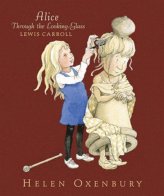
Alice Through the Looking Glass (May 27, 2016)
Fantastic Beasts and Where to Find Them (November 18, 2016)
The Jungle Book (April 15, 2016)
The BFG (July 1, 2016)
The Little Prince (March 18, 2016)
Middle School: The Worst Years of My Life (October 7, 2016)
The Great Gilly Hopkins by Katherine Paterson (February 16, 2016)

MOVIES2Young Adult
Allegiant (March 18, 2016)
The 5th Wave (January 15, 2016)
Miss Peregrine’s Home for Peculiar Children (December 25, 2016)
Delirium (September 30, 2016)
A Monster Calls by Patrick Ness (October 14, 2016)
Let It Snow by John Green (December 9, 2016)

MOVIES3Adult
The Finest Hours (January 29, 2016)
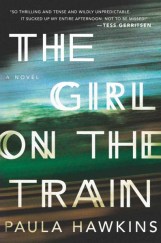
The Girl on the Train (October 7, 2016)
The Shack (August 12, 2016)
Tarzan (July 1, 2016)
Pride and Prejudice and Zombies (February 5, 2016)
Jack Reacher: Never Go Back (October 21, 2016)
The Lost City of Z by David Grann (No Date Given 2016)

I (Finally) Read “It”

I am not a fan of horror. I would not shut the shower door for ten years because Kolchak: The Night Stalker scared the daylights out of me. My father’s description of the movie Killdozer made me terrified of construction equipment – as if I wasn’t already, from a preschool nightmare involving dump trucks. I watched the original 1931 Dracula and got a bloody nose in sympathy. I won’t sleep in a room with a vacuum cleaner thanks to Zenna Henderson. I like sleeping at night, and I don’t need any more anxiety in my life. I have kids for that.

ZX0AYe8 It was my mother who got me reading Stephen King. I was about twelve, sick in bed, and Night Shift, his book of short stories, came out. Wouldn’t you know it, the light from the bathroom at night struck every knob on the dresser at just the right angle so each one looked like an eye staring at me, just like the cover story. I only dared read half of them, and never enjoyed going to the dry cleaners again. But I read The Shining (I will NOT go into a hotel bathroom without a light on), read The Stand (his best, I think), Cujo, The Dead Zone (more my style), Firestarter (I needed a book for the train back from Canada) and Christine (Like I didn’t suspect that already). One thing you can say about King without ever reading his books: he doesn’t write short volumes.

Jacket.aspxBut by Christine, I was Kinged out. The books were were getting to be too similar, and I moved on. That was how I missed reading It, the book everyone seems afraid of. I avoided it for the longest time, but it popped up in a series of references this year, and I decided the time had come to tackle it. I’d re-read The Stand, and The Shining, but nothing new of King’s in 30 years.

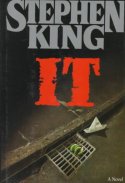
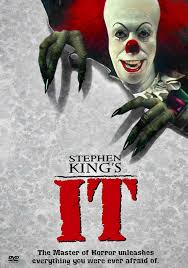
“It” tells the story of an evil presence that takes over4775612-3278691654-IT.jp the town of Derry, Maine, until a ragtag band of seven misfit children decide to take it on. Although the entity takes the shape of what scares a person most (werewolves, mummies, giant birds, etc), it often lures children to their deaths by taking the shape of a clown, Pennywise. I’ve never been afraid of clowns, though I understand the psychology behind it (like Daleks, you can’t read a clown’s frozen face, and it makes some people uneasy). I’m still not afraid of clowns; but I’m now nervous about balloons. Calling the evil “It” is a brilliant stroke of semantics – think of all the times you use the pronoun It: It was calling me. I tripped over It. It snuck up on me. I’m scared of it. You can’t help it; you can’t escape it. You talk about it all the time. Because you know it’s there. “It” can be anything, and you know it to be true.

But for everything anyone told me about the book, I think this is his worst that I’ve read. He’s written 55 novels, 200 short stories, comic books, films, has awards oozing out his ears – he knows what he’s doing. I don’t mind the back and forth nature of the story, bouncing between 1958 and 1985. The characters and style are classic King, but it is soooo long (1100+ pages), it really, really could have had sections of character description cut. It drags in places. It’s not the length: Game of Thrones is 1200 pages, scatmanbut I read it with more gusto. King’s name-dropping of characters from his other works grated on me. One is cool, but not several. Don’t stick Dick Hallorann in your book, a man with a strong sense of Shining (or, if you’re a Simpsons fan, Shinnin’), and have a catastrophe or a presence about that he doesn’t get ESP on. You laid Hallorann out in detail in The Shining; you let him drift in It. Sometimes the action is too cartoonish: having a victim’s head pop out of a box on a spring and go boing ruins my tension. I understand it might be appropriate to scare a child, but I’m not a child. Dolores Claiborne smashing my ankles with a sledgehammer makes me lie awake in a sweat all night. Cartoon boings don’t. I won’t tell the ending, but after fighting tooth and nail to wade through 1100 pages, I wanted more of a bang for my effort. The original Stand was 800 pages or so, and that ended with a nuclear explosion.

Yeah, yeah, I shouldn’t criticize King because he’s one of the most successful novelists images itof our time, and I don’t disagree with his talent. But perhaps he set his own bar too high. No one – not even Shakespeare – hits the nail of perfection every time. From the man who brought you Stand By Me, The Green Mile, Under the Dome, and so many, many wonderful tales, I just don’t think it’s his best.

What do you think is King’s best work – book or film?

Childhood Revisited

  ramona If you grew up in the 70’s and 80’s, you probably read at least one of the Ramona Quimby books by Beverly Cleary. Cleary documents inquisitive, quirky Ramona from the age of four upward, and how her innocent rationales confound and vex her parents, sister, and just about everyone she meets. Cutting her own hair, baking her doll inside a birthday cake, fighting with her sister, starting school – stories every child or parent can relate to with much laughter.

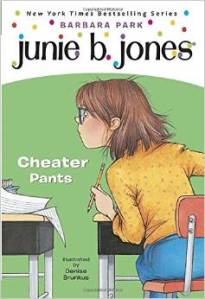
Fast forward a generation. Ramona gives way to Junie B. Jones, a kindergartener of the modern age whose misinterpretations and misguided notions get her into just as much trouble as Ramona, at home and in school. But while Ramona is filled with the sweet innocence of a bygone era, Junie is modern empowered sass. Whether getting into trouble on the schoolbus or with her family or with her nemesis, That May, Junie says aloudjunie what many children and adults often think.

Myself, I’ll take Ramona over Junie B, simply because Junie is a little too fresh for me, but I confess: I love the Junie B. Jones books, and sneak off to read them even though my youngest is now 17. And yes, I would have no problem rereading a Ramona book if I had an hour to kill – I have the whole set. If you love the genre but won’t read a kid’s book, there is hope: if you miss those kinds of stories, of seeing the world through a child’s eyes as they struggle to make sense of the world around them, often hilariously misinterpreting things, fear not! The adult form of those stories exists.

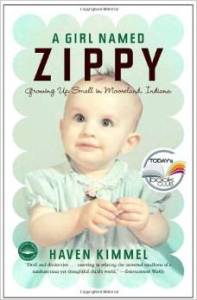
zippyEnter Haven Kimmel, who grew up in the tiny town of Mooreland, Indiana, in the 1970’s (population 300). Kimmel is a real life Ramona Quimby, and she chronicles her life in a book called A Girl Named Zippy. How she sees things, both odd and oh-so-totally familiar (“A Short List of Records My Father Threatened to Break Over my Head If I Played Them One More Time” “A Short List of Things My Father Won Gambling” “The Breakfast Bar at Which No Breakfast Was Ever Eaten.”), will have you laughing out loud where ever you happen to be reading at the time. Her cast of crazy characters, both friends and family, are common to almost every family, whether they admit them or not. Her father works in a factory, her mother lies on the couch watching TV ignoring any and all household chores, and there’s nothing in the house to eat but carrots. Although Kimmel never has clean clothes (people she visits tend to wash her clothes for her when she stops by), only one room has heat, and the house is falling down around them, Kimmel never feels neglected. She hates her Quaker roots and three-times-a-week church, her mother’s best friend has the mouth of a sailor (I can’t help but see Kathy Bates playing her in a movie), and her brother and sister flee home at the first opportunity.couch

In her second book, She Got Up Off the Couch, Kimmel describes her later years when her mother got some gumption, got off the couch, and decided to enroll at Ball State University – though it only made the home conditions worse, if possible. While being on campus with her mother, attending theater, even just listening to her mother’s phone conversations, Kimmel is suddenly thrust into realizing there’s a world beyond Mooreland, and she is never the same again. Things are not always fun and games, and Kimmel starts to become aware of the differences of how she lives versus how other people live (her father’s friend has gold toilets and velvet wallpaper; they have a hole in their wall that goes almost to the outside, and no running water), and begins to notice her parents are never together. Eventually she catches on to the fact her father’s having an affair, but even then Kimmel’s tone is wistful and both painfully accusatory and forgiving at the same time.

Whether you grew up in the 60’s, 70’s, or 90’s, the fact that you grew up at all gives you a common experience shared by everyone else, oftentimes more than you know. If you can’t relate directly to Kimmel, you probably knew someone in your neighborhood just like her. Whether you grew up in Indiana, Oregon, Arizona, or Massachusetts, you will find delight and painful familiarity in Kimmel’s youthful innocence (“She picked out a wig to wear on the special day, too, a style and color she considered “subtle’ and which I thought said ‘Pekingese.’”), while your children laugh knowingly at Junie and Ramona. It is the same story, different audiences.