I (Finally) Read “It”

I am not a fan of horror. I would not shut the shower door for ten years because Kolchak: The Night Stalker scared the daylights out of me. My father’s description of the movie Killdozer made me terrified of construction equipment – as if I wasn’t already, from a preschool nightmare involving dump trucks. I watched the original 1931 Dracula and got a bloody nose in sympathy. I won’t sleep in a room with a vacuum cleaner thanks to Zenna Henderson. I like sleeping at night, and I don’t need any more anxiety in my life. I have kids for that.

ZX0AYe8 It was my mother who got me reading Stephen King. I was about twelve, sick in bed, and Night Shift, his book of short stories, came out. Wouldn’t you know it, the light from the bathroom at night struck every knob on the dresser at just the right angle so each one looked like an eye staring at me, just like the cover story. I only dared read half of them, and never enjoyed going to the dry cleaners again. But I read The Shining (I will NOT go into a hotel bathroom without a light on), read The Stand (his best, I think), Cujo, The Dead Zone (more my style), Firestarter (I needed a book for the train back from Canada) and Christine (Like I didn’t suspect that already). One thing you can say about King without ever reading his books: he doesn’t write short volumes.
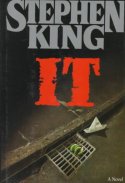
Jacket.aspxBut by Christine, I was Kinged out. The books were were getting to be too similar, and I moved on. That was how I missed reading It, the book everyone seems afraid of. I avoided it for the longest time, but it popped up in a series of references this year, and I decided the time had come to tackle it. I’d re-read The Stand, and The Shining, but nothing new of King’s in 30 years.

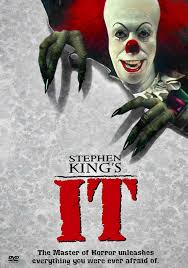
“It” tells the story of an evil presence that takes over4775612-3278691654-IT.jp the town of Derry, Maine, until a ragtag band of seven misfit children decide to take it on. Although the entity takes the shape of what scares a person most (werewolves, mummies, giant birds, etc), it often lures children to their deaths by taking the shape of a clown, Pennywise. I’ve never been afraid of clowns, though I understand the psychology behind it (like Daleks, you can’t read a clown’s frozen face, and it makes some people uneasy). I’m still not afraid of clowns; but I’m now nervous about balloons. Calling the evil “It” is a brilliant stroke of semantics – think of all the times you use the pronoun It: It was calling me. I tripped over It. It snuck up on me. I’m scared of it. You can’t help it; you can’t escape it. You talk about it all the time. Because you know it’s there. “It” can be anything, and you know it to be true.

But for everything anyone told me about the book, I think this is his worst that I’ve read. He’s written 55 novels, 200 short stories, comic books, films, has awards oozing out his ears – he knows what he’s doing. I don’t mind the back and forth nature of the story, bouncing between 1958 and 1985. The characters and style are classic King, but it is soooo long (1100+ pages), it really, really could have had sections of character description cut. It drags in places. It’s not the length: Game of Thrones is 1200 pages, scatmanbut I read it with more gusto. King’s name-dropping of characters from his other works grated on me. One is cool, but not several. Don’t stick Dick Hallorann in your book, a man with a strong sense of Shining (or, if you’re a Simpsons fan, Shinnin’), and have a catastrophe or a presence about that he doesn’t get ESP on. You laid Hallorann out in detail in The Shining; you let him drift in It. Sometimes the action is too cartoonish: having a victim’s head pop out of a box on a spring and go boing ruins my tension. I understand it might be appropriate to scare a child, but I’m not a child. Dolores Claiborne smashing my ankles with a sledgehammer makes me lie awake in a sweat all night. Cartoon boings don’t. I won’t tell the ending, but after fighting tooth and nail to wade through 1100 pages, I wanted more of a bang for my effort. The original Stand was 800 pages or so, and that ended with a nuclear explosion.

Yeah, yeah, I shouldn’t criticize King because he’s one of the most successful novelists images itof our time, and I don’t disagree with his talent. But perhaps he set his own bar too high. No one – not even Shakespeare – hits the nail of perfection every time. From the man who brought you Stand By Me, The Green Mile, Under the Dome, and so many, many wonderful tales, I just don’t think it’s his best.
What do you think is King’s best work – book or film?

Childhood Revisited

  ramona If you grew up in the 70’s and 80’s, you probably read at least one of the Ramona Quimby books by Beverly Cleary. Cleary documents inquisitive, quirky Ramona from the age of four upward, and how her innocent rationales confound and vex her parents, sister, and just about everyone she meets. Cutting her own hair, baking her doll inside a birthday cake, fighting with her sister, starting school – stories every child or parent can relate to with much laughter.

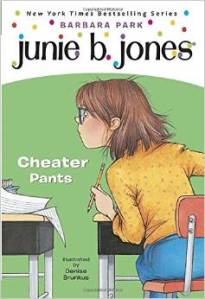
Fast forward a generation. Ramona gives way to Junie B. Jones, a kindergartener of the modern age whose misinterpretations and misguided notions get her into just as much trouble as Ramona, at home and in school. But while Ramona is filled with the sweet innocence of a bygone era, Junie is modern empowered sass. Whether getting into trouble on the schoolbus or with her family or with her nemesis, That May, Junie says aloudjunie what many children and adults often think.

Myself, I’ll take Ramona over Junie B, simply because Junie is a little too fresh for me, but I confess: I love the Junie B. Jones books, and sneak off to read them even though my youngest is now 17. And yes, I would have no problem rereading a Ramona book if I had an hour to kill – I have the whole set. If you love the genre but won’t read a kid’s book, there is hope: if you miss those kinds of stories, of seeing the world through a child’s eyes as they struggle to make sense of the world around them, often hilariously misinterpreting things, fear not! The adult form of those stories exists.

zippyEnter Haven Kimmel, who grew up in the tiny town of Mooreland, Indiana, in the 1970’s (population 300). Kimmel is a real life Ramona Quimby, and she chronicles her life in a book called A Girl Named Zippy. How she sees things, both odd and oh-so-totally familiar (“A Short List of Records My Father Threatened to Break Over my Head If I Played Them One More Time” “A Short List of Things My Father Won Gambling” “The Breakfast Bar at Which No Breakfast Was Ever Eaten.”), will have you laughing out loud where ever you happen to be reading at the time. Her cast of crazy characters, both friends and family, are common to almost every family, whether they admit them or not. Her father works in a factory, her mother lies on the couch watching TV ignoring any and all household chores, and there’s nothing in the house to eat but carrots. Although Kimmel never has clean clothes (people she visits tend to wash her clothes for her when she stops by), only one room has heat, and the house is falling down around them, Kimmel never feels neglected. She hates her Quaker roots and three-times-a-week church, her mother’s best friend has the mouth of a sailor (I can’t help but see Kathy Bates playing her in a movie), and her brother and sister flee home at the first opportunity.couch

In her second book, She Got Up Off the Couch, Kimmel describes her later years when her mother got some gumption, got off the couch, and decided to enroll at Ball State University – though it only made the home conditions worse, if possible. While being on campus with her mother, attending theater, even just listening to her mother’s phone conversations, Kimmel is suddenly thrust into realizing there’s a world beyond Mooreland, and she is never the same again. Things are not always fun and games, and Kimmel starts to become aware of the differences of how she lives versus how other people live (her father’s friend has gold toilets and velvet wallpaper; they have a hole in their wall that goes almost to the outside, and no running water), and begins to notice her parents are never together. Eventually she catches on to the fact her father’s having an affair, but even then Kimmel’s tone is wistful and both painfully accusatory and forgiving at the same time.

Whether you grew up in the 60’s, 70’s, or 90’s, the fact that you grew up at all gives you a common experience shared by everyone else, oftentimes more than you know. If you can’t relate directly to Kimmel, you probably knew someone in your neighborhood just like her. Whether you grew up in Indiana, Oregon, Arizona, or Massachusetts, you will find delight and painful familiarity in Kimmel’s youthful innocence (“She picked out a wig to wear on the special day, too, a style and color she considered “subtle’ and which I thought said ‘Pekingese.’”), while your children laugh knowingly at Junie and Ramona. It is the same story, different audiences.

Author Jill Shalvis Never Disappoints!

bored face

I read a lot of contemporary romance books, although lately, I haven’t been reading much.  The books seem to carry the same theme and they were all starting to sound alike.   I’ve even passed on some new books by a few of my favorite authors.  But then one of my most favorite authors came out with a new series and I gave her new book a shot.  Nirvana!  I was not disappointed in the least!

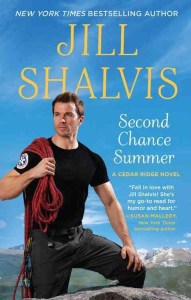
second chance summerSecond Chance Summer by Jill Shalvis is the first book in her new series, Cedar Ridge.  Cedar Ridge, Colorado, is famous for crisp mountain air, clear blue skies, and pine-scented breezes. And it’s the last place Lily Danville wants to be. But she needs a job, and there’s an opening at the hottest resort in her hometown. What has her concerned is the other hot property in Cedar Ridge: Aidan Kincaid-firefighter, rescue worker, and heartbreaker. She never could resist that devastating smile .

The Kincaid brothers are as rough and rugged as the Rocky Mountains they call home. Aidan has always done things his own way, by his own rules. And never has he regretted anything more than letting Lily walk out of his life ten years ago. If anyone has ever been in need of rescuing, she has. What she needs more than anything are long hikes, slow dances, and sizzling kisses. But that can only happen if he can get her to give Cedar Ridge-and this bad boy-a second chance .


There have been plenty of books about firefighters and rescuers, but somehow (because she’s overflowing with talent?), Ms. Shalvis consistently writes books that are fresh, new, and exciting –  and this one is a real page turner.  From the very first chapter, you are completely engaged in the characters and the location.  Readers can relate to the Kincaid family – it is flawed and struggling with a life that hasn’t been easy.  Ms. Shalvis’ description of the town of Cedar Ridge makes you want to move there.  The story flawlessly moves along enveloping you in lots of romance and laughter, great chemistry between characters, and enticing secondary characters throughout that make you very excited for the next book to come out!

happy face POST NOTE:  On July 25, 2015, Ms. Shalvis was awarded a RITA award at the Romance Writers of America one in a millionconference in New York City for her book, One In A Million, the last book in her Lucky Harbor series.

(RITA Award – The purpose of the RITA award is to promote excellence in the romance genre by recognizing outstanding published romance novels and novellas.  The award itself is a golden statuette named after RWA’s first president, Rita Clay Estrada, and has become the symbol for excellence in published romance fiction.)

Linda Reads: The Nightingale by Kristin Hannah

nightThe Nightingale by Kristin Hannah is a poignant, beautifully written book that takes us back in history to France during World War II.

The book starts off in present day and the story is told by an elderly woman facing a move into a nursing home to face her last battle, cancer.  But first, she has something she must do.

The story follows two sisters, Viann and Isabelle Rossignol, who have always been close despite their differences. Younger, bolder sister Isabelle lives in Paris while Viann lives a quiet and content life in the French countryside with her husband Antoine and their daughter. When World War II strikes and Antoine is sent off to fight, Viann and Isabelle’s father sends Isabelle to help her older sister cope. As the war progresses, it’s not only the sisters’ relationship that is tested, but also their strength and their individual senses of right and wrong. With life as they know it changing in unbelievably horrific ways, Viann and Isabelle will find themselves facing frightening situations and responding in ways they never thought possible as bravery and resistance take different forms in each of their actions.

Ms. Hannah writes heartfelt, vivid descriptions taking great care with every detail.  You will be transported to wartime France.  You will feel all the pain, joy, love, and hardships of the Rossignol family and those who interact with them.  I read the book in one sitting, unable to put it down and the story still lingers with me a month later.  It earned a spot on my top ten favorite books list.

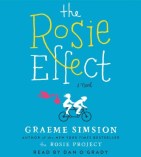
Louise Reads: The Rosie Effect by Graeme Simsion

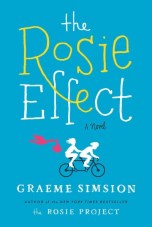
The Rosie Effect ibooks the sequel to 2013’s runaway hit The Rosie Project, author Graeme Simsion’s debut novel (reviewed here). That romantic comedy followed the efforts of Don Tillman, a genetics professor and extremely socially inept, to procure a life partner for himself. The Wife Project ends successfully with Don finding true love with the free-spirited and quirky-in-her-own-way Rosie.

The sequel opens with Don and Rosie starting their married life in New York City. Don is feeling very satisfied with his adjustment to marriage, until he notices orange juice on his breakfast table one morning. “Orange juice was not scheduled for Fridays.” , he muses in the book’s opening sentence,  and it’s the beginning of even more changes for Don. Rosie, you see, is pregnant.

A comedy of errors ensues as Don tries to adjust to this unplanned event. His best friend from Australia moves in with Don and Rosie after his wife kicks him out, Don’s endeavors to observe fathers in action end up getting him arrested, and his attempts to take control over the pregnancy have, of course, the opposite effect. As troubles start mounting, Rosie begins to doubt that Don is meant for fatherhood.

This blurb from Simon & Schuster sums it up nicely: “As Don tries to schedule time for pregnancy research, getting Gene and Claudia to reconcile, servicing the industrial refrigeration unit that occupies half his apartment, helping Dave the Baseball Fan save his business, and staying on the right side of Lydia the social worker, he almost misses the biggest problem of all: he might lose Rosie when she needs him the most. ”

audioI enjoyed The Rosie Effect, though I must admit, not as much as The Rosie Project. Half of the fun in the first story was getting to know Don and his myriad of quirks. The sequel also seemed a bit rushed to me, with almost too many crazy misunderstandings thrown into the plot to keep it lively. I listened to the audiobook version narrated by Dan O’Grady, who was fantastic. A very enjoyable read, even if I didn’t love it as much as the original. I give it 4 out of 5 stars.