Have You Thought about Being Mortal?

Have you thought about dying? It’s such a scary topic, fraught with so much emotion. We like to think we’ll always have more time ahead of us. But what happens when something–an illness, an accident, a disease–sets a limit on our time? What happens when we are forced to confront the end of our lives?

Jacket.aspxBeing Mortal: Medicine and What Matters in the End by Atul Gawande explores this issue, an issue that we all must inevitably face.

Many folks first confront mortality when dealing with their aging parents, but illness can strike at any time of life. Then we are forced to make decisions about treatments. About living wills. About how we want to live the remainder of our lives. We want to live longer at all costs and we’d do anything to achieve that goal, right? Perhaps not. As Doctor Gawande discovered in his research on aging and dying, what most people want is not necessarily a longer life, but a quality life.

Gawande, a practicing surgeon, notes that doctors are often committed to extending life at all costs. This can mean painful and expensive procedures, even for those for whom there is no cure. Gawande questions this rationale, while admitting he himself has often advised patients to pursue treatments that he knew would not extend their lives by more than a few months or year. However, patients, he came to realize, wanted procedures that would guarantee them ten or twenty more years of life.

But medicine often cannot deliver such outcomes. The exceptions, the people who do survive for years in spite of the odds, are just that–exceptions. Gawande equates it with winning the lottery. Everyone believes they will be lucky but very few actually are. Gawande also noted that, in the case of terminal illness, the trade-offs of pursuing treatment–time, money, pain, recovery–were often not worth the small extension of life to most people.

What the mortally ill or infirm person really wants is a meaningful life, even if there is only a few months left of that life. The terminally ill desire to retain independence and control, as much as they possibly can. They desire to stay in their homes. They want their loved ones around them. They fear prolonged and painful deaths. They fear bankrupting their families.

Gawande illustrates the importance of these issues with depictions of  traditional nursing homes, which place safety and monitoring of vitals above the fulfilling lives people need and want. He counterpoints these with illustrations of models of care that take patients out of hospitals and nursing homes for a variety of assisted living facilities and hospice services.

I was especially intrigued by his description of hospice, a service I had (erroneously) believed was only for the last few weeks of life. Hospice gives the aged and terminally ill choices. Hospice workers ask what your goals are. They ask you to think about what you want. They ask you what you don’t want. They talk about your fears. And they address every issue.

And that is the gift of this wonderfully written book. It makes you ask those questions, of yourself and perhaps of those around you. For someday you may be in a position to have to make choices for a loved one, or in the position of having a loved one making choices for you.

I (Finally) Read “It”

I am not a fan of horror. I would not shut the shower door for ten years because Kolchak: The Night Stalker scared the daylights out of me. My father’s description of the movie Killdozer made me terrified of construction equipment – as if I wasn’t already, from a preschool nightmare involving dump trucks. I watched the original 1931 Dracula and got a bloody nose in sympathy. I won’t sleep in a room with a vacuum cleaner thanks to Zenna Henderson. I like sleeping at night, and I don’t need any more anxiety in my life. I have kids for that.

ZX0AYe8 It was my mother who got me reading Stephen King. I was about twelve, sick in bed, and Night Shift, his book of short stories, came out. Wouldn’t you know it, the light from the bathroom at night struck every knob on the dresser at just the right angle so each one looked like an eye staring at me, just like the cover story. I only dared read half of them, and never enjoyed going to the dry cleaners again. But I read The Shining (I will NOT go into a hotel bathroom without a light on), read The Stand (his best, I think), Cujo, The Dead Zone (more my style), Firestarter (I needed a book for the train back from Canada) and Christine (Like I didn’t suspect that already). One thing you can say about King without ever reading his books: he doesn’t write short volumes.

Jacket.aspxBut by Christine, I was Kinged out. The books were were getting to be too similar, and I moved on. That was how I missed reading It, the book everyone seems afraid of. I avoided it for the longest time, but it popped up in a series of references this year, and I decided the time had come to tackle it. I’d re-read The Stand, and The Shining, but nothing new of King’s in 30 years.

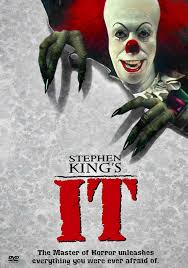
“It” tells the story of an evil presence that takes over4775612-3278691654-IT.jp the town of Derry, Maine, until a ragtag band of seven misfit children decide to take it on. Although the entity takes the shape of what scares a person most (werewolves, mummies, giant birds, etc), it often lures children to their deaths by taking the shape of a clown, Pennywise. I’ve never been afraid of clowns, though I understand the psychology behind it (like Daleks, you can’t read a clown’s frozen face, and it makes some people uneasy). I’m still not afraid of clowns; but I’m now nervous about balloons. Calling the evil “It” is a brilliant stroke of semantics – think of all the times you use the pronoun It: It was calling me. I tripped over It. It snuck up on me. I’m scared of it. You can’t help it; you can’t escape it. You talk about it all the time. Because you know it’s there. “It” can be anything, and you know it to be true.

But for everything anyone told me about the book, I think this is his worst that I’ve read. He’s written 55 novels, 200 short stories, comic books, films, has awards oozing out his ears – he knows what he’s doing. I don’t mind the back and forth nature of the story, bouncing between 1958 and 1985. The characters and style are classic King, but it is soooo long (1100+ pages), it really, really could have had sections of character description cut. It drags in places. It’s not the length: Game of Thrones is 1200 pages, scatmanbut I read it with more gusto. King’s name-dropping of characters from his other works grated on me. One is cool, but not several. Don’t stick Dick Hallorann in your book, a man with a strong sense of Shining (or, if you’re a Simpsons fan, Shinnin’), and have a catastrophe or a presence about that he doesn’t get ESP on. You laid Hallorann out in detail in The Shining; you let him drift in It. Sometimes the action is too cartoonish: having a victim’s head pop out of a box on a spring and go boing ruins my tension. I understand it might be appropriate to scare a child, but I’m not a child. Dolores Claiborne smashing my ankles with a sledgehammer makes me lie awake in a sweat all night. Cartoon boings don’t. I won’t tell the ending, but after fighting tooth and nail to wade through 1100 pages, I wanted more of a bang for my effort. The original Stand was 800 pages or so, and that ended with a nuclear explosion.

Yeah, yeah, I shouldn’t criticize King because he’s one of the most successful novelists images itof our time, and I don’t disagree with his talent. But perhaps he set his own bar too high. No one – not even Shakespeare – hits the nail of perfection every time. From the man who brought you Stand By Me, The Green Mile, Under the Dome, and so many, many wonderful tales, I just don’t think it’s his best.

What do you think is King’s best work – book or film?

Same Old Tune

unnamedI am a semi-hard-core Pink Floyd fan. I’ve likely spent more hours listening to them than any other musical group, and I think I know the entire Wall album from memory – lyrics and orchestration. So when David Gilmour, who, along with Roger Waters wrote many of their greatest hits, came out with a new album, Rattle that Lock, of course I had to listen to it.

The album, I must admit, left me with mixed feelings. It’s a varied album, with some pieces (The Girl in the Yellow Dress) being almost classical jazz, and others being such classic Floyd in tone you can almost recognize lines from Learning to Fly (Echoes), and riffs straight from The Wall. Parts of it are cranking rock, and other parts are very ethereal and New-Agey in feel – not unlike inventive Floyd tracks from Dark Side of the Moon. There are even two instrumental tracks. It was good, it was fresh, but I’m still not sure if I liked it. I’m not a jazz person, no matter how hard I try, and though I love my Floyd, it’s 2015, not 1979, and I want to say, “Yes, it’s good, but what are you doing now?”

Which got me to thinking: Why is it often so easy to pick out a band/singer on the radio? Because they are often stuck in the same style that made them famous. Their songs are caught in a groove of sound – it’s a good sound, but it doesn’t change. Sometimes they try but the fans turn away, because it’s not “their” sound. Sometimes they do and it works beautifully (how many heavy metal bands have one or two incredible slow ballads, like Kiss’s Beth, or the Scorpions’ Still Loving You?). Listen to The Police’s Every Breath You Take – the first four songs are almost identical in format, all hits, but identical. I love R.E.M., but they get monotonous if you listen to six albums in a row. As George Thorogood said, “I only know four chords on the guitar, so of course all my songs sound alike.”27club-660x300

According to the internet, some of today’s popular bands are guilty of unoriginality and being one-trick ponies. Not even getting into Boy Bands, or Brittney, or other manufactured stars (it’s fair to place The Monkees here, too), too many artists sound – well, too much like themselves. Pete Townshend’s last albums drifted song to song like a dream; you couldn’t tell where one ended and the next began, and he’s a music legend. Ed Sheeran, Oasis, Ke$ha, Flo Rida, and the often-unfairly picked on Nickelback are among the worst offenders, by internet polls. Having a trademark “sound” is good, but a truly talented musician masters versatility.

So who, then, has successfully changed their tunes and embraced versatility over the CyndiLauperBodyAcousticyears? Both Paul McCartney and Billy Joel have attempted branching out into classical music, but classical music doesn’t rake in money on radio ads. One I would consider would be Cindy Lauper – she’s older than you think. Before she was a shock-haired icon of the 80’s, she fronted a rockabilly band called Blue Angel. They put out one album, Blue Angel (duh), which did well in the Netherlands, but you could see the genius. Check it out here: https://www.youtube.com/watch?v=36MgP5Hg6KU. To go from Money Changes Everything to Above the Clouds on her Body Acoustic album – she has an impressive range. What a Broadway career she could have had! Oh wait – she wrote all the music for Kinky Boots, winner of 6 Tony awards, including Best Musical and Best Score!  She’s not as ditzy as she looks.

Robert_Plant_and_Alison_Krauss_-_Raising_SandAnother would be Robert Plant – the former lead singer for hard-rocking Led Zeppelin. Post-Zeppelin he formed the R&B group The Honeydrippers in 1981, and they shot up the charts with their # 3 slow-dance hit Sea of Love. If that wasn’t different enough, he’s recorded several folksy albums with Allison Krauss – my personal favorite being “Trampled Rose” from the album Raising Sand. Truly, no one would guess this soulful folk singer is one of heavy rock’s legends.

A third I would nominate would be David Bowie (yes,ZiggyStardust I’ve chosen all older musicians, because 40-50 year careers are living, breathing entities). Ziggy Stardust is a far cry from his later success with Suffragette City, and another layer removed from 2013’s The Next Day album, let alone his (in)famous duet with Bing Crosby on The Little Drummer Boy – and the soundtrack to Labyrinth.

So now we know David Gilmour can write and play good jazz, even if it feels like the jazz is being played in the dance hall of a Pink Floyd dream. Is it progress or stagnation? You have to decide that for yourself.

One Million Steps

indexI read a an eclectic variety of books; I rarely set out to read a specific book, unless I have a reason. Books come into my hands; if they sound intriguing, whether neurology, biography, the history of Times Square, or a fantasy novel, I read them. As a writer, I may step outside my normal zone of interest as part of research for something I’m writing. Such was my current situation, researching background details for a fictional warrior culture I was developing.

I don’t follow military anything. Yes, my grandfather was in the Navy, my uncles and cousins in the army, Uncle Laurie was lost at sea in WWII, and Uncle Art was a Marine at Iwo Jima, but that’s not the same as being from a military family, where service is a way of life. No one in my family has seen combat in 50 years, so I needed a lot of research. I didn’t want a diatribe on why we did what we did, the politics involved, or a lot of technical jargon that was going to make my head spin. I needed to know what it was like in the trenches, how do you respond when pinned down by gunfire, how do you get yourself out? What do you do when the population you’re fighting for wants you dead?

And I found a number of books and films that were not just entertaining, but fascinating to read and watch.

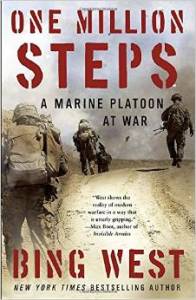
If you can read just one book on the subject – one – read One Million Steps: A Marine Platoon at War” by Bing West. West, a Viet Nam vet, embedded with Kilo Company, a Marine rifle company of the 3rd Battalion of the 5th Marine Regiment (3/5). This was exactly the book I was looking for. West takes you along with the Marines as they walk their daily walk in Sangin, Afghanistan, the worst sector for casualties. Each day’s walk was approximately 5,000 steps; their rotation was up after 200 days, or approximately one million steps, a million steps that could trigger a mine or a bullet from a mostly invisible enemy. In a country torn by war for decades, no one was welcoming them as liberators. West is actually critical of the war without being nasty about it, showing you how the policies over the years, the lack of unified vision from the uppermost tiers, the conflicting orders from above all kept the troops from doing what they were trained and equipped to do: take out the Taliban. This was a wonderful book, easy to read, easy to follow, and left you with deep respect for every man who who went over there.51zvSX4uIPL._AA160_

I also read “The Reaper: Autobiography of One of the Deadliest Special Ops Snipers” by Nicholas Irving. Although it’s simple to read, I would not rate it close to West’s book. His story – most likely ghost-written, rambles along like you’re sitting next to him at a bus station. He gives detailed accounts of one or two missions, but the rest – you might as well be talking to him at a birthday party while he tells you his life. He may be a very good sniper, but he’s not a great storyteller.

hornetsIf you don’t have time to sit and read, there are some great war films out there, both fiction and non-fiction, that will put you in the line of fire. The Hornet’s Nest is probably the most realistic of them, because it’s actual footage. A father and son journalism team go to Afghanistan to cover what is supposed to be a one-day strike that turns into a harrowing nine-day seige. If you want to see and feel exactly what goes on, this is your film. You will be riveted.

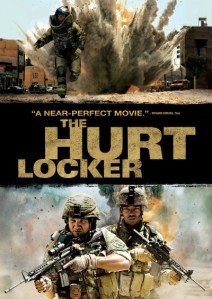
If you’re looking for more of a Hollywood polish, I recommend The Hurt Locker, starring Jeremy Renner as a bomb disposal expert addicted to the adrenaline rush he gets in the face of danger. It has the documentary style, and will keep you on the edge of your seat. An ex-Marine handed me Full Metal Jacket, which I’d only heard of. A serious and yet farcical film directed by Stanley Kubrick in the best of the 70s style, FMJ gives you all the grit of Viet Nam with the horrific insensibility of M*A*S*H*. For any Firefly fans, check out a very young Adam Baldwin toting an old-fashioned Vera. I watched it three times in one week. Another I recommend is 9th Company, which is a Russian film about battles the Russians fought in Afghanistan in the 80’s. If you don’t mind subtitles, it’s an action-packed film that gives a non-American perspective.

Sometimes you have to step away from your comfort zone to find something wonderful. This time, I hit the jackpot.


large_uToiRjgTYfGrXnMNxpyiGZPgvM0              FMJ               9th company

The Martian is Coming!

martiAll I can say is

WOW.

I have not read a book this gripping in ages. Oh, sure, I adore the Retribution Falls series by Chris Wooding, they are delightful and make my heart sing, but in The Martian, Andy Weir has managed to catch me in my weakest spot, a tale that feeds both my need for a good imagine-if story and lovingly nerdy details that set my non-fiction scientific brain on fire. I got to the end, and I wanted to read it all over again.

Very rarely do I seek a book out. They just happen to come to me in weird ways and tickle my interest enough that I open the cover (and covers are so VERY important. If it wasn’t for the fantastic artwork on the original Dragonlance books, I never would have entered a world that kept me trapped for more than ten years and ultimately sent to me to Lord of the Rings, which, really, is the Great-Granddaddy of the genre anyway). This time, I saw the trailer for the upcoming movie version of The Martian (release date: October 2, 2015), and was intrigued enough that when the book passed through my hands, I grabbed it.

Mark Watney is a crewman on the third manned mission to Mars. When a dust storm hits the crew on their way back to the lander, a piece of equipment snaps off and skewers his spacesuit, sending him reeling down a dune. His crew searches, but can’t locate him in the storm. His vital signs aren’t registering, and they all saw him toothpicked by that antenna. At the last possible second, they admit to themselves he’s dead and blast off to the mother ship while they can.

Only one problem.

He’s not dead.MV5BMTcwMjI2NzM2MF5BMl5BanBnXkFtZTgwNDkyNTI5NTE@._V1_SX214_AL_

The story revolves around Watney’s ability to survive the impossible, figuring things out as he goes, making everything out of the most basic substances, James T. Kirk channeling MacGyver. Because the supplies left behind were meant for six and he’s only one, he’s able to piece things along using his own ingenuity until NASA realizes he’s still alive. They try and mount a rescue mission, but NASA being NASA and twisted up in bureaucracy and safety margins, not everything is going to go by plan. The chances of Watney making it or not remain 50-50 right up until the final pages. This is a book that will make you sneak off every possible second to read just one more paragraph. From the first page, it will grab you and never let you go. By the end, you’re going to be looking around your house to see if you, too, have anything that can free oxygen or create water, and you will never look at potatoes the same way.

Knowing that in the film Matt Damon has the lead role of Watney makes you read the story in his voice. He is a brilliant piece of casting; the book seems written for him and he will be utterly convincing in the role. Check out the trailer here:  https://www.youtube.com/watch?v=Ue4PCI0NamI . Ridley Scott (Alien, Blade Runner, Thelma and Louise) is directing, and he is certainly adept at handling suspense. I’m waiting to see what they do with the soundtrack, since it’s a running joke through the book that the only music that was left behind is disco (can you imagine being stuck somewhere for months or years with nothing but a few tracks of disco to listen to? I love the Saturday Night Fever album, and I do love ABBA, but not for weeks on end!).

You don’t have to know science to enjoy the book. You don’t even have to know your Phobos from your Deimos. You just have to love a good pressure-cooker story. Don’t let this one skip your orbit.

Andy Weir, I love you.

Mars surface close to equator

Mars surface close to equator