Unorthodox Aliens

Reading science fiction can be overwhelming — what on earth is a chrono-synclastic infundibulum? Despite the tough jargon and speculative concepts, it’s quite an inward-looking genre. These stories typically loop back around to reflect something about ourselves — an assumption or expectation or fear that could use some interrogation. Aliens are possibly the most overt display of this narrative device. They are funhouse mirror versions of ourselves: the same but different. Aliens carry all the social, cultural, and political baggage we tend to associate with Otherness, but evoke sympathy too. At the end of E.T., are we not puffy-eyed to see that strange creature, who’s been nurtured and accepted, finally return home?

And don’t we all feel like E.T. — an alien, a pariah — in some way?

Here are some novels and stories that feature subtle and unconventional alien characters.


Sirens of Titan by Kurt Vonnegut

Kurt Vonnegut loves his unorthodox aliens. Hand-shaped Tralfamadorians play a significant role in Slaughterhouse-Five, but I’d like to mention a minor alien race from Sirens of Titan. In a slight deviation from his main journey, protagonist Malachi Constant crash-lands on a planet populated by harmoniums: flat, kite-shaped beings that cling to cave walls and only perceive the world through touch. They communicate with limited telepathic abilities and are able to send two possible messages:


The first is an automatic response to the second, and the second is an automatic response to the first.
The first is, “Here I am, here I am, here I am.”
The second is, “So glad you are, so glad you are, so glad you are.”


Hyperion by Dan Simmons

Hyperion borrows its framing device from The Canterbury Tales. Its narrative unfolds as each of six pilgrims tells their portion of the story on their way to the time tombs, where they plan to confront the omnipotent Shrike. The Shrike fits your evil-monster-alien archetype (with some twists along the way), but there are other alien beings that populate the many planets of Hyperion. Most poignant is Simmons’ depiction of a human race that has lost its home: the Earth. They become aliens in their own right, establishing new civilizations around the galaxy but ultimately “alienated” in one way or another.

Stories of Your Life and Others by Ted Chiang

“Story of Your Life,” from the short story collection Stories of Your Life and Others, is about language, specifically the field of science known as linguistic relativity. Researchers in this field try to determine whether the language we use affects the way we think. For example, some languages describe time using distance terms (like “short” and “long”) and others describe time using quantity related terms (like “much” or “little”). A study from 2017 concluded that, under certain circumstances, these language differences result in actual differences in time perception.

Chiang takes this idea to its extreme and introduces an alien race that communicates in a completely circular language. As a result, these aliens perceive time as though it were a circle, living the entirety of their lives simultaneously- past, present, and future.

What if a human were to learn their strange and powerful language? “Story of Your Life” was adapted into the 2016 film Arrival.


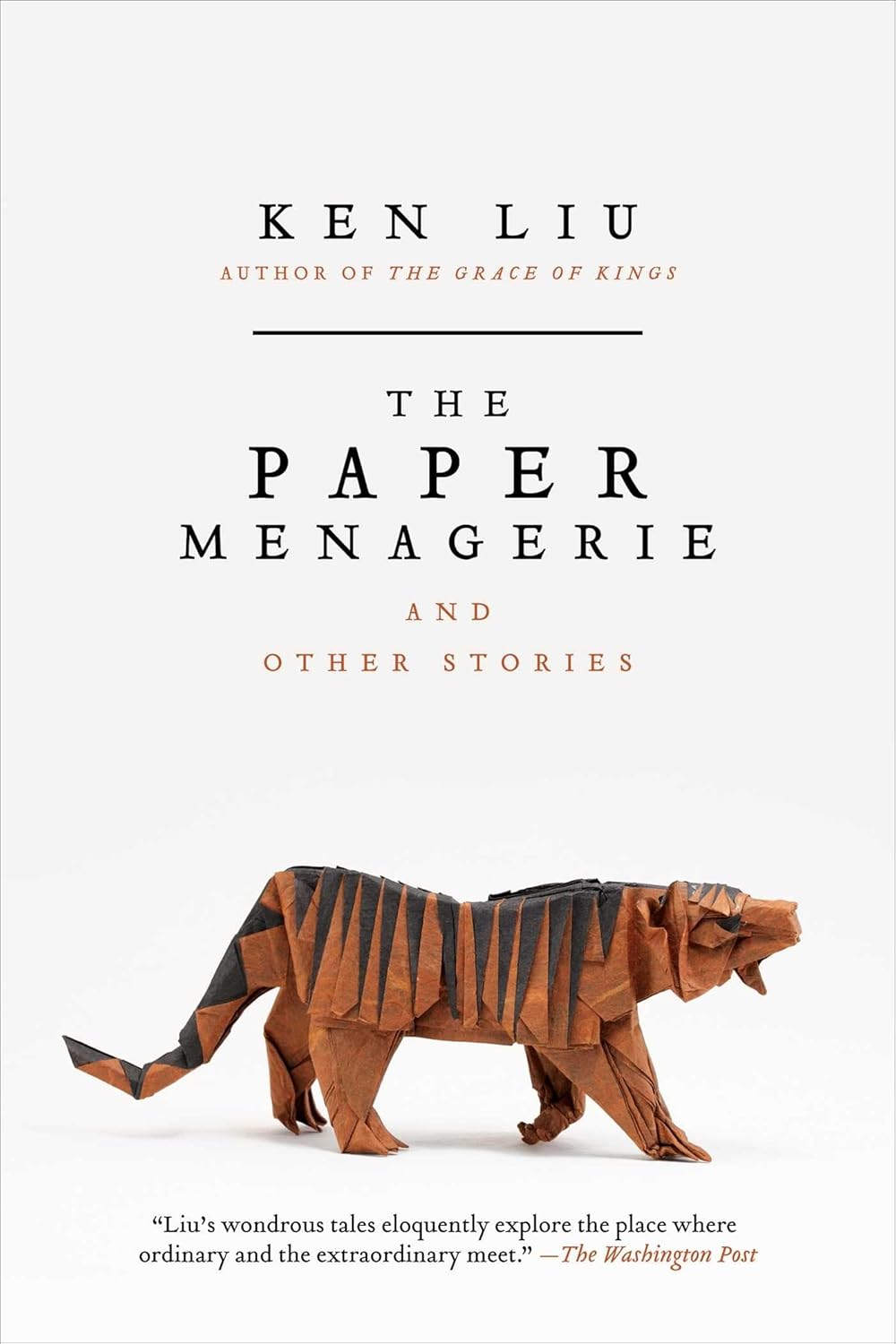
The Paper Menagerie by Ken Liu

Some might be familiar with Ken Liu’s translation work. He’s best known for the English translation of The Three-Body Problem, a sci-fi epic by Liu Cixin (now a Netflix Original). He also writes novels and short stories that blend sci-fi, fantasy, and folklore.

His short story collection Paper Menagerie opens with “The Bookmaking Habits of Select Species.” The title says it all — how might alien races create persistent representations of their language and thoughts? I particularly like how he describes the Allatians: they stick their proboscis onto an impressionable surface, and as they speak, their proboscis vibrates and etches a groove into the surface. To read what another Allatian has written, one drags their own proboscis through the groove, and a hollow part of their skull amplifies the sound; the voice of the writer is recreated.

The Book of Strange New Things and Under the Skin by Michel Faber

Aliens are a recurring theme in Michel Faber’s writing. His 2014 novel, The Book of Strange New Things, takes place on a far-away planet that has been introduced to Christianity. Missionary Peter Leigh becomes the new minister of a docile alien congregation but struggles to reconcile his ecclesiastical commitment and the guilt of leaving his wife back on Earth, where climate change and political turmoil conspire to topple civilization.

Under the Skin, Faber’s first novel, paints a darker portrait of humanity (or alienity, ha). It’s the kind of book that holds its cards close and lets the reader marvel (and shudder) as the story progresses.

Faber presents a kaleidoscope of Otherness; themes of exploitation, gender, immigration, class politics, and animal cruelty are woven throughout and explored with satirical levity. The book was loosely adapted into a movie of the same name in 2013 with Scarlett Johansson.


Which “Unorthodox Aliens” am I missing? Let me know in the comments section below.

Freedom to Read

Almost every evening, my husband and I take a walk around our neighborhood in New Haven.  And stapled to almost every telephone pole, are numerous flyers in varying states of decay. Notices for tag sales, concerts, scientific studies and lost pets paper poles along our route.  Occasionally, someone uses this unofficial public forum to express their political viewpoint.  Recently I passed a flyer with language that I found offensive, and my first urge was to rip it down.  After all, technically people aren’t allowed to post flyers on telephone poles.  And there are children walking by who shouldn’t be exposed to that kind of language.  I would be doing a good thing for our neighborhood by removing the offensive poster.  And then my personal feelings took a backseat as I reminded myself we live in a society where free speech is a constitutional right.  While I may have a negative reaction to flyers or books with viewpoints that I disagree with, I prefer to live in a world where everyone is free to choose what they read or don’t read.  So, I averted my eyes and kept walking.

This week the Cheshire Public Library is celebrating Freedom to Read Week (formally known as Banned Books Week) to highlight the dangers of censorship.  This annual celebration was launched in 1982 by the American Library Association’s Office of Intellectual Freedom (OIF) in response to an increase in book challenges.  Interestingly, forty-plus years after the first Banned Books Week, the nation is again experiencing an increase in book challenges.  According to the OIF, in 2023 4,240 different titles were challenged which represents a 65% increase over 2022.  Books representing LGBTQIA+ and BIPOC individuals account for 47% of those titles targeted for removal.  According to the OIF Director, Deborah Caldwell-Stone, “This is a dangerous time for readers and the public servants who provide access to reading materials. Readers, particularly students, are losing access to critical information, and librarians and teachers are under attack for doing their jobs.”

It would be dishonest to say that librarians don’t struggle with buying books whose content they disagree with.  But providing a collection that represents diverse viewpoints is fundamental to supporting ALA’s Freedom to Read Statement which asserts that the ability to read freely is essential to our democracy.  This is not to say that everything published makes it into the collection as librarians also must be careful to curate materials based on the authority of the author, accuracy of content, and even price and format.  For a full list of the criteria used at the Cheshire Library please see our Materials Selection Policy.

As part of our celebration of Freedom to Read Week, staff have created two drop-in activities for all ages that will be available during our regular hours of operation:

Guess the Challenged Book Game where a copy of a challenged book has been shredded and placed in a jar.  Each day a new clue is added to help you solve the puzzle.

Shine a Light on Censorship Scavenger Hunt where each participant will be given a small black light to use to uncover cleverly hidden letters and solve a secret word.

Whether you stop in this week to try one of our activities or visit anytime in future, we hope you will register for a library card and borrow materials so you too can read often and read freely.

10 Recent Favorites From Our Staff

What was the best book you read in 2022? I recently asked staff members this question and have compiled their answers here. Interestingly, there were no duplications, everyone had a different favorite. Some books were published in 2022, some were many years older, some were fiction, some were nonfiction. Without further ado, here’s a selection of 10 recent favorites from our library staff.

Lessons in Chemistry by Bonnie Garmus. In the early 1960s, chemist and single mother Elizabeth Zott, the reluctant star of America’s most beloved cooking show due to her revolutionary skills in the kitchen, uses this opportunity to dare women to change the status quo.

Neopolitan series by Elena Ferrante. Beginning in the 1950s in a poor but vibrant neighborhood on the outskirts of Naples, Ferrante’s four-volume story spans almost sixty years, as its protagonists, Lila and Elena, become women, wives, mothers, and leaders, all the while maintaining a complex and at times conflictual friendship.

Boneshaker by Cherie Priest. Commissioned to build a machine that will promote gold-rush land-breaking efforts between Civil War-era Seattle and Alaska, inventor Leviticus Blue inadvertently triggers the release of a deadly gas that transforms people into the living dead, a situation that prompts his teenage son to restore the family reputation years later.

Summer Sons by Lee Mandelo. When his best friend dies of an apparent suicide, Andrew uncovers lies and secrets left behind by the person he trusted most, discovering a family history soaked in blood and death.

What We Wish Were True by Tallu Schuyler Quinn. A non-profit leader, humanitarian and minister, after being diagnosed with an aggressive form of terminal brain cancer, pens profound essays on what it means to live with a terminal diagnoses and still find meaning and how to discover beauty in life’s ordinary moments.

Foundryside by Robert Jackson Bennett. A thief in a city controlled by industrialized magic joins forces with a rare honest police officer to stop an ancient evil ritual that endangers thousands of lives.

Piranesi by Susanna Clarke. Living in a labyrinthine house of endless corridors, flooded staircases and thousands of statues, Piranesi assists the dreamlike dwelling’s only other resident throughout a mysterious research project before evidence emerges of an astonishing alternate world

The Book Woman of Troublesome Creek by Kim Michele Richardson. During Kentucky’s Great Depression, Pack Horse Library Project member Cussy Mary Carter, a young outcast, delivers books to the hillfolk of Troublesome Creek, hoping to spread learning in these desperate times, but not everyone is keen on her or the Library Project.

Tomorrow and Tomorrow and Tomorrow by Gabrielle Zevin. A modern love story about two childhood friends, Sam, raised by an actress mother in LA’s Koreatown, and Sadie, from the wealthy Jewish enclave of Beverly Hills, who reunite as adults to create video games, finding an intimacy in digital worlds that eludes them in their real lives.

Finding the Mother Tree by Suzanne Simard. The world’s leading forest ecologist, in her first book, draws us into the intimate world of trees where she brilliantly illuminates the fascinating and vital truth — that trees are a complex, interdependent circle of life.

One Book, Two Readers – Teens Review “It Ends With Us”

Teens: did you know that you can earn community service credit for writing a book review and submitting it to us? Today, we’ll hear from two teens who did just that, and get their takes on the same book. Find out more about how to earn community service hours from home at cheshirelibrary.org/teens/.

It Ends With Us by Colleen Hoover. Reviewed by Anja J.

This book had me in actual tears by the end of it, and I finished it in less than 2 days. Colleen Hoover did an outstanding job at portraying the hard-to-hear truths of domestic violence in this book. The story outlines the childhood of Lily Bloom living and growing up in an unstable household, with a father that got angry at her mother very easily. At the same time, she falls in love with a boy, Atlas, with whom she found refuge and comfort. The two, however, part ways.

Fast-forwarding to her post-college years, she meets a man in Boston, Ryle, who seems like the perfect fit for her. Until he isn’t. Meanwhile, Lily runs into her first love, Atlas, after all these years, which challenges the strength and trust of Lily and Ryle’s relationship.

The story of Lily and Ryle’s relationship has the reader engaged from the very beginning. It perfectly demonstrates the gray areas of abusive relationships and how one can fall into the cycle of abuse and struggle to break their way out. Hoover’s beautiful writing creates a waterfall of emotions and exemplifies the contradictions in characters that we see in everyday life. Everything is written so personally and eloquently that it is like you are literally in Lily’s shoes and experiencing everything firsthand. Parts of the book were also written in the form of journal entries that provided so much more insight into the internal workings of Lily. This book has never made me hate, and yet, sympathize with a character more. After reading this book, I had realized this story could be so much more realistic than it is fiction. So many women face the same awful and heart-breaking situations that Lily was in and reading this story was getting to know, intimately, what that is like. This book has recently gained a lot of popularity, and it is justifiable, as it truly lives up to all of the hype.

5 stars.

It Ends With Us by Colleen Hoover. Reviewed by Jocelyn C.

Lily Bloom grew up in a traumatizing household. She never had it the same as some of her classmates and friends. She was born in a small town in Maine, graduated from college, and ended up moving. She moved to Boston and opened up her own business, which she’s always dreamed of. When she meets a handsome neurosurgeon, Ryle Kincade, her whole life is turned around. She falls in love with him.

Ryle had many attributes. He is stubborn, strong, and even a little conceited. Among all of these, he is extremely caring with a huge spot in his heart for Lily. As Lily navigates through her crazy and wild ride of a relationship with Ryle, thoughts of Atlas Corrigan come back to haunt her. Atlas was her first love. Her protector with the biggest heart and soul she’d ever met. They were together when they were in high school and were inseparable. They saw each other every waking moment of the day. They couldn’t bear to not see each other until one day Atlas left and Lily was left all alone, completely heartbroken. When she graduated college, she finally said she needed to get out of Maine, and that’s how she ended up in Boston, where everything seemed better.

When Atlas all of a sudden reappeared back in her life 15 years later, Lily and Ryle’s entire relationship is jeopardized. He was a link to her past that she didn’t want to remember. Lily and Ryle struggle to rekindle their relationship, all while Atlas is in the back of both of their minds. We see jealousy, anger, and reconciliation all throughout the book. It will make you fall in love, rip your heart out, and be so angry while dealing with sensitive topics. Colleen Hoover conveys an excellent novel of love and heartbreak that jump started a new groundbreaking career for her.

5 stars

Teen Book Reviews: the “Raven Cycle” series

Teens: did you know that you can earn community service credit for writing a book review and submitting it to us? Today, we’ll hear from someone who did just that. Find out more about how to earn community service hours from home at cheshirelibrary.org/teens/.

The Raven Cycle consists of four books, all reviewed below. WARNING: Possible spoilers exist.

The Raven Boys by Maggie Stiefvater. Reviewed by Mia V.

The Raven Boys is the first book in the Raven Cycle, and is the story of four prep school boys, Adam, Ronan, Gansey and Noah, who embark on a journey to find the deceased Welsh king, Glendower. Adam is a poor farm boy with an abusive father, while Ronan is a somewhat scary and viciously protective friend, and Gansey is an extremely passionate and extremely wealthy boy who simply wants to find Glendower. And Noah… well we don’t know a lot about Noah other than that he is friends with the other Raven Boys.

Blue, the daughter of a psychic, also finds herself swept up in the quest to find Glendower, while she tries to make sense of the prophecy her mother has given her; that she will cause her true love to die. Despite coming from a family of clairvoyants, Blue does not possess the ability to see into the future. Although she initially dislikes the snobby, prep-school boys, she later becomes close friends with all of them.

The four boys spend practically all of their time together, at their school Aglionby Academy, and at their own place, Monmouth Manufacturing. Gansey leads Adam, Ronan, Noah and Blue, on the quest to find Glendower which proves to be both frustrating and dangerous. Gansey and his friends find themselves competing with Mr. Whelk, their high school Latin teacher. Mr. Whelk has his own reasons for finding Glendower, which are revealed later as the race to Glendower commences. Blue and the Raven Boys uncover shocking secrets and supernatural powers as they try to find Gansey’s king.

The Raven Boys is a beautifully adventurous novel with many supernatural elements and crazy occurrences. I also enjoyed the witty humor of many of the characters as well as their unique personalities and hobbies (and their secrets). Overall I would definitely recommend this book. But get ready to read the next three Raven Cycle books (which are just as good or maybe even better than the first,) because this book ends on a cliffhanger.

4 stars.

The Dream Thieves by Maggie Stiefvater. Reviewed by Mia V.

The second book in the Raven Cycle focuses more on Ronan rather than Gansey. The Dream Thieves focuses on Ronan’s ability to bring items from his dreams to the real world and his struggle with controlling this power. Ronan tells his friends Gansey, Blue, Adam and Noah, about this skill early in the novel. Ronan and his friends had already been on a supernatural quest to find “Gansey’s king”, Glendower, who is a deceased Welsh king. At Aglionby Academy, the private school that Ronan, Adam and Gansey attend, Ronan’s brother, Declan is badly beaten by a sinister man who calls himself the Gray Man. The Gray Man was hired by a powerful man who wants to find the Greywaren, an object that can bring items back from dreams. Even though Declan knows his brother is the Greywaren and that it is not a physical object, he keeps his mouth shut to keep his brother safe.

Meanwhile, in the hunt for Glendower, Ronan finds himself accidentally bringing horrifying and powerful creatures back from his dreams. Ronan and his friends have to battle Ronan’s uncontrollable dream-nightmare creatures while continuing the quest to find Glendower. Simultaneously, Ronan is being hunted down by the Gray Man, who is out to kill Ronan because of his ability to bring things back from his dreams. This book is fantastic, and possibly my favorite out of all four of the Raven Cycle books.

The stakes have definitely been raised since the last book, with all of the characters experiencing more risks in the quest to find Glendower. Meanwhile, Ronan battles some deep internal issues which manifest in the things he brings back from his dreams, which can sometimes be dangerous. This book is great and I highly recommend it!

5 stars.

Blue Lily, Lily Blue by Maggie Stiefvater. Reviewed by Mia V.

Blue Lily, Lily Blue is the third book in the Raven Cycle, which continues the tale of Gansey, Ronan, Adam, Noah and Blue, and their quest to find Glendower, a dead Welsh king, whom Gansey feels a strange connection with. This connection has led him to embark on a quest to find Glendower, a quest that he drags his friends on as well.

After the friends discover Ronan’s ability to bring items and creatures back from his dreams in the previous novel, it is discovered that Adam also has a unique power. Henrietta, Virginia, the town where the book takes place, has a large ley line running directly through the town. Blue’s family of psychics are very familiar with ley lines, which emit energies that psychics are able to harness to help see the future. These energies are also responsible for the various supernatural occurrences in Henrietta. Adam discovers that he can harness the power of the ley lines with the help of Peresphone.

Meanwhile, the Raven Boys and Blue discover a new threat in an artifact collector, Colin Greenmantle who targets Blue’s mom, Maura. As the group continues their search for Glendower they discover many strange and supernatural occurrences. The Raven Boys and Blue navigate new territories, and encounter unexpected surprises in their quest to find Glendower. Blue and her family unveil new prophecies that tell terrible fates for some of the characters, and reveal hidden secrets. I really enjoyed this book.

Although I feel like the other Raven Cycle books are better, I still really enjoyed this book, and I know that the Raven Cycle would not be complete without Blue Lily, Lily Blue. This book sets the reader up perfectly for the last book in the series, The Raven King.

4 stars.

The Raven King by Maggie Stiefvater. Reviewed by Mia V.

The Raven King is the final book in the Raven Cycle series, which completes the story of the Raven Boys and Blue, as well as their search for Glendower. Noah, the friendly ghost-friend, Ronan, with his powers in pulling objects from his dreams, Adam with his power to harness the energy of the ley lines, Blue the psychic’s daughter and Gansey, their fearless leader, face many challenges in finding Glendower.

Their quest has stretched out for a very lengthy period of time, and has taken a toll on many of the characters. However this quest for Glendower seems it may finally come to a close, though not without many obstacles and near-death experiences. One of which occurs when Gansey and his friends make a major blunder by awakening a demon which is set upon “unmaking” the world. Meanwhile, Cabeswater is in danger of dying due to a strange sickness. As black ooze drips out of the beloved trees of Cabeswater, Gansey and his friends become increasingly more concerned about the health of Cabeswater. Perhaps more terrifying, Adam, with his deep connection to Cabeswater, finds himself falling apart along with Cabeswater.

The quest to find Glendower becomes increasingly complex as new threats rear their ugly heads and time begins to run out. The final book closes the series with a dramatic flare as prophecies are tragically fulfilled and demons are fought. Additionally, during The Raven King, romantic relationships that were hinted at during the previous books are finally made official.

I would definitely recommend this book to anyone who enjoys adventurous books that involve the supernatural. The Raven King closes off the Raven Cycle with a fantastic ending that helps finish the Raven Boys’ story, while leaving an opening to other related books in the future (like Call Down the Hawk). All in all, highly recommended.

5 stars.