Taming the Epidemic

51DfIYszbDL._SX326_BO1,204,203,200_I have tried writing this several times, but I need 8,000 words instead of 800. I didn’t want to write about a politically charged topic at a time when politics are tearing the country apart. There is so much here you should read, need to read, that I cannot emphasize how important these books are, on such a difficult topic. And yes, if you’re living in this very town, they are relevant to YOU.

I read Chasing the Scream by Johann Hari in January – that’s how long it’s taken me to write this. I was skeptical – yeah, yeah, failed war on drugs. We know. But the information she presents is hard-core, well-documented, and agonizing. You can check it yourself. It blew my mind and changed my outlook not only on drug addiction, but my outlook on life. Hari shows – starting with Billie Holiday – that the war on drugs began early in the 1900’s as a method to exert control on “undesirables” – Mexicans, Blacks, Irish, Chinese. It blew up into a witch hunt, reinforced by Nixon to control war protestors. In the early 1900’s, drugs were legal. People could buy a small amount, get their controlled fix, and carry on. When the drugs were banned, junkies were forced to go underground, for huge amounts of money and unknown quality. People died. Crime exploded. Gangs took over. We knew this would happen, because we saw the exact pattern in Prohibition. The U.S. put a gag on every other country in the world – you want our aid, you make these drugs illegal. Now we control all the cartels.

And most of our addicts are addicts because…. they have psychological issues. Soldiers with PTSD. Rape and abuse victims. Homeless. Mentally ill. People with trauma. People without hope. And we have spent billions jailing them, punishing them, and sometimes killing them, because after all, they’re junkies, who cares.

But what happens when junkies (who make up only 10% of people who have used illegal drugs: 90% walk away fine) are not jailed, but treated as mentally ill, counseled, given a purpose? People tend to get clean and stay clean. What happens when illegal drugs are decriminalized – or even legalized, as in parts of British Columbia, or Portugal? Even heroin? Crime drops. Gangs fail. People become productive. And eventually, people get off the drugs themselves because it’s not who they are anymore. It’s a frightening concept, and against everything we have ever been brainwashed with.

Move on to Dreamland: The True Tale of America’s Opiate Epidemic, by Sam Quinones. 51pEBowSD9L._SX327_BO1,204,203,200_Quinones traces the perfect storm of the modern heroin epidemic: a false assumption, a powerful painkiller, a drug marketing lie, and a whole new method of peddling Mexican heroin. Oxycontin was touted as an addictionless drug because it was time-released, at a time when pain management was the rage in medicine. In reality, Oxycontin was very chemically similar to heroin, just as addictive, and pain “clinics” sprang up that did nothing but pump millions of addiction pills into the country. As people fought to get oxycontin, enter the Mexicans, who broke the rules by delivering drugs to your door. No guns. No violence. All under the radar. And their heroin was uncut Black Tar. Competition brought the price down to $6 a fix – cheaper than the $1/milligram Oxy. Washington State finally made the connection when their drug overdose fatalities were higher than their auto accident fatalities. Purdue Pharma paid more than $630 million dollars in fines for faking their addiction data. Pfizer paid more than $3 Billion for misrepresenting their drugs – less than 3 weeks take of their sales from them. Oxycontin was changed to help prevent abuse, but no one has yet put a dent in Mexican heroin sales.

51h74NFYq2L._SX331_BO1,204,203,200_A slightly older book to read is Methland, which shows the damage done to the Midwest with the rise of Meth, which is so easy to produce you can manufacture it while riding a bicycle around town. Why does everything seem to start in the Midwest? These are the areas hardest hit economically by the collapse of American industry. When people are hopeless, with no jobs, or if you are injured on the job, the doc will write you a pain prescription. You stretch it out to a disability claim, get on payments, and you no longer worry about money, or how to pay for prescriptions. You sell those pain pills for three times what you were charged. For students, it’s often sports. Children are pushed to excel, to work through the pain, given pain pills to take the field and win this one, and they get hooked. Most teens start with sports injuries.

If you think drug users are minorities in deepest urban ghettos, you’re wrong. They’re here. At least two students in this very town died this school year from overdoses. We don’t talk about them. They don’t make the paper. But the students know. It’s bad enough that there is now a clinic in this town. Let’s stop pretending. It’s the kid on the sports team. It’s the kid behind the register. Your hairdresser. The PTA mom.

These books are thought provoking in their information and ideas. Though I’m – thankfully – not directly affected by the drug epidemic, I feel I dodged a bullet when my daughter was only 13 (2006). A heavy jar fell on her foot and I took her to the ER. It wasn’t broken, but badly bruised. They offered her Oxycontin or Percocet for the pain. I said no, something less strong. They gave me scripts for both, and I could fill which I wanted (dead truth). A thirteen year old. I tore up both of them. She did fine with Motrin.index

If you can read one book this year, read Chasing the Scream. If you can read two, read Dreamland as well. Even if you don’t agree with them, let’s get a national dialogue going. And if you want something a little more technical but utterly fascinating about the chemical aspects of addiction, track down How Drugs Influence Behavior: a Neurobehavioral Approach by Jaime Diaz. I was – still am – amazed at the information, and it’s not so technical a layman can’t understand it. Never have I seen a medical book with opinions like this.

How to Throw Things Away

apartment-cleaningOkay, let’s get something straight right at the beginning. This is not a blog post about how to store your stuff more efficiently. This is all about having less stuff. That’s right, it’s about throwing stuff away.

Part of minimalism, which I’ve been exploring in my own life these last few months, is living with less. This doesn’t mean building more shelving or uber-organizing my books. It means LIVING WITH LESS.

A simple concept with life-changing implications and many questions, the biggest of which is, how do you even begin to get rid of all your stuff?

Frankly, you have to face your mountain of clutter and be ruthless.

Jacket1For instance, in the book, Simplify Your Space by Marcia Ramsland, she recommends the following tools to simplify your bedroom: a wastebasket, a recycling bin, and three boxes. One box is for things to keep. The other two boxes are for items to donate Jacket2and sell. In  For Packrats Only by Don Aslett, he outlines four steps to follow to ditch the junk.

  • Recognize that junk is bad.
  • Repent (Admit that your junk is hurting you, your energy, your bank account, and your relationships.)
  • Remove the junk. Yes, perform the physical act of throwing things away.
  • Refrain from bringing new junk into your life.

Get the picture?

Fortunately, there are dozens of titles that can help you on your way to a clutter-free life. These books outline plans of action, suggest tips for helping you decide what to keep and what to get rid of, and advice on how to deal with the emotional side of throwing things away. My favorites are listed below.

Personally, I found getting rid of stuff liberating, although, to be honest, so far my family is not quite on board yet. Stay tuned for the further adventures of a hopeful minimalist.

50 thingsThrow Out Fifty Things : Clear the Clutter, Find Your Life by Gail Blanke

Never Too Busy to Cure Clutter : Simplify Your Life One Minute at a Time  by Erin Rooney Doland

The Ultimate Guide to Clearing Your Clutter : Liberate Your Space, Clear Your Mind, and Bring in Success by Mary Lambert

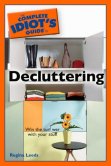
Jacket.aspxThe Complete Idiot’s Guide to Decluttering by  Regina Leeds

The 100 Thing Challenge : How I Got Rid of Almost Everything, Remade My Life, and Regained My Soul by Dave Bruno

Clutter Control: Putting Your Home on a Diet by Jeff Campbell

Downloadable Audiobooks

Stop Clutter from Stealing Your Life : Discover Why You Clutter and How You Can Stop by Mike Nelson

Ebooks

Winning the Clutter War by Sandra Felton

Conquering Clutter : Getting To The Bottom Of Clutter by Megan Francis

Decluttering Secrets : Tips And Tricks To Becoming Organized by Sally Munroe

Homesteading and Sustainability Practices on the Rise

Prices for many necessities continue to rise, while pay and compensation for most people do not seem to be rising at the same rate. Homesteading, or making the attempt to live more self sufficiently, is becoming a major trend as people make an effort to save more and do more for themselves. Most of these things are things our parents or grandparents did as a matter of course, but more and more people are learning how to revive these methods of taking care of the environment and their families.

Some of the activities that are seeing a major come back for one reason or another that can be considered a step towards homesteading or sustainable living include, knitting or crocheting, sewing, canning, gardening, raising chickens or other livestock, and so much more.  I have done some of the traditional homesteading activities, but I will admit to cheating in some departments. While I might garden and crochet, I have not homesteading1started canning like my family did when I was growing up. Frankly, I still have nightmares of peeling steamed tomatoes from my childhood as we made sauce and stewed tomatoes among other things.  If you are interested in learning more about what exactly homesteading is, or you want to move towards living a more self sufficient lifestyle, here are some resources that can get you started and answer some questions.

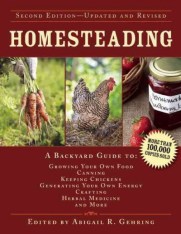
Homesteading: a Backyard Guide to Growing Your Own Food, Canning, Keeping Chickens, Generating Your Own Energy, Crafting, Herbal Medicine, and More edited by Abigail R. Gehring

Urban Homesteading: Heirloom Skills for Sustainable Living by Rachel Kaplan with K. Ruby Blume

Made from Scratch: Discovering the Pleasures of a Handmade Life by Jenna Woginrich

The Nourishing Homestead: One Back-to-the Land Family’s Plan for Cultivating Soil, Skills, and Spirit by Ben Hewitt with Penny Hewitt

The Urban Homestead: Your Guide to Self-Sufficient Living in the Heart of the City by Kelly Coyne & Erik Knutzen

You might also be interested in Homeward Bound: Why Women are Embracing the New Domesticity by Emily Matchar, Zero Cost Living: Explore Extreme Frugality by James R. Delcamp, Back to Basics: a Complete Guide to Traditional Skills edited by Abigail R. Gehring, The Complete Idiot’s Guide to Self-Sufficient Living by Jerome D. Belanger, Barnyard in your Backyard: a Beginner’s Guide to Raising Chickens, Ducks, Geese, Rabbits, Goats, Sheep, and Cattle edited by Gail Damerow, The Backyard Homestead Book of Building Projects by Spike Carlsen, The Renewable Energy Handbook: a Guide to Rural Independence, Off-Grid and Sustainable Living by William H. Kemp, Mini Farming : Self Sufficiency on a 1/4 Acre by Brett L. Markham,  and Sustainably Delicious: Making the World a Better Place, One Recipe at a Time by Michel Nischan with Mary Goodbody.

May Is National Photography Month

national photo month

In 1987, May was recognized by Congress as National Photography Month.  The word photography comes from the Greek words ‘photos’ (light) and ‘graphein’ (to draw).  Photography has certainly evolved over the years.  This is a great opportunity to reflect on its history which is highlighted below in a very condensed timeline.

In 1827 Joseph Nicephore Niepce produced the first photographic image with a camera obscura.  His sun prints, or heliographs, allowed light to draw his pictures.  In 1829, Louis Daguerre helped Niepce improve the process and developed a method called daguerreotype.  This method ‘fixed’ images onto a sheet of silver plated copper.   It was commercially introduced in 1839.  In 1889, George Eastman invented film that had a flexible, unbreakable base.  In the 1940’s color and Polariod photographs were developed with digital and disposable cameras making their appearance in the 1980’s.

The first negative was invented by Henry Fox Talbot, an English botanist and mathematician. In 1841, he perfected the paper-negative process and called it calotype.  Tintypes were patented in 1856 by Hamilton Smith.  A more stable and detailed negative called wet plate negatives (Collodion process), was introduced in 1851 by Frederick Scoff Archer.  The processing of these negatives required a portable darkroom, which limited the range of photography.

By 1879, the dry plate negative was invented.  This meant no more portable darkrooms and cameras could become hand-held devices.  In 1889, George Eastman invented film that could be rolled which made the mass-produced box camera a reality.  This opened up a whole new world of photography and the evolution of cameras.

The first twin-lens-reflex camera was introduced in 1929.

Polaroid photography (instant photos) was invented by Edwin Herbert Land and first sold to the public in November 1948.

Fuji introduced the disposable camera in 1986.

Canon demonstrated the first digital camera in 1984.

And in the early 2000’s,  the first camera phone was sold in Japan.


Explore the world of photography through Cheshire Public Library’s extension collection here. 

A sampling:

history of photographyThe History of Photography – from 1839 to present – Traces the evolution of photography and offers vivid illustrations of technical innovations in this visual form of communication.
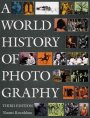
 

world history of photographyA World History of Photography – Traces photographic history both topically and chronologically, profiles key masters, explains terms and processes, and features the landmarks in the development of photography.

book ofThe Book of Photography – the history, the technique, the art, the future – Anne H. Hoy – A reference guide to the history and production of photography provides definitions, biographies, a timeline of photographic milestones, and information on genres and technical and aesthetic achievements.

camera phoneThe Camera Phone Book: secrets to making better pictures – A compact guide to using one’s cell phone to take digital photographs demonstrates the capabilities of the latest models of camera phones, explaining how to select the right equipment, take better pictures, and store, print, and send images.

kodakKodak, the art of digital photography – The revolution in digital technology has turned us all into shutterbugs. Never before has it been so easy to snap photos and share them instantly. But what about the quality of these images? Does simply owning a digital camera make you a first-rate photographer? For those who want to take a better picture, this lavishly illustrated guide reveals the art of composing incredible photos in any scenario.

llL.L. Bean Outdoor Photography Handbook –  A beautifully illustrated in-depth guide that offers practical instruction on making the best of your outdoor shots, for beginning through intermediate photographers.


joyJoy of Photography – Provides advice on equipment and accessory selection, effective use of camera functions, basic photography techniques, techniques for a variety of subjects, and development of a personal style, and includes discussions with well-known professional photographers.

annieA Photographer’s Life –  A visual narrative offers more than three hundred images that document the photographer’s relationship with her late companion Susan Sontag, the birth of her daughters, the death of her father, and famous actors and politicians.


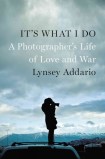
it'sIt’s What I Do: a photographer’s life of love and war –  A MacArthur Genius Grant and Pulitzer Prize-winning photojournalist documents her relentless pursuit of complex truths in the years after September 11, describing her witness to the American invasion of Afghanistan and the lives of people before and after Taliban reign.

We also offer two monthly magazines:   Outdoor Photographer Magazine and  Popular Photography Magazine.


Here are the 2017 Nutmeg Nominees!

NUTMEG-LOGOThe Nutmeg Children’s Book Award is the “Children’s Choice” Award for Connecticut. The goal of the committee is to encourage children in grades two through twelve to read quality literature. Here is a listing of the nominees, divided by the four grade based categories. The library has purchased and cataloged multiple copies of each book. There might be a waiting list for the book(s) you are interested in most, but if you place a hold on the item we will contact you when it is your turn.

The links that I have included for each title are for searches that include all formats of the material that we own, including the print copy, audiobooks, and digital formats. How many have you already read? Are there any that you loved, hated, or are surprised by?

High School (Grades 9-12)
Mosquitoland by David Arnold
The Queen of the Tearling by Erika Johansen
Those Who Wish Me Dead by Michael Koryta
A Death-Struck Year by Makiia Lucier
How It Went Down by Kekla Magoon
I’ll Give You the Sun by Jandy Nelson
Gabi, a Girl in Pieces by Isabel Quintero
Jackaby by William Ritter
Challenger Deep by Neal Shusterman
Sway by Kat Spears

Teen (Grades 7-8)
The Night Gardener by Jonathan Auxier
Turn Left at the Cow by Lisa Bullard
The Iron Trial by Holly Black and Cassandra Clare
Swagger by Carl Deuker
Memoirs of an Imaginary Friend by Matthew Dicks
Sure Signs of Crazy by Karen Harrington
The Mark of the Dragonfly by Jaleigh Johnson
Far Far Away by Tom McNeal
Endangered by Eliot Schrefer
A Time to Dance by Padma Venkatraman

This slideshow requires JavaScript.

Intermediate (Grades 4-6)
Gaby, Lost and Found by Angela Cervantes
Red Berries, White Clouds, Blue Sky by Sandra Dallas
Space Case by Stuart Gibbs
Escape from Mr. Lemoncello’s Library by Chris Grabenstein
Roller Girl by Victoria Jamieson
Masterminds by Gordon Korman
The Misadventures of the Family Fletcher by Dana Alison Levy
A Snicker of Magic by Natalie Lloyd
The Boundless by Kenneth Oppel
Eddie Red Undercover: Mystery on Museum Mile by Marcia Wells

Elementary (Grades 2-4)
Mr. Ferris and His Wheel by Kathryn Gibbs Davis & Gilbert Ford
Phineas L. MacGuire Gets Cooking by Frances O’Roark Dowell & Preston McDaniels
Skateboard Party (The Carver Chronicles) by Karen English & Laura Freeman
Queen of the Diamond: The Lizzie Murphy Story by Emily Arnold McCully
Grandma in Blue with Red Hat by Scott Menchin & Harry Bliss
Ranger in Time: Rescue on the Oregon Trail by Kate Messner
One Plastic Bag: Isatou Ceesay and the Recycling Women of the Gambia by Miranda Paul & Elizabeth Zunon
Quinny and Hopper by Adriana Brad Schanen & Greg Swearingen
Winter Bees and Other Poems of the Cold by Joyce Sidman and Rick Allen
Star Stuff: Carl Sagan and the Mysteries of the Cosmos by Stephanie Roth Sisson
Hana Hashimoto, Sixth VIolin by Chieri Uegaki & Qin Leng
In a Village By the Sea by Muon Van & April Chu
Hamster Princess: Harriet the Invincible by Ursula Vernon
Lulu’s Mysterious Mission by Judith Viorst & Kevin Cornell
Hilo: The Boy Who Crashed to Earth by Judd Winick

This slideshow requires JavaScript.

Who do you think will win?