Childhood Revisited

  ramona If you grew up in the 70’s and 80’s, you probably read at least one of the Ramona Quimby books by Beverly Cleary. Cleary documents inquisitive, quirky Ramona from the age of four upward, and how her innocent rationales confound and vex her parents, sister, and just about everyone she meets. Cutting her own hair, baking her doll inside a birthday cake, fighting with her sister, starting school – stories every child or parent can relate to with much laughter.

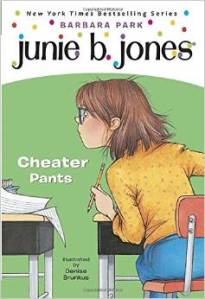
Fast forward a generation. Ramona gives way to Junie B. Jones, a kindergartener of the modern age whose misinterpretations and misguided notions get her into just as much trouble as Ramona, at home and in school. But while Ramona is filled with the sweet innocence of a bygone era, Junie is modern empowered sass. Whether getting into trouble on the schoolbus or with her family or with her nemesis, That May, Junie says aloudjunie what many children and adults often think.

Myself, I’ll take Ramona over Junie B, simply because Junie is a little too fresh for me, but I confess: I love the Junie B. Jones books, and sneak off to read them even though my youngest is now 17. And yes, I would have no problem rereading a Ramona book if I had an hour to kill – I have the whole set. If you love the genre but won’t read a kid’s book, there is hope: if you miss those kinds of stories, of seeing the world through a child’s eyes as they struggle to make sense of the world around them, often hilariously misinterpreting things, fear not! The adult form of those stories exists.

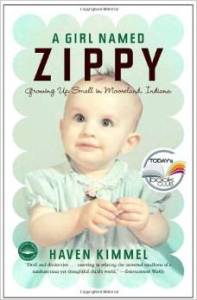
zippyEnter Haven Kimmel, who grew up in the tiny town of Mooreland, Indiana, in the 1970’s (population 300). Kimmel is a real life Ramona Quimby, and she chronicles her life in a book called A Girl Named Zippy. How she sees things, both odd and oh-so-totally familiar (“A Short List of Records My Father Threatened to Break Over my Head If I Played Them One More Time” “A Short List of Things My Father Won Gambling” “The Breakfast Bar at Which No Breakfast Was Ever Eaten.”), will have you laughing out loud where ever you happen to be reading at the time. Her cast of crazy characters, both friends and family, are common to almost every family, whether they admit them or not. Her father works in a factory, her mother lies on the couch watching TV ignoring any and all household chores, and there’s nothing in the house to eat but carrots. Although Kimmel never has clean clothes (people she visits tend to wash her clothes for her when she stops by), only one room has heat, and the house is falling down around them, Kimmel never feels neglected. She hates her Quaker roots and three-times-a-week church, her mother’s best friend has the mouth of a sailor (I can’t help but see Kathy Bates playing her in a movie), and her brother and sister flee home at the first opportunity.couch

In her second book, She Got Up Off the Couch, Kimmel describes her later years when her mother got some gumption, got off the couch, and decided to enroll at Ball State University – though it only made the home conditions worse, if possible. While being on campus with her mother, attending theater, even just listening to her mother’s phone conversations, Kimmel is suddenly thrust into realizing there’s a world beyond Mooreland, and she is never the same again. Things are not always fun and games, and Kimmel starts to become aware of the differences of how she lives versus how other people live (her father’s friend has gold toilets and velvet wallpaper; they have a hole in their wall that goes almost to the outside, and no running water), and begins to notice her parents are never together. Eventually she catches on to the fact her father’s having an affair, but even then Kimmel’s tone is wistful and both painfully accusatory and forgiving at the same time.

Whether you grew up in the 60’s, 70’s, or 90’s, the fact that you grew up at all gives you a common experience shared by everyone else, oftentimes more than you know. If you can’t relate directly to Kimmel, you probably knew someone in your neighborhood just like her. Whether you grew up in Indiana, Oregon, Arizona, or Massachusetts, you will find delight and painful familiarity in Kimmel’s youthful innocence (“She picked out a wig to wear on the special day, too, a style and color she considered “subtle’ and which I thought said ‘Pekingese.’”), while your children laugh knowingly at Junie and Ramona. It is the same story, different audiences.

Not Quite Old School Anymore

phone

As I mentioned in a previous post, I’ve been lagging behind in embracing some technology.  I was still using a flip phone and was quite content with it.  But in keeping with my recent foray with new things (moving into a new home and buying way too many new things for it) and the fact that my phone was barely working, I took a huge leap and bought a smart phone.

It was quite a process and I took my time in researching the various options.  I started off by going to Cheshire Library’s website and under Research it! I clicked on Consumer ReportsFrom there I looked up the articles reviewing smart phones and thoroughly read them.  This was a great resource for someone who didn’t know anything about smart phones.  I settled on a phone I thought would be the best for me.  But in the end, knowing I would need some tech help from my daughters, I went with the same phone that they have.

cell phone 2If you are looking to move to a smart phone, or are thinking of replacing your current smart phone, the Cheshire Library is a great place to start.  Besides Consumer Reports, here are a few books that also might help you.

Galaxy S4 – The Missing Manual

Teach Yourself Visually –  android phones & tablets

IPhone: The Missing Manual


Spooky Selections for Middle Grade Readers

mgspook1Do you have a middle grade reader that lovers anything spooky? This age group often loves to be scared, but not terrified, by their scary stories. Finding books that make parents and readers happy is sometimes hard, but here are some books that might just hit the mark.

Wait Till Helen Comes by Mary Downing Hahn
Unhappy about moving into a converted church in the country with her mother and new stepfather, Molly must put aside her dislike of her little stepsister, Heather, when the child is possessed by a malevolent ghost.

The Graveyard Book by Neil Gaimanmgspooky3
Raised since he was a baby by ghosts, werewolves, and other residents of the cemetery in which he has always resided, Bod wonders how he will manage to survive amongst the living with only the lessons he has learned from the dead.

Doll Bones by Holly Black
Zach, Alice, and Poppy, friends from a Pennsylvania middle school who have long enjoyed acting out imaginary adventures with dolls and action figures, embark on a real-life quest to Ohio to bury a doll made from the ashes of a dead girl.mgspooky4

A Tale Dark & Grimm (A Tale Dark & Grimm, #1) by Adam Gidwitz
Follows Hansel and Gretel as they walk out of their own story and into eight more tales, encountering witches, devils, warlocks, kindly strangers, and other helpful folk as they take charge of their own happily ever after.

The Cavendish Home for Boys and Girls by Claire Legrand
Practically-perfect twelve-year-old Victoria Wright must lie, sneak, and break the rules when her investigation of the disappearance of her best–and only–friend, Lawrence, mgspooky6reveals dark secrets about her town and the orphanage run by the reclusive Mrs. Cavendish.

Skulduggery Pleasant (Skulduggery Pleasant, #1) by Derek Landy
When a not-so-innocent twelve-year-old girl named Stephanie inherits her eccentric uncle’s estate, she must join forces with Skulduggery Pleasant, a skeleton mage, to save the world from an ancient evil.

This slideshow requires JavaScript.


Looking for more spooky mayhem that will please a middle grade (or older) reader? Here are a few more of the many avalible options: Coraline by Neil Gaiman, The Old Willis Place by Mary Downing Hahn, The Nightmarys by Dan Poblocki, The Doll in the Garden by Mary Downing Hahn, The Halloween Tree by Ray Bradbury, The House with a Clock in Its Walls (Lewis Barnavelt, #1) by John Bellairs, School Spirit (Suddenly Supernatural #1) by Elizabeth Cody Kimmel,  Skeleton Man by Joseph Bruchac, The Ghost Comes Calling by Betty Ren Wright, Liesl & Po by Lauren Oliver,  Ghosts I Have Been by Richard Peck, and The Ghost’s Grave by Peg Kehret.

What’s Better Than Pizza and Cookies?

autumn

pizza 3Enjoying them in October!  Fantastic weather, beautiful foliage, and it’s National cookiesPizza month and National Cookie month!  Feeling a little down?  Go outside with a handful of your favorite cookies.  Find a picnic table and munch on hot pizza pie!  Soak up the beautiful weather and add some tasty food.  Want to be creative and make your own cookies and pizza?  The Cheshire Library has books to inspire and tantalize!

PIZZA

Pizza: grill it, bake it, love it!

Pizza: a slice of heaven

Cool Pizza to Make and Bake

Artisan Pizza and Flatbread in Five Minutes a Day

Revolutionary Pizza

American Pie: my search for the perfect pizza


COOKIES

Martha Stewart’s Cookies

Crazy About Cookies

Slice and Bake Cookies

Gluten-Free Cookies

Simply Sensational Cookies

The Gourmet Cookie Book

There are many more books to choose from.   Click on the headings Pizza and Cookies and our catalog will come up so you can browse to your heart’s content.


In the Public Domain

 dressIn the past few years we’ve seen a sudden resurgence of fairy tales, bombarded by big-screen live-action versions of Snow White and the Huntsman, Mirror, Mirror (which came out the same year, just for overkill), Maleficent, Cinderella, Oz the Great and Powerful, the soon-to-be released Peter Pan (October 9), Alice Through the Looking Glass (spring 2016, reprising the 2010 cast of Alice in Wonderland), Beauty and the Beast (2017 release date) and so many more. While some of these have been spectacular (who can forget Cinderella’s dress!), did you ever wonder why?

It’s more than just the fact Hollywood can’t seem to come up with anything original lately, or that remakes are a fad. Movies cost huge coin to produce – truly, hundreds of millions of dollars, from pre-production through movie rights to scripting, set design, music, choreography, lighting, costuming, and advertising. One of those big costs is often acquisition of rights – buying the rights to the material from the original author. In the case of fairy tales, the cost of that right is Zero, and that is a producer’s favorite number. Zero means you can do whatever you want with the material. Yes, you could feasibly make (and I’m sure it’s been done) a very dirty film of Snow White, Cinderella, and Ariel and no one can stop you, as long as you don’t reference anyone else’s version.

We’re accustomed to believing that Disney or Touchstone or some other major Alice in Wonderland.jpg.653x0_q80_crop-smartcompany created Snow White, Sleeping Beauty, Cinderella, Rapunzel, Beauty and the Beast, The Little Mermaid, Peter Pan, and so many other cherished films. In fact the answer is no, they did not. They only made their own version of them. Many of Disney’s greatest tales were old folk tales and fairy tales, borrowed from collections by Hans Christian Anderson or the Brothers Grimm, or bought way back when from J. M. Barrie or Rudyard Kipling. The original tales were often a bit different and usually very dark (Mermaid is a very murderous tale; the Little Match Girl freezes to death, etc). They all have one thing in common however: they are all in what’s called the Public Domain. That means they are not copyrighted, and anyone can make their own version of the tale. The stories don’t have to be bought, no author has to be fought with, and a producer can do whatever he or she wants to the story.

panIn the United States, copyright is generally good for the life of the author plus seventy years (in some instances, it is extended to as much as 120 years). If the author has good descendants and they renew on behalf of the estate, it can continue further. This is how Peter Pan is now in the public domain: J.M. Barrie died in 1937; his copyrights have expired. Treasure Island is a free e-book, because it’s in the public domain. Gone With the Wind will enter into public domain in 2031. Many of the early silent films are also free for making use of. This also holds true with music: that’s why so much classical music is used in movie and TV soundtracks: no one has to pay a penny to use it. You can tour the country playing Beethoven and Mozart all you want, and you never have to pay them a dime. Their works, like Shakespeare, and Byron, and even the Bible are all available for public use and performance.

Yes, Anne is now the public's darling, too.

Yes, Anne is now the public’s darling, too.

Now, that’s not to say you can pick up a copy of a play and start performing it for money. While the play and its characters are not under copyright, the person who planned out/composed/wrote the playbook or libretto has a copyright on the booklet or sheet music you are using – their “version” – which is why school plays cost so much (the same way “Snow White” is a public domain tale, but “Disney’s Snow White” is most definitely under copyright). Unless you’ve taken the idea of Romeo and Juliet and written up your own version, you’re going to wind up having to pay someone somewhere for your performance of the material.

Here’s one list of free public-domain books available on ebook, including both adult and children’s classics: https://www.goodreads.com/list/tag/public-domain.

So whether you look forward to some of the new, spectacularly beautiful versions of old tales coming out, or grumble about how much more money does Disney need rehashing their own blockbusters, remember the reason: movie studios are cheapskates, and copyrights don’t last forever.

Fairy tale fact: Cinderella is the most universal fairy tale. Almost every culture has a version of it. The very first known “Cinderella” story can be traced back to the story of Rhodopis, a real Greek slave girl from Thrace who married the King of Egypt. That story is from 7 BC! Our current version of Cinderella (Cendrillon) goes back to the late 1600’s France, a French version by Charles Perrault.