I don’t read as much as I wish I could; I just don’t have time at the moment. It doesn’t help that I wind up with sometimes 600 page books in my hands, and those take longer. I never know what I’ll read next, and I read a bunch of good ones last year. Here are some of my favorites:
 One of the two best books I read this year, I’ve already blogged about: Creativity, Inc, by Ed Catmull, was amazing. Not just a history of Pixar films, it’s also the best darned, most entertaining book on business and employee management you will read. Pixar is a 5-star company for a reason.
The second of my Best Reads this year is The Man from the Train: The Solving of a Century-Old Serial Killer Mystery by Bill James and  Rachel McCarthy James. From approximately 1898 to 1912, a serial killer traversed the US by train – coming through New Haven’s Union Station on the way – with an MO of bludgeoning his victims with the back of an axe. Because of communications at the time, few people were able to connect the murders. James painstakingly, with the utmost detail, traces the dozens of murders and examines them, deciding if they were likely by the same killer or not, and why. He traces the paths through the states and the seasons, chasing the trail to a man who was most likely the killer. By the time he’s done, you are convinced and amazed. I could not stop reading this book. I read it while waiting for the school bus. I read it while cooking. I would have read it in the shower if I could have. If you love a mystery, if you love history, if you love crime stories, this book is a must.
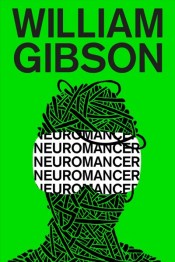 I’m only 30 years late in reading Neuromancer, the Hugo-winning cyberpunk novel by William Gibson. I can see why it is held as one of the greatest novels of our time. Gibson predicts and writes about today’s modern computers and internet and gaming – long before they existed. The scenarios he describes are both familiar and futuristic at the same time. While not only visionary, it’s written in a flawless style and with realistic, interesting characters. If you loved Ready Player One or The Matrix (which has to have been influenced by this book), you will love Neuromancer.
If you’re aware of social and racial issues, I strongly recommend Survival Math, by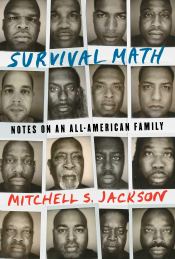 Mitchell S. Jackson. A professor of writing, in achingly beautiful prose worthy of Martin Luther King Jr., with the voice of a preacher without being preachy, Johnson breaks down the issues faced in his own family, examining how he came to where he is, how racism played into it without even being visible, and how despite all the odds, it’s possible to thrive. He covers harsh topics without flinching. The book is brilliant, spellbinding, and a superb read from a voice that soars with truth.
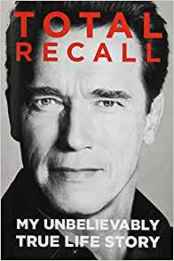 Far more than I expected, I loved Total Recall, an older door-stop of a biography on Arnold Schwarzenegger. From his birth in a tiny town in Austria (which still has only 2500 people) to his divorce from Maria Shriver, Arnold is witty and candid and down to Earth. No matter what you think of his politics or his movies or his personal life, this book may be older, but it was highly entertaining. His best friend just died in September of this year.
Not my favorite, but worth mentioning because of its local importance, is Frog Hollow by Susan Campbell. Campbell, a former reporter with the Hartford Courant, digs into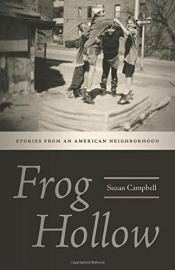 the history of the notorious Frog Hollow section of Hartford, and through tireless research shows the former glory of the neighborhood as not only an important area in Colonial times, but once a major manufacturing center (in 1898, Pope automotive made half the cars in the US). I was hoping for a deep sociologic dissection of the issues, but instead Campbell gives us an upbeat view from street level about the good aspects of Hartford and the people who live there, not just the doom and gloom of ad-selling news clips.
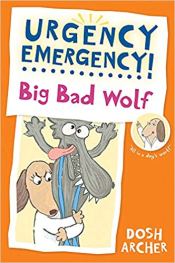 Last but not least, I’ll throw in a kid’s series you probably missed; with 18 years between my last two kids, I certainly did, but my youngest is so hooked on the British easy reader series Urgency Emergency! by Dosh Archer, I wound up buying most of them. The series is so witty and enjoyable you don’t mind reading them over and over again. Doctor Glenda, Nurse Percy, and the Pengamedics, in predictable melodrama, assist the maladies of Humpty Dumpty, The Big Bad Wolf, the Itsy Bitsy Spider, and many more. They are a delight. The library has several of the stories; be sure to read them all!
 Not every book becomes a movie; not every movie started out as a book, but the two feed off each other like peanut butter and chocolate. Many of the top Oscar-winning films started out as books (



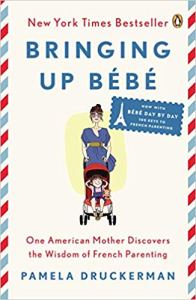
 Perhaps one of the fastest ways to pick a fight with a stranger is to comment on their parenting style. Around the country, let alone around the world, each culture or region is convinced only their way is right. Yet, American education has been in decline for years, currently ranking 27th in the world.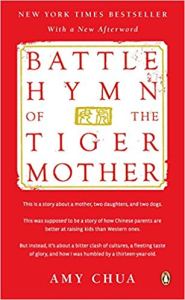



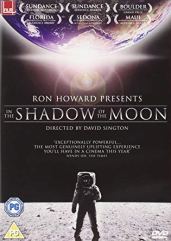
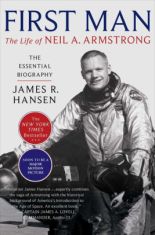
 On July 21, it will be FIFTY years since mankind first walked on the Moon.
 [for reference, an MP3 recording of the Star Spangled Banner runs around 900 Kb – half your memory]). The entire country surged forward with that dream, no doubt spurred on as an homage to Kennedy following his assassination. TV picked up the dream with serious and non-serious programs like
  idn’t even manage to smash a probe onto the moon until 1962. We made it through the Gemini program, only to learn that some things couldn’t be rushed or corners cut when the Apollo 1 crew – Gus Grissom, Ed White, and Roger Chaffee – burned to death in an oxygen fire in a test module, because the pressurized doors opened the wrong way. This led to a pause – there was no Apollo 2 or 3, and 4-5-6 were all unmanned. If ever there was a lot of pressure on a crew, Apollo 7 was the first 3-manned crew to blast off Earth, period. Missions 8-10 looped the moon, giving us the famous Earthrise photo.
 lunar lander settled on the moon, Armstrong sent out the famous words, “The Eagle has landed,” followed shortly by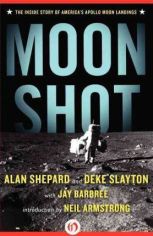
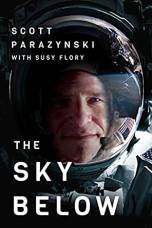
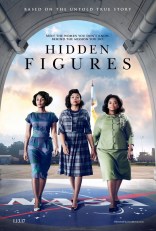
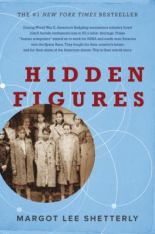



 Legend has it “It” girl Lana Turner was “discovered” at a soda counter in 1937. Outside of perhaps Hedy Lamar, who invented some heavy military tech in WWII, most of the actors in the “glory days” of Hollywood were not known for smarts but for looking glamorous. Hollywood was the way for good-looking people from the back fields of America to break free and become wealthy and “cultured.” They had to speak well, dress well, stay thin, know their lines and marks, and obey the studio.
 who have never been considered heart-throbs (Steve Buscemi, Clint Howard, Vincent Schiavelli, Mike Smith, Linda Hunt, etc). Hollywood may have its mega-cash flow (A-listers make $15-20 million per film; Dwayne Johnson had 9 films 2016-2018), but many stars aren’t afraid to flaunt their smarts and get that college degree, knowing how fickle the acting business is. Jodie Foster has a degree from Yale, Natalie Portman from Harvard, Emma Watson from Brown, Mayim Balik has a PhD in Neuroscience, Gerard Butler a law degree, James Franco is finishing a PhD from Yale, and more.
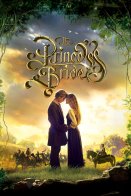
 speak and interviewing him briefly. Never heard of him? I’ll bet you have. Perhaps most famously he is known for the Inconceivable role of Vizzini in the cult classic,



 The Cheshire Library Blog