 Not every book becomes a movie; not every movie started out as a book, but the two feed off each other like peanut butter and chocolate. Many of the top Oscar-winning films started out as books (The Godfather, Lord of the Rings, One Flew Over the Cuckoo’s Nest, No Country for Old Men, Schindler’s List, and more). Some movies were better films than their book (in my opinion, Planet of the Apes, Poseidon Adventure, and Casino Royale are three). Some people want to read a book before they see a film adaption, while others see a great film and want to read the book to see if any good bits were left out.
If you’re of the group that prefers to read the book first, better get started! A whole new wave of book adaptions is readying for the coming year. Here’s a peek at some of them:
Old Possum’s Book of Practical Cats – that’s the collection of T.S. Elliott’s poem collection  that became the musical CATS. Whether this is a filmed “stage” production or a cohesive musical film remains to be seen, but it stars Judi Dench and Ian McKellan, no theater slouches. Look for it at Christmas.
Death on the Nile – Kenneth Brannaugh’s second attempt to capture Agatha Christie’s Hercule Poirot in a mystery due out in October of 2020. It also stars Gal Godot of Wonder Woman fame.
Doctor Sleep – Stephen King’s sequel to The Shining stars  Ewan McGregor as the adult Danny Torrence, due out in November 2019.
Dune – Yet another attempt to harness Frank Herbert’s cornerstone classic, most assuredly without the winged underwear. Although it bears an all-star cast, I loved the deep details of the novel, and I have a special affinity for the admitted mess of the 1984 Lynch adaption. Like Batman, all the reboots get tedious after a while. Sometimes you can’t capture greatness.
The Goldfinch – Donna Tartt’s Pulitzer-Prize winning novel hits theaters in September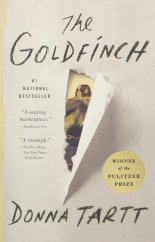 of 2019. It has promised to be faithful to the book, a coming of age story of a boy whose life changes in an instant.
The Turning – A modern adaption of Henry James’s Turn of the Screw, it’s produced by Stephen Spielberg. Spielberg’s track record isn’t perfect, but still one of the best in Hollywood. The story is the one of the classic horrors of literature. Due out in January of 2020.
Little Women – The long-time classic of girl literature by Louisa May Alcott, it was first adapted for film in 1933, and most recently in 1994. A very strong cast (Saoirse Ronan, Emma Watson, Timothée Chalamet, Laura Dern, Meryl Streep, the list goes on) has given this move a lot of buzz. Now’s the time to catch up on the classic story you may have missed (it’s not as bad as you fear). Look for it at Christmas, 2019.
The Good Liar – Nicholas Searle’s novel will star Helen Mirren and Ian McKellan as a con man trying to steal from a widow who has more than one trick up her sleeve. Look for it in November of 2019.
The Woman in the Window – A.J. Finn’s #1 thriller of a woman who witnesses a crime will star Amy Adams, Julianne Moore, and Gary Oldman. Since Disney acquired 20th Century Fox, it’s technically a Disney film (with no princesses, no mermaids, and no singing), due out in October of 2019.
Bond 25: Ian Fleming wrote only 12 Bond novels, and two collections of short stories. The films have now exceeded the original material. The movie has been through a long list of issues from a revolving door of writers and directors to explosions on set, and the working title of Bond 25 gives away no details about the story, but you can get your fill on the original novels. The movie, purportedly the last for Daniel Craig, is set for April of 2020.
Deadpool 3, Black Panther 2, Black Widow, Wonder Woman 1984 : 2020’s crop of Comic-book Hero films, from Marvel and DC. Most of them still have current story lines, or track down the older versions online or in graphic novel compilations.
Motherless Brooklyn – Jonathan Lethem’s novel of a detective with Tourette’s Syndrome searching for the killer of his best friend won multiple awards for fiction and crime fiction. The all-star cast is headed by Ed Norton, who stars, directed, produced, and wrote the script. During filming, a set caught fire and a fireman died during the response, fueling accusations and lawsuits. It’s due out in November of 2019.
 Perhaps one of the fastest ways to pick a fight with a stranger is to comment on their parenting style. Around the country, let alone around the world, each culture or region is convinced only their way is right. Yet, American education has been in decline for years, currently ranking 27th in the world.



 On July 21, it will be FIFTY years since mankind first walked on the Moon.
 [for reference, an MP3 recording of the Star Spangled Banner runs around 900 Kb – half your memory]). The entire country surged forward with that dream, no doubt spurred on as an homage to Kennedy following his assassination. TV picked up the dream with serious and non-serious programs like
  idn’t even manage to smash a probe onto the moon until 1962. We made it through the Gemini program, only to learn that some things couldn’t be rushed or corners cut when the Apollo 1 crew – Gus Grissom, Ed White, and Roger Chaffee – burned to death in an oxygen fire in a test module, because the pressurized doors opened the wrong way. This led to a pause – there was no Apollo 2 or 3, and 4-5-6 were all unmanned. If ever there was a lot of pressure on a crew, Apollo 7 was the first 3-manned crew to blast off Earth, period. Missions 8-10 looped the moon, giving us the famous Earthrise photo.
 lunar lander settled on the moon, Armstrong sent out the famous words, “The Eagle has landed,” followed shortly by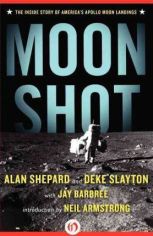
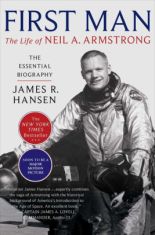
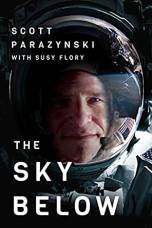
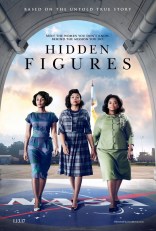
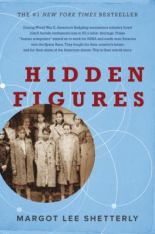



 Legend has it “It” girl Lana Turner was “discovered” at a soda counter in 1937. Outside of perhaps Hedy Lamar, who invented some heavy military tech in WWII, most of the actors in the “glory days” of Hollywood were not known for smarts but for looking glamorous. Hollywood was the way for good-looking people from the back fields of America to break free and become wealthy and “cultured.” They had to speak well, dress well, stay thin, know their lines and marks, and obey the studio.
 who have never been considered heart-throbs (Steve Buscemi, Clint Howard, Vincent Schiavelli, Mike Smith, Linda Hunt, etc). Hollywood may have its mega-cash flow (A-listers make $15-20 million per film; Dwayne Johnson had 9 films 2016-2018), but many stars aren’t afraid to flaunt their smarts and get that college degree, knowing how fickle the acting business is. Jodie Foster has a degree from Yale, Natalie Portman from Harvard, Emma Watson from Brown, Mayim Balik has a PhD in Neuroscience, Gerard Butler a law degree, James Franco is finishing a PhD from Yale, and more.
 speak and interviewing him briefly. Never heard of him? I’ll bet you have. Perhaps most famously he is known for the Inconceivable role of Vizzini in the cult classic,



 Mars, our nearest planetary neighbor, has always fascinated science fiction writers here on planet earth. Science fiction about Mars began with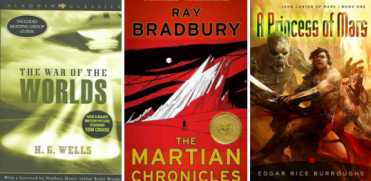
 Beginning in the 1970s, the first NASA and Russian probes and rovers obtained real scientific data about Mars. Once sci fi writers realized that there were no little green men on Mars, science fiction tackled more realistic Martian topics and focused on the challenges of human colonization on the red planet. A major sci fi theme was terraforming Mars to make it into a self-sustaining environment that was fit for life that developed on earth. Another major theme was what type of society and governmental structure might exist in a Mars colony.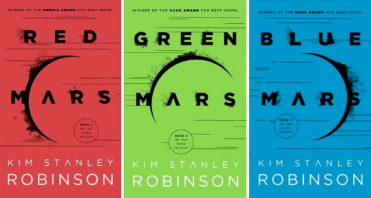
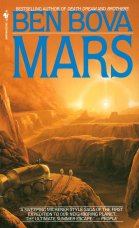 Ben Bova has written four related novels about Mars:
 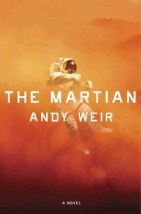 The Martian
