Cloning Around

Cloning seems new, but it’s technically been around longer than man – identical twins can be considered clones, splitting a single fertilized egg into two or even four genetically identical individuals from that one egg. Modern cloning, wherein cells are taken from a living donor and a primitive cell is induced to become an organism traces back to just 1996, when Dolly the Sheep was cloned from a mammary cell of another sheep, the first time a body cell was used instead of a sex cell – an egg or sperm.

The success of Dolly induced a rush to clone everything. Companies still offer to clone your pet, so that when it dies you can have an exact replica. Zoos and conservationists tried vainly to clone endangered species. And, due to the discovery of some well preserved remains of extinct creatures such as the mammoth and Otzi, the ancient hunter, biologists, paleoarchaeologists, and dreamers leaped at the chance to resurrect ancient animals, or possibly even a Neanderthal (if you believe they are truly extinct. It’s been found that modern people of European descent may have as much as 5% Neanderthal DNA .

Is this even possible? Jurassic Park resurrected the dinosaurs, and outside of making a tidy sum for their producers (four films have brought in more than 3.6 billion dollars. Billion with a B, not counting book sales), we understand the havoc that created, substituting frog DNA for missing strands of dinosaur.

Two recent books discuss this possibility in thoughtful detail.

Resurrection Science, by M.R. O’Connor, is philosophical and easy to read. She discusses reasonable ethics regarding several endangered species, but leaves the questions open for the reader to decide. Should millions of people be denied electricity because a mere handful of frogs live only in six square feet of mist of one waterfall deep in the jungle? Should we be captive-breeding the Florida panther, only to release them into a concrete jungle so they can be hit by cars and shot by people freaking out when they see them? Species have been going extinct for millions of years; should we be trying to save them if we’ve destroyed the very environment that made them what they are? And by the time you artificially recreate animals, hand-rear them (because the parents are extinct), and then set four of them free – are they really the animal you were trying to save? Because they were artificially created, they don’t know what to do, how to attract mates, what or how to forage and eat, and can starve to death.

How to Clone a Mammoth, by biologist Beth Shapiro, is still easy to read, but contains a chapter on the hard-core dynamics involved in splicing and replicating DNA material. While Shapiro is among those who would love to see mammoths cloned, she’s deep in the know and admits it’s not feasible. Not only has not a single complete strand of viable DNA been recovered, no study takes into account the near impossibility of actually making the goal: in trying to resurrect the recently extinct Bucardo (a type of Spanish Ibex), using frozen cells taken from a then-living animal (not a 20,000 year old dried out one), 780 cells were transplanted to eggs, but only 407 developed into embryos. Two hundred eight were implanted into hosts, of which only seven became pregnancies (an efficacy rate of 3%). Of these, just ONE made it to term (0.4%). That one animal had a lung defect so severe it lived less than ten minutes. Cloning, depending on specie, has a terrible rate of success, with animals frequently dying of defects or cancers. Shapiro discusses the ethical concerns of what to do with a mammoth if you do create one – no one knows its behaviors. The MAMMOTH won’t even know how to act like a mammoth. Are they solitary or social? Will it pine in loneliness? What does it eat? Does that diet still exist? Where will you keep it? We’re bringing alive an animal we have no data on whatsoever. Is this fair to the animal? If not a mammoth, should we try to resurrect something else recently extinct whose absence IS having a deleterious effect on the environment? Shapiro paints a harsher ethical – and realistic – picture.

Technology is closer than ever to reaching de-extinction goals, and with increasing earth temperatures melting permafrost and releasing better-preserved specimens every year, the chance of finding usable DNA grows ever closer. Both of these books present a balanced side to the argument. Of course we WANT to bring back mammoths. The question remains: should we?

Quick Read: Mozart: A Life

Mozart: A Life by Paul Johnson is a short and simple biography of Wolfgang Amadeus Mozart. It is only five chapters long! However, don’t let that fool you into thinking that it doesn’t provide a decent account of his life and music. It describes Mozart in a way that is easy to understand by all. The author also gives the reader new insights into information about his life, and a good understanding both of what his music is about and just how prolific a writer he was. I would have preferred it if this book had been longer and more detailed, but it works well with its simple approach.

Did you know that Mozart wrote over 600 pieces of music in his lifetime? This is especially impressive since he only lived for 35 years.

Did you know that Mozart had a brief a relationship with his wife’s sister?

Did you know that Mozart was literally kicked in the rear by one of his employers when he was fired?

Genre: Biography

Setting: Different parts of Europe from 1756-1791

Is this good for a book club? Yes, if the book club is interested in biographies, music, or just a quick read.

Objectionable content? Yes, but it is not detailed. Religion, sex, violence, incest, and death are referenced, but nothing is explicitly described.

Can children read this? Yes, if they have interest in Mozart and a good vocabulary regarding history and music. Teenagers would be the most likely to be interested.

Who would like this? Anyone who is interested in Mozart and his music. It is also good for people who like quick and interesting reads.

Number of pages: 164

Rating: Four stars

Save

Save

Save

Save

Save

Save

Save

Save

Save

Save

Save

Save

Save

Save

Colorful Workplaces

If you have been following our adventures in color, you may recall a previous post showing off the bright colors in the children’s room.  Well, the color revolution is continuing at Cheshire Public Library. Recently, we bid goodbye to the dull beige walls (dubbed “library paste white” by the staff) of the hallways around our offices  and added some color.

Our offices are in the basement of the library and windows are few. These wonderful colors have perked up the place considerably. Mint green. Golden yellow. Light blue. It’s a big improvement! Who says workplaces have to be dull?

Before

After


Join the color revolution! Whether you are decorating your office or your home, you can get started with these titles:

A Colorful Home: Create Lively Palettes for Every Room by Susan Hable.
Create dynamic palettes, and translate them into stunning interior spaces.

Color: The Perfect Shade for Every Room by Lisa Cregan.
Select the perfect hue for any room, create modern twists on traditional colors, experiment with colors you might never have considered, and more!

1001 Ideas for Color and Paint by Emma Callery.
Ideas range from contemporary treatments to traditional looks, in everything from bold colors to pretty pastels.

Crafting a Colorful Home: A Room by Room Guide to Personalizing Your Space with Color by Kristen Nicholas.
Learn how to make your home sing through handmade crafts and a bold use of color.

The Right Color by Eve Ashcraft.
The science of color, the language of color, finding your home’s palette, where to begin, inspirations for a palette and more!

Library Partners

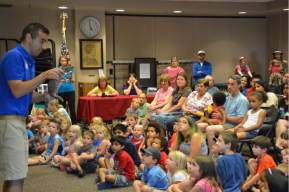
Did you know that the Children’s Department at the Cheshire Public Library visits almost every preschool in Cheshire once a month?  Did you know that Cheshire Birth-to-Three child development experts visit library programs to answer questions caregivers have?  Did you know that the library participates at local festivals such as Fall Festival, Strawberry Festival, Touch-a-Truck and more?  Over the past two and half years the Children’s Department has been partnering with local organizations who serve youth to share resources, expertise, and reach more people.  Below is a brief summary of a few of our partners.

Cheshire Birth-to-Three:
Cheshire Birth-to-Three program has a highly qualified and experienced staff consisting of a physical therapist, occupational therapist, speech pathologist, social worker and special education teachers. The staff makes home visits to provide speech, physical, occupational and/or educational services. In addition, B-3 hosts the Parent/Child Resource Center which is a playgroup for children ages 0-3 and their parents.

If you have concerns regarding your child’s development, either attend the Parent/Child Resource Center at Darcey School (call for times 203-272-9108) or call Infoline at 1-800-505-7000 and request the Cheshire Birth-to-Three Program. The Birth-to-Three Team can conduct a complete developmental evaluation in your home.

Artsplace:
Artsplace provides a creative environment for students to explore their artistic endeavors. This is possible with our fantastic teaching staff (many national award winners) of over 20 professional artists.  Art classes and workshops are offered in a wide variety that are suitable for all ages and levels. The youngest Artsplace student is three and the oldest is ninety nine. Artsplace is a most uncommon art school in that standard supplies are provided for all classes.

Cheshire Parks and Recreation:
The Cheshire Parks and Recreation Department offers a wide variety of activities to the residents of Cheshire and maintains the beauty of the many parks in our town.  The department maintains and schedules six major park facilities, the Youth Center, and the Community Pool.

Visit their website to find classes and other activities for yourself or your young one.  They offer everything from adult yoga to toddler music classes. Visit here to learn more.

Cheshire YMCA:
The Cheshire Community YMCA is the premier child care provider by offering a safe and nurturing environment in which children are encouraged to develop social skills through age appropriate curriculum. They offer everything from enrichment classes for youth, preschool to aftercare for elementary school students.  Visit their Child Development page to find out more about their youth services.

Musical Folk:
Musical Folk offer Music Together® Program, Ukulele and Movement classes! Have you ever wondered what you can do to nurture the musical growth of your child, regardless of your own musical ability? Experience Music Together and find out how important–and how fun–your role can be!  Music Together® classes build on your child’s natural enthusiasm for music and movement while developing important musical, social, cognitive, physical & language skills.

Vacation Reading

I don’t know about you, but I like to read on vacation. Considering I work in a library, it’s probably not surprising that I like to bring a book with me wherever I go, but vacation reading is special. Laying about, maybe on a beach or by a pool, with nothing on my schedule but relaxing with a book is my idea of a perfect vacation.


One wrinkle in this perfect plan, though,  is getting the books from here to there. How many to pack? (don’t want to run out…) How much book-space is in the suitcase? Are these books going to put me over the baggage weight limit?


This is where eBooks become the vacationing bibliophile’s best friend. You can bring 10 (or 20, or 30!) books with you in less space than 1 book would take in your luggage.  Rapture!

As I write this I am preparing to head out on a vacation myself, and believe me, I have loaded my ereader with plenty of reading material for my trip, downloaded for FREE from the library.  I use an e-ink reader (the kind with a monochrome screen, like Nook GlowLight and Kindle Paperwhite), so OverDrive is my go-to for downloading eBooks from the library.  I can borrow up to 10 titles at once, and keep them on my ereader for up to 21 days, after which they will return themselves. No worries about overdue books on my vacation.

If you prefer to read on a tablet (color screen, like an iPad), there are even more options for downloading eBooks. You can use the OverDrive App for iPad & Android to download & read eBooks. You can also use the hoopla app to download 5 books a month for up to 21 days, and they’ll return themselves at the end of the lending period. Super simple, and best of all free, with a Cheshire Library card.

I’ll be by the pool…