 The unofficial nickname of Connecticut is “The Nutmeg State.” This stems from a story dating back to the mid-1800’s, whereby a southerner called foul that his order of nutmegs were made of wood – and they do look similar. One thought is that shrewd Yankee traders were cheating by carving wooden nutmegs to pad out a sale and thus increase profit at the expense of the consumer, but another assumption is that the ignorant southerner didn’t know nutmegs had to be grated, and tried to eat them like a walnut.
Either way, the practice of substituting one food – or non-food – substance for another has probably been around since the dawn of man. Egyptians did it. Romans complained about it. And all the way up until Victorian England, food adulteration could kill you.
That’s the subject in Swindled: The Dark History of Food Fraud, by Bee Wilson. The book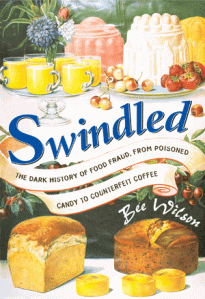 was far more interesting than I thought, chronicling the history of food cheats, such as substituting chicory or wood shavings for ground coffee, or adding alum to cheap bread to make it whiter. The medieval guild system helped keep staple foods clean, but England gave up the guilds earlier than Europe, and suffered more malnutrition for it. Poisonings and deaths were common, as bad food was often colored with copper and arsenic to make it prettier. Finally, the microscope helped discern without a doubt what was real and what wasn’t, starting the “pure food” campaign that continues today. It wasn’t until World War II’s shortages that people began to embrace modern chemical foods, and the decline of modern health can be clearly linked to it.
 A similar book is Death in the Pot: The Impact of Food Poisoning on History, by Morton Satin. Satin, a retired expert in microbiology and food-borne illness, traces several turning points in history that were likely caused by accidental or deliberate food poisoning, from the Great Plague of Athens to the Salem Witch trials, right through modern day KGB tactics. Satin also reiterates Wilson on discussion of the “Poison Squads” of the early 20th century, human guinea pigs who consumed chemicals to see if they were safe to put into foods.
Perhaps the Granddaddy of the entire subject, dredged up in almost any conversation on food safety and purity, is the novel The Jungle by Upton Sinclair, the seminal book from 1906 that sent such shock through America that the Pure Food and Drug Act followed just five months later. Sinclair, a socialist pushing for unions in the horrific meat-packing industry in Chicago, slipped inside the factories to investigate the situations for himself, and what he found was chilling, from rats mixed into the meat to allegedly men themselves that fell into the rendering vats. When President Roosevelt sent men to investigate, they, too, were appalled that it was true. While he didn’t bring many converts to socialism, he cleaned up the food supply as well as working conditions in the meat packing plants. As Sinclair said, “I aimed at the public’s heart, and by accident I hit it in the stomach.”
 More modern – and thus frightening – is Eating Dangerously, by Michael Booth and Jennifer Brown, a balanced book which discusses modern food safety in the wake of so many deaths from salmonella, E coli O157, and other bacteria, that kill people, especially children and elderly, every year. Nothing makes you scrub your hands like reading about deadly germs, and, outside of undercooked meat or that dire warning to never eat your raw cookie dough, most of the deadliest food poisoning outbreaks have centered on produce that is eaten raw: lettuce, spinach, sprouts, cantaloupe, and peanuts. The authors acknowledge what farmers and the government already know: producers can’t wash every leaf of spinach adequately, even in the best scenario. Animals walk through fields. Birds poop in flight. Flies are everywhere. WASH YOUR PRODUCE. It grows in dirt. Wash it. The biggest problem with US Food Safety? Continuous cuts to the CDC, inspectors, and FDA, lawmakers afraid of industry lobbyists, and unclear departmental responsibilities. And the huge demand for out of season produce shipped from other countries, where growing practices aren’t as clean as the US.
It’s hard to separate sensationalism from fact when it comes to health. Today’s fact is tomorrow’s proven gimmick. Poisoned food, however, is a reality we live with each day, from undercooking our meat to leaving that mayonnaise sitting out, or the grim fact chickens are BORN positive for salmonella. Wash your food. Wash your counters. Wash your hands. Watch your food temperatures. Know what’s in your food – remember, cellulose can mean wood pulp, too. Still love raw cookie dough? Make it with Eggbeaters, which is pasteurized, and you won’t have to worry.








 The Cheshire Library Blog