Draw A Bird Day

Last year the Cheshire Library celebrated Draw a Bird Day by having staff make their own bird drawings. This post appeared a few weeks later, describing the experience and the significance of Draw a Bird Day. Here it is again, for those who wish to know the story behind Draw a Bird Day.
__________________________________________________
2015-04-09 18.27.16In 1943, Dorie Cooper was a 7 year old living in England. Her mother took her to a hospital to visit her uncle who was wounded in the war. While they were there, Dorie’s uncle was very distraught, having lost his right leg to a land mine. In an attempt to cheer him up, she asked him “Draw a bird for me, please.” Even though he was unwell, he decided to do as Dorie asked. He looked out his window and drew a picture of a robin.

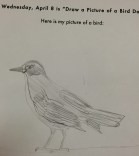
On April 7, 2015 the director of the Cheshire Library put a piece of paper into everyone’s mailbox. The page was blank except for one sentence across the top: Wednesday, April 8th is “Draw a Picture of a Bird Day” followed by the line: Here is my picture of a 2015-04-09 18.25.46bird.2015-04-09 18.25.57

What fun, I thought and took my paper home to plan a drawing for the next day. On April 8th when I arrived at work, several staff had created bird drawings. There were all types from simple line drawings to colorful sketches. Owls, doves, robins, swans, and hummingbirds found their way onto the wall of our staff room.

After seeing her uncle’s bird picture, Dorie laughed out loud and proclaimed that he was not a very good 2015-04-09 18.26.34artist, but that she would hang the picture in her room nonetheless. Her uncle’s spirits were lifted by his niece’s complete honesty and acceptance. Several other wounded soldiers also had their day brightened by the event and every time Dorie came to visit thereafter, they held drawing contests to see who could produce the best bird pictures. Within several months, the entire ward’s walls were decorated by bird drawings.

2015-04-09 18.26.12The next evening, as I was standing there looking at the pictures, I became curious about the source of Draw a Bird Day. So, I did some research and discovered the Draw a Bird Day website. I read with interest about Dorie and her uncle. And then came the third paragraph.

3 years later, Dorie was killed after being struck by a car. At her funeral, her coffin was filled with bird images that had been made by soldiers, nurses and doctors from the ward where her uncle had been. Ever since then, those men and women remembered the little girl who brought hope to the ward by drawing birds on her birthday, April 8th.
2015-04-09 18.26.25

I was stunned. Dorie, the girl who had loved bird drawings, died at age ten? That was not the way I was expecting the tale to end. And then I read a little further.

Draw a Bird Day was never declared an official holiday, but it grew through those soldiers and medical personnel and their families. Today, it is celebrated world wide as a way to express joy in the very simplest of things in life.

2015-04-09 18.26.07I went back into the staff room and looked at the bird drawings again. I had enjoyed making my drawing and viewing the drawings of my coworkers. It had lifted my spirits to make that picture and to see the creativity of the people I worked with. It had, in fact, the same effect that it had in that hospital ward all those years ago.

2015-04-07 16.45.35Seventy-two years after a little girl asked her uncle to draw her a bird, people all over the world are still drawing birds on her birthday. Still celebrating hope and happiness. Still celebrating joy in the simple. Still sharing the fun.

Would you like to learn how to draw a bird? Try these titles:

Drawing Birds     Colored Pencil     Laws guide

How a Stuffed Bear Can Give You Tranquility

Stuffed bears and other beloved toys certainly gave us tranquility when we were children, but that’s not what I’m talking about. I’m talking about philosophy. I’m talking about Taoism. I’m talking, of course, about Winnie-the-Pooh.

Jacket.aspxNow what, I can hear you asking, does Winnie-the-Pooh have to do with tranquility, philosophy, and Taoism? The answers are revealed in Benjamin Hoff‘s The Tao of Pooh, a book of 158 pages that deftly explains the principles of Taoism and applies them to modern life using the seemingly-odd, but, ultimately, not-so-odd example of Winnie-the-Pooh.

Using excerpts from the Pooh books by A.A. Milne, Hoff makes Taoism approachable and easy to understand. It’s not just a deep Eastern philosophy for hermits and mystics!  The tenets of Taoism can be incorporated into everyday life as Hoff illustrates via Pooh, a bear who exists very much in the now.

Using Pooh as his Taoist master, Hoff explores  “the ability to enjoy the simple and the quiet, the natural and the plain” along with “the ability to do things spontaneously and have them work”.  He uses the examples of Rabbit (Knowledge for the Sake of Being Clever), Owl (Knowledge for the Sake of Appearing Wise), and Eeyore (Knowledge for the Sake of Complaining About Something) to illustrate non-Taoist aspects of life, things that get in the way of happiness.

“When you discard arrogance, complexity, and a few other things that get in the way, sooner or later you will discover that simple, childlike, and mysterious secret…: Life is Fun.”

And what are the lessons of Taoism?

Things Are As They Are.
Everything has its own Inner Nature.
Enjoy the Process.
Things just happen in the right way, at the right time. At least they do when you let them.

And so much more. This is a perfect  read when you need some tranquility, perfect for Jacket.aspx2those desiring some calmness, slowness, some quiet. And the book is fun. It reads easily, quickly, with humor, wit, and quotes from Milne’s beloved stories. It can’t miss and it doesn’t miss.

By the way, Pooh Day is January 18th (also the birthday of A.A. Milne). What better way to celebrate than by reading the Tao of Pooh and it’s companion book, The Te Of Piglet.

Keep Yourself Reading

I’ve always been an avid reader, but sometimes I stall out for weeks at a time. It could be that a book just isn’t clicking with me, and so I never make the time to finish it. Or maybe I finish a particularly challenging or emotional book, and I’m hesitant to jump into a new story right away. Or maybe I’m just busy. Or maybe I’m watching too much Netflix!

If this sounds like you, I can help. Over the years, I’ve learned a few tricks to keep myself always reading.

  1. Keep track of the books you want to read so you never have to wonder “What’s Next?” I love www.goodreads.com for keep tracking of what I’ve read and what I plan to read.
  2. Don’t waste time on a book that isn’t for you. If you’re not enjoying something, allow yourself to read another book instead. Reading for pleasure should never be a chore! You can always come back to that other book later.
  3. If life seems to get in the way of making time for reading, grab something that you can’t put down. It’s OK to indulge in fluffier stories if that’s what keeps your momentum going. You’ll be surprised by the time you suddenly “find” when a book is too good to ignore.
  4. Make reading a part of your routine. Whether it’s with your morning coffee, on your lunch break, or before you go to sleep, try to make a set time to read every single day.
  5. And my favorite tip: When you finish a book, immediately start reading another one, if only just the first page. This remedies the problem of letting a book “sink in” for a day, or two days, before picking up another.

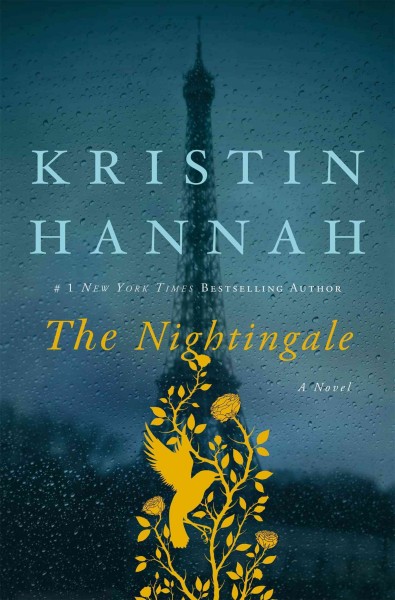
I recently stalled after reading The Nightingale. It was such an emotionally intense book that I couldn’t bring myself to open another after I’d finished it, and soon a week, and then two went by. Luckily, a friend let me borrow a real page-turner, The Headmaster’s Wife, and I got my momentum back. If you like ivy-covered boarding schools, mystery, and intrigue, check it out!

The Nightingale        The Headmaster's Wife

The Nightingale by Kristin Hannah

The Headmaster’s Wife by Thomas Christopher Greene


Find the Good

rosesI’m the first to admit that I am a skeptic. I’m always the one saying, “Yeah, but…” in any conversation. However, I have discovered skepticism is not synonymous with pessimism.

This was brought home to me when an acquaintance recently toured my gardens and did nothing but point out the weeds.

“Oh, look,” she exclaimed, her finger quivering as she pointed. “There’s a weed underneath that bush.”

I squinted. Sure enough, a weed was sprawling at the feet of a beautiful pink Knock-Out Rose.

She did this three more time during the tour. She never once mentioned the flowers.

After she left, I wondered what her life must be like since she seemed incapable of seeing anything but weeds. Skeptic though I am, I go through life looking at the roses.

Jacket.aspxIf you like the philosophy of looking at the flowers and not the weeds, I highly recommend the book Find the Good by Heather Lende. The book description says it all:

As the obituary writer in a spectacularly beautiful but often dangerous spit of land in Alaska, Heather Lende knows something about last words and lives well lived. Now she’s distilled what she’s learned about how to live a more exhilarating and meaningful life into three words: find the good. It’s that simple–and that hard.

Top Picks: Outdoor Literature

mountains

“I now walk into the wild.”
― Jon Krakauer, Into the Wild

It’s summer, and everyone is busy enjoying the outdoors with friends and family. Nice weather brings swimming, hiking, camping, and picnics, and a greater appreciation for nature. With so much time outside, you may feel inspired to read some Outdoor Literature. The Cheshire Public Library has you covered!

Outdoor Literature encompasses several different subgenres of literature, including exploration literature, adventure literature, mountain literature, and nature writing. Here’s a small sample of the books we carry to get you started.

Jacket.aspx4 2


Walden by Henry David Thoreau

Originally published in 1854, Walden, or Life in the Woods, is a vivid account of the time that Henry D. Thoreau lived alone in a secluded cabin at Walden Pond. It is one of the most influential and compelling books in American literature.

Roughing It by Mark Twain

Roughing It follows the travels of a young Mark Twain through the Wild West during the years 1861–1867. U.S. astronauts Frank Borman and Jim Lovell read Roughing It aloud to pass the time aboard NASA’s Gemini VII in 1965.

Into the Wild by Jon Krakauer

In April 1992 a young man from a well-to-do family hitchhiked to Alaska and walked alone into the wilderness. He had given $25,000 in savings to charity, abandoned his car and most of his possessions, burned all the cash in his wallet, and invented a new life for himself. Four months later, his decomposed body was found by a moose hunter. How McCandless came to die is the unforgettable story of Into the Wild.


5    63

Epic: stories of survival from the world’s highest peaks edited by Clint Willis

Epic is a collection of fifteen memorable accounts of legend-making expeditions to the world’s most famous peaks, often in the world’s worst possible conditions. Editor Clint Willis has gathered the most exciting climbing literature of the modern age into one cliff-hanging volume.

American Earth: environmental writing since Thoreau, edited by Bill McKibben; foreword by Al Gore

American Earth is an anthology of seminal American environmental writing from the past two centuries. It considers the influence on the ways in which people view the natural world and includes pieces by such figures as Henry David Thoreau, John Muir, and John James Audubon.

Wild by Cheryl Strayed

A powerful, blazingly honest, inspiring memoir: the story of a 1,100 mile solo hike on the Pacific Crest Trail that broke down a young woman reeling from catastrophe–and built her back up again.

If you care to delve deeper into the subject of Outdoor Literature, check out National Geographic’s list, Extreme Classics: The 100 Greatest Adventure Books of All Time.