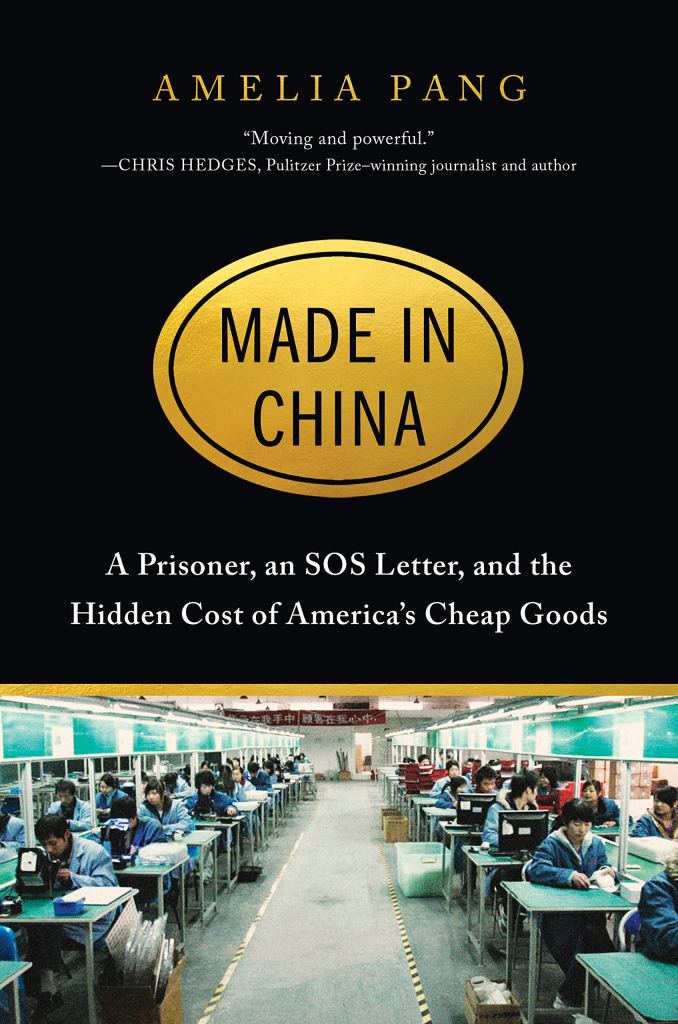
Made in China

Every now and then you read a book so disturbing you change your life because of it. That’s how I felt about Amelia Pang’s book, Made in China. I have not been so disturbed by a book since Road of Lost Innocence, by Somaly Mam. 

In 2012 Julie Keith opened up Halloween decorations, only to find a note in broken English, asking her to “kindly resend this letter to the World Human Right Organization. Thousands people here who are under the persecution of the Chinese Communist Party Government will thank and remember you forever.”

Julie did – contacting Amnesty International, Human Rights Watch, The United Nations Human Rights Council, and Anti-Slavery International.

None of them called her back.

Through her own research, she slowly learned the extent that America’s cheap consumer goods are, too often, being manufactured illegally by political prisoners in China, who work in concentration camp conditions amid torture and starvation.

 It wasn’t until she spoke to Immigration and Customs and Border Protection that she got anyone to listen – ICE and CBP are the agencies responsible for preventing forced-labor products from entering US markets. ICE made a formal request to visit the “reeducation center” where the product was made. China refused. Keith learned that China has never allowed inspection of their manufacturing facilities, and one piece of evidence isn’t enough to push further.

But Keith couldn’t stop thinking about the person who wrote the note. She wound up doing an interview for The Oregonian, and suddenly found herself in the spotlight of Chinese dissident news, CNN, Fox, and more. Through the group Human Rights Watch, Keith found out it’s almost impossible to prove human rights violations – Kmart insisted the factory had been audited every 6 to 12 months, absolutely within the law, but audits cost money and mostly check for cleanliness and quality control. They never check for the source of labor. When you have a hundred thousand subcontractors, and each audit is $1,000, the costs and time add up to impossible.

Sun Yi and his letter

Sun Yi was the man who wrote that note in 2009, three years before Julie Keith found it. He was imprisoned and tortured for belonging to a meditation group that fell into disfavor with the Party. After two years of  starvation, torture, and working sometimes 24 hours a day in inhumane conditions, he was released. CNN interviewed him, blocking his face so he could not be identified. Sun Yi decided that, while he could get the information out, he wanted to write a letter to Julie, thanking her. He included his email address. Sun realized if he was to live, he had to leave China, and slipped out to Indonesia before the Chinese authorities could stop him, since Indonesia didn’t require a visa for Chinese citizens. There, he had free communication with the world.

In March of 2017, Julie Keith flew 36 hours to Indonesia, to meet Sun Yi in person, something she always wanted to do. The meeting was bittersweet, and Keith learned much about Yi’s poor treatment.

In October of 2017, Sun Yi died mysteriously of a lung infection and kidney failure. He was said to have been befriended by a Chinese woman not long before. She wasn’t seen in Jakarta afterward. No autopsy was performed.

This book tore at my heart. It’s short, easy to read, and always engaging. As we flip past internet bargains and snap up dollar deals, think twice before buying cheap merchandise. Ask if the item was made in the USA, and try (oh yes, it’s difficult) to buy items made only in countries who pay fair wages and rely on fair trade. Does that pop-up ad on social media look beautiful, at a reasonable price? Google the company. If there’s little to no information on it, it may be because it’s fly-by-night. You might get a nice product, but the company may fold in one town and open up under a different name three blocks away in the same Chinese city, using the same illegal workers. 

I got suckered in by that myself: researched the company, found no red flags, ordered what I thought was a hand-made item by a small Mom & Pop company, until a few weeks later when I got an email telling me my package had just cleared customs from China.

Huh? 

The package arrived with a label that had a New York State company address – slapped directly over the label that was on the envelope that arrived from China.

Think when you purchase something. Without demand for cheap products, there will be less demand for labor. Ask yourself: Do I really need this? Is the price too good to be true? Where was it made? Who made it? Who is profiting from my buying it? Was someone harmed by my decision to purchase this item?

Sometimes, the answer might be yes.

The Scandalous World of Art

Edvard Munch, The Scream

 On May 1, CPL is hosting a program on The Art of the Scandal: Thefts, Vandals and Forgeries.

 Well, that’s nice, you say, but art doesn’t interest me.

Are you sure about that? Everyone loves a good mystery, and high art is probably the most mystery-filled subject there is. Anything with that much crime circling around it means there is a bank vault of money involved. 

There are many sides to fine art – the talent side (no one disputes a da Vinci, but you can start a fight over Pollock), the artsy side (the use of light and dark in paintings creates mood and movement that symbolizes man’s desire to control the universe: discuss), the history side (Phoenician art of the 18th century BCE shows a developing amalgamation of influence of the entire Mesopotamian region), and the rarity side (there are more Roman statues than there are da Vincis). We can discuss the purpose of art, of man’s desire to create, of the abstractness of art that leads back to man as the only animal who creates art for art’s sake, despite our knowledge that apes will draw and paint for pleasure, and that elephants, dolphins, and rabbits can be taught to paint as a behavior. It often boils down to one thing: 

Money.

The price of fine art (paintings and drawings, as opposed to jewelry work, sculpture, enamelwork, etc) has a few things going for it. First is rarity – many of the greatest paintings are hundreds of years old. They are one-of-a-kinds, and not a lot of them have survived. There are only 15 authenticated da Vincis known – as opposed to 400 Rembrandts. A second consideration is fragility – light, moisture, and age can cause ancient paintings to crack, flake, and fade (Van Gogh liked using red lake pigments, which fade rather quickly). The Mona Lisa is not painted on canvas, but an old board. A third thing is authenticity, and here is where the art world goes to pieces.

Salvator Mundi, by da Vinci

Because of the money involved in fine art (Da Vinci’s Salvator Mundi sold for $450 million dollars), as in too many movies, everyone is out to steal or fake originals. Forgery rings have been around for hundreds of years – one of the biggest was by Han Van Meegeren in the late 1930’s, a talented artist who sold more than $30 million in fake Vermeers to the Nazis. In 2004,  Xiao Yuan, the Chief Librarian at an academy of fine arts, stole more than 140 paintings in his care by carefully replacing them with his own copies – only to find some of HIS copies stolen and replaced with less-skilled replacements. Forgeries (actually, they’re called counterfeits, since legally only documents can be forged) are so rampant (about 50% of the market), Sotheby’s bought their own forensics lab to weed out fakes

Modern fakes are often easy enough to spot – today’s paints and canvases and even brushes aren’t the same as the 1500’s, and simple chemistry will find them. But what if the work copied is of modern origin – say, a Picasso, or a Warhol? Because of the modernity of materials, it is incredibly difficult to prove authenticity. 

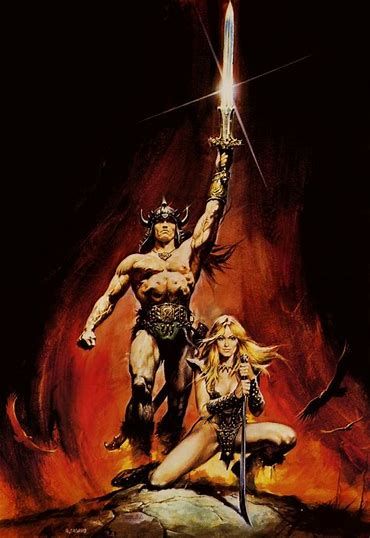
Conan the Barbarian, by Boris Vallejo

Questions still arise, though, as to what constitutes an authentic work of art. That 450 million dollar da Vinci has had so much restoration that there is more paint by restorers than by da Vinci, so is it still genuine? If a student of an artist (Rembrandt, Renoir, Reubens, etc) is so talented that a professional art historian/critic cannot tell the difference, how are you defining fine art and value? Where does the value lie – in the skill, the history, the age, or the subject matter? Why do we so value Edvard Munch’s The Scream (of which four originals exist, two of which were stolen), yet not value Boris Vallejo?

Art, by its very interpretational nature, is a scandal.

Art of the Scandal is an on-line program sure to peak your interest. You can sign up for the attendance link here.

New Trends in Science Fiction

Say Science Fiction, and most readers will make a face as images of bad 50’s movies, computers and technobabble, and Star Wars arguments come to mind. “I don’t read Science Fiction,” but chances are, you do. Science Fiction simply means a story that more or less follows the laws of science as we know them, as opposed to fantasy, which drags in magic and elves and things that don’t normally exist on Earth. The material is as broad as anything else in fiction.

Science Fiction has come a long way since 1977, and is almost unrecognizable to the campy 50’s tin-can imagery. Like rock music, science fiction has a hundred sub-categories, and chances are you’ve read – and liked – at least one. Here are some of the newest trends you may not know about.

Soft Science Fiction:  “Soft SF” isn’t new, but the definition is newer. Soft SF doesn’t deal with “hard” techno stuff, but concentrates on people, societies, psychology, and intrigue.  Cloud Atlas, The Handmaid’s Tale, Flowers for Algernon, Yiddish Policemen’s Union, The Time Traveler’s Wife, and Alas, Babylon all fall under “Soft” SF. Half of Stephen King can be categorized here. You could make an argument for Jason Bourne, too.

Gender-Focused: These stories explore cultures and people who may have a single gender, multiple genders, or are genderless entirely. Check out Ancillary Justice by Ann Leckie, Seveneves by Neal Stephenson, Mask of Shadows by Linsey Miller, or the Grandmama of them all, The Left Hand of Darkness by Ursula K. LeGuin.

Afrofuturism: Representation of minorities is growing in SF, and with it new ways of seeing inclusion in the future. Check out top authors like N. K. Jemisin, Colson Whitehead, Nnedi Okorafor, P. Djeli Clark, and Octavia Butler.

International: There’s a huge influx of stories being translated from other countries. While America may be stuck on space opera and predictable heroes, other countries aren’t, and offer a refreshing break from the Same Old Thing. Try The Three-Body Problem by Liu Cixin, Master and the Margarita by Mikhail Bulgakov, The Witcher Series (yeah, the TV one) by Andrzej Sapkowski, The Lost Village by Camilla Sten, or Shadow of the Wind by Carlos Ruis Zafon.

Generation Ship fiction: No faster than light ships here, but pressure-cooker stories onboard ships making a long haul. Dangers take on a whole new meaning when you’re dependent on your ship for years on end. Check out Across the Universe by Beth Rivis, Rendezvous with Rama by Arthur C. Clarke, Aurora by Kim Stanley Robinson, or Ship of Fools by Richard Russo.

New Space Opera: Space opera traditionally involves weapons, danger, heroes, and rescued damsels (Star Wars being a perfect example, among many), but newer stories are throwing in more gritty realism. They’re a higher quality of writing, more scientifically plausible, and tend to address more social issues under the guise of “fiction.” Grown-up SF. Try the Leviathan Falls series by James Corey, Hail Mary by Andy Weir, the Thrawn series by Timothy Zahn, The Echo Wife by Sarah Gailey, or Winter’s Orbit, by Everina Maxwell.

Climate SF:  With the doomsday clock ticking down the moments to an expected 6th mass extinction, climate SF may be the most relevant wave of stories to hit shelves, and can fully include apocalyptic virus stories. Read them!  State of Fear by Michael Crichton, New York 2140 by Kim Stanley Robinson, The Overstory by Richard Powers, Oryx and Crake by Margaret Atwood, The Bone Clocks by David Mitchell, Flight Behavior by Barbara Kingsolver.

Science Fiction isn’t the same old trope you’re used to, but a growing, evolving body of literature with numerous authors, styles, and focus – and guaranteed there’s one right for you!

Read it Before You See it: Book-to-Screen Adaptations Coming in 2022

So many screen adaptations, so little time! There are so many books coming to big and small screens this year, it’s easy to lose track or what’s coming out when. We’ve put together a list of some adaptations that we’re really looking forward to this year – some have release dates, some do not, but the list will give us time to read as many books as we can before their adaptations come out! Which books are you most looking forward to seeing on the screen this year?


MOVIES


The Black Phone Release date: Feb. 4, 2022

Death on the Nile Release date: Feb. 11, 2022

Mothering Sunday Release date: Feb. 25, 2022

Where the Crawdads Sing Release Date: July 22, 2022 (Netflix)

Salem’s Lot Release Date: September 9, 2022

White Bird: A Wonder Story Release Date: October 14, 2022

She Said Release date: Nov. 28, 2022

The Nightingale Release Date: December 23, 2022

Persuasion Release date: TBD 2022

The School for Good and Evil Release Date: TBD 2022 (Netflix)

The Wonder Release Date: TBD 2022 (Netflix)


TV SERIES


Outlander Season 6 (Starz) Premiere Date: March 6, 2022

Based on the book: A Breath of Snow and Ashes by Diana Gabaldon 

Bridgerton Season 2 (Netflix) Premiere Date: March 25, 2022

Based on the book: The Viscount Who Loved Me by Julia Quinn

Lord of the Rings (Amazon Prime Video) Premiere Date: Sept. 2, 2022

Based on the books: The Lord of the Rings trilogy by J.R.R. Tolkein 

The Sandman (Netflix) Premiere Date: TBD 2022

Daisy Jones & the Six (Amazon Prime Video) Premiere Date: TBD 2022

Conversations with Friends (Hulu) Premiere Date: Spring 2022

Shifting Dunes

When it comes to epic book series impossible to film, first came Lord of the Rings, (which was done marvelously at last but needed more than 10 hours of screen time).

Then came Dune.

Dune, by Frank Herbert, is considered the best-selling Science-Fiction novel of all time (though it’s far more Game of Thrones than space ships), with more than 12 million copies sold in 14 languages. It tied for the 1966 Hugo Award. And like Lord of the Rings, getting it to film is a Holy Grail of filmmakers.

Dune tells the far-distant-future story of Duke Leto Atreides, who is given the stewardship of the desert planet Arrakis, also known as Dune. Dune is the only place in the universe where the spice Melange exists – a spice that not only can alter your mind, in some species it lets them fold time and space, creating almost instant space travel. “He who controls the spice, controls the universe.” Thus, Dune is a hotbed of politics and backstabbing. When the Duke is murdered, his son Paul, deemed an abomination by a powerful religious group, is seen as a prophesied savior by the natives of Dune. So begins the battle for control of Dune. The book is an immersive, detailed, visionary epic of grand scope (there’s a dictionary in the back). When you read the book, you are on Dune. This is a book that sticks with you for years to come.

Herbert wrote five books to the series; his son Brian added another twelve after his death. Dune – even just the first installment – is a novel of such grand scope (like GOT and LOTR) that putting it to film has been almost laughable – think of Rankin Bass’s 90-minute adaption of The Hobbit. Game of Thrones took 8 years and more than 73 hours to tell – can you imagine it as a three-hour theater film and have it make sense? It was tried in the 70’s, but after 3 years of attempts, the budget just couldn’t be managed. In 1984, David Lynch did make it, condensing much of the book to ethereal voiceovers, changing major points to condense action, and adding some now-cheesy early computer effects (the blue contacts of the Fremen didn’t work, and every frame of the film had to be colored by hand). It’s a film you either love or hate, with musician Sting as Feyd Rautha famously flexing in a winged bikini.

In 2000, SyFy channel did two Dune mini-series, which were much better received, won several awards, yet seemed to fade into obscurity faster than Lynch’s version, with the chief complaint it stuck too close to the source material, and dragged. Now, thanks to Warner Bros and HBO, we have a $165 million dollar spectacle by Denis Villeneuve that covers – only half the book, with a sequel (hopefully the second half) due in 2023. 

While the film has been viewed favorably, the scenery and cinematography spectacular, Villeneuve took many liberties with the material that once again changes the focus and depth of the story. To modernize it, he gender-swapped characters (which goes against the society Herbert wrote) and changed the roles of other women (no, the Bene Gesserit. He left out much of the religious aspect, the mysticism, even avoided the word jihad, used by the Fremen. It gives a sanitized, whitewashed view of the story, afraid of offending anyone. Herbert believed that modern societies will always decay back to a feudalistic society, and that the desert cultures, especially those of the Middle East, were more prone to messianic complexes and religious wars (remember, he’s writing in 1964 or so, when the Middle East was still rather bland politically. Think Star Wars and Tatooine, or The Great Humongous in Road Warrior, etc. There’s a lot to be said for that theory). To remove the root of the story – is it still the same story? Can anyone ever make a decent, book-abiding video version of Dune?

If you can’t wait for the new film to come out on DVD (or, rather, the first half of the book), check out the book series itself. Few things are better than the source material.

I can give up Sting in his bikini (though I thought he was a perfect Feyd), but there is no better Gurney Halleck than pre-Captain Picard Patrick Stewart. That’s my opinion, and I’m sticking to it!

Dune

Dune Messiah

Children of Dune

God Emperor of Dune

Heretics of Dune

Sandworms of Dune

Dune: House Atreides

Dune: House Harkonnen

Dune: House Corrino

Dune: The Machine Crusade

Dune: The Lady of Caladan

The Winds of Dune

The Sisterhood of Dune

Paul of Dune

Mentats of Dune

Navigators of Dune