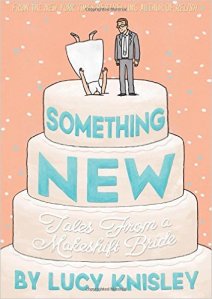
Something New: Tales From a Makeshift Bride

Something New: Tales From a Makeshift Bride by Lucy Knisley is a funny and interesting biographical graphic novel about Lucy’s relationship with her boyfriend, John, and their wedding. This book takes you through how they met in college, moved in together, broke up, dated other people for three years, then abruptly became engaged.

Then, it takes you through a year of a DIY wedding. DIY: decorations (ALL the decorations), music playlist, ties for the men in the wedding party, photo booth, personalized gifts for every single guest, personalized gifts for everyone in the wedding party, and the list goes on. What they could not do themselves they worked out as cheaply as possible: a wedding dress that was on sale (it had pockets!), a backyard barn built for the occasion, and a friend of the family to cater everything.

There is also plenty of wedding stress. Lucy’s mother had her own list of guests to invite that mostly consisted of people who were strangers to Lucy and John, and it was longer than Lucy and John’s list of guests. The mother-of-the-bride also kept insisting on other things such as hiring a wedding planner without consulting the bride and groom, changing the size of the intended barn which forced the couple to remove guests from their invitation list, a band instead of their DIY playlist, and her badly-behaved dog walking down the aisle at the wedding. As Lucy and John worked through all of this stress, Lucy also reflected on what weddings used to be, what they have become, what marrying a man means for her bisexuality, and what she wants most in a marriage.

Genre: Non-fiction graphic novel

Setting: Most of the story takes place in modern-day Chicago and New York state.

Number of pages: 291

Is this good for a book club? Yes, if the club is willing to read a graphic novel. This book contains a lot of good discussion material about an important cultural milestone. It is also very quick to read, despite the number of pages.

Themes: The history of weddings, the modern wedding industry’s influence on what people think weddings are supposed to be (and what they are supposed to cost), how weddings can negatively impact people who are not heterosexual, what it means to have a good marriage, different types of relationships, and how wedding stress can bring out the worst in people.

Objectionable content: Suggestive themes, sexuality, and alcohol.

Can children read this? Teenagers would enjoy this.

Who would like this? Anyone who is preparing for their own wedding, preparing for someone else’s wedding, has gone through a wedding, thinks weddings are overrated, thinks weddings are wonderful, or enjoys examining the wedding industry.

Rating: Five stars

Save

Save

It’s International Cake Day!

July 20th is International Cake Day! Here’s a low-calorie way to celebrate the day.

The Particular Sadness of Lemon Cake by Aimee Bender
Being able to taste people’s emotions in food may at first be horrifying. But young, unassuming Rose Edelstein grows up learning to harness her gift as she becomes aware that there are secrets even her taste buds cannot discern.


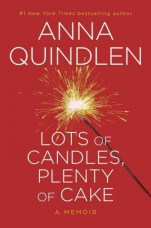
Lots of Candles, Plenty of Cake by Anna Quindlin
In this irresistible memoir, the #1 “New York Times” bestselling author writes about her life and the lives of women today, looking back and ahead–and celebrating it all–as she considers marriage, girlfriends, our mothers, faith, loss, all that stuff in our closets, and more.


Wedding Cake Murder by Joanne Fluke
Hannah is marrying Ross Barton, her college crush, but not before she can solve the murder case of nasty celebrity chef Alain Duquesne found stabbed to death in the Lake Eden Inn’s walk-in cooler.


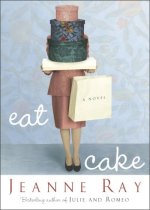
Eat Cake: A Novel by Jeanne Ray
Ruth draws on her talent for concocting delectable cakes and desserts when her family begins to disintegrate around her–her husband loses his job, her mother moves in, and her long-estranged father shows up at the door with no place to go.


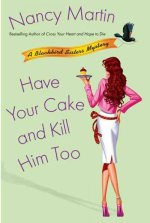
Have Your Cake and Kill Him, Too by Nancy Martin
When the tycoon owner of a spectacularly tacky sports bar is killed, Nora Blackbird suspects a secretive politician, a shady former rock star doubling as a pastry chef, and a dangerous aristo-brat on the verge of stardom.


Brief Histories of Everyday Objects

Brief Histories of Everyday Objects by Andy Warner is a hilarious non-fiction graphic novel that describes how many of the items that we take for granted have interesting, unusual, and sometimes downright silly origins. The author guessed when it came down to deciding what people looked like and what they said (unless they were quoted), but the facts are all true! Once you read this book, you will never look at the things you use on a daily basis in the same way again. The next time you go to a party, you’ll be able to tell people about the story behind the pull tabs on their soda cans.

Did you know that the woman who invented flat-bottomed paper grocery bags had to fight for her right to the patent when a man tried to steal it? She became the first woman to win a patent lawsuit.

Did you know that Earl Tupper invented Tupperware, but Brownie Wise made it sell? In fact, she was so successful that she became the face of the product. This greatly angered Mr. Tupper, so he fired her, sold the company, and purchased an island where he lived for the rest of his life.

Did you know that postcards were the results of an elaborate prank?

Did you know that roller skates were first invented in 1760 when John Joseph Merlin, a prolific inventor, built a pair so he could show off at a masquerade?

Genre: Non-fiction graphic novel

Setting: All over the world, throughout different times

Is this good for a book club? Only if the book club is interested in discussing previously unknown facts regarding everyday things.

How long is the book? 206 pages

Objectionable content? Barely. There are some references to bathing, bras, excrement, and violence, but there is nothing explicit. There are some illustrations of women wearing sports bras.

Can children read this? The humor and information are enjoyable for all ages, as long as they have a good vocabulary.

Who would like this? Anyone with a good sense of humor and a good appreciation for learning about how everyday objects were created.

Rating: Five stars

Save

Save

Cloning Around

Cloning seems new, but it’s technically been around longer than man – identical twins can be considered clones, splitting a single fertilized egg into two or even four genetically identical individuals from that one egg. Modern cloning, wherein cells are taken from a living donor and a primitive cell is induced to become an organism traces back to just 1996, when Dolly the Sheep was cloned from a mammary cell of another sheep, the first time a body cell was used instead of a sex cell – an egg or sperm.

The success of Dolly induced a rush to clone everything. Companies still offer to clone your pet, so that when it dies you can have an exact replica. Zoos and conservationists tried vainly to clone endangered species. And, due to the discovery of some well preserved remains of extinct creatures such as the mammoth and Otzi, the ancient hunter, biologists, paleoarchaeologists, and dreamers leaped at the chance to resurrect ancient animals, or possibly even a Neanderthal (if you believe they are truly extinct. It’s been found that modern people of European descent may have as much as 5% Neanderthal DNA .

Is this even possible? Jurassic Park resurrected the dinosaurs, and outside of making a tidy sum for their producers (four films have brought in more than 3.6 billion dollars. Billion with a B, not counting book sales), we understand the havoc that created, substituting frog DNA for missing strands of dinosaur.

Two recent books discuss this possibility in thoughtful detail.

Resurrection Science, by M.R. O’Connor, is philosophical and easy to read. She discusses reasonable ethics regarding several endangered species, but leaves the questions open for the reader to decide. Should millions of people be denied electricity because a mere handful of frogs live only in six square feet of mist of one waterfall deep in the jungle? Should we be captive-breeding the Florida panther, only to release them into a concrete jungle so they can be hit by cars and shot by people freaking out when they see them? Species have been going extinct for millions of years; should we be trying to save them if we’ve destroyed the very environment that made them what they are? And by the time you artificially recreate animals, hand-rear them (because the parents are extinct), and then set four of them free – are they really the animal you were trying to save? Because they were artificially created, they don’t know what to do, how to attract mates, what or how to forage and eat, and can starve to death.

How to Clone a Mammoth, by biologist Beth Shapiro, is still easy to read, but contains a chapter on the hard-core dynamics involved in splicing and replicating DNA material. While Shapiro is among those who would love to see mammoths cloned, she’s deep in the know and admits it’s not feasible. Not only has not a single complete strand of viable DNA been recovered, no study takes into account the near impossibility of actually making the goal: in trying to resurrect the recently extinct Bucardo (a type of Spanish Ibex), using frozen cells taken from a then-living animal (not a 20,000 year old dried out one), 780 cells were transplanted to eggs, but only 407 developed into embryos. Two hundred eight were implanted into hosts, of which only seven became pregnancies (an efficacy rate of 3%). Of these, just ONE made it to term (0.4%). That one animal had a lung defect so severe it lived less than ten minutes. Cloning, depending on specie, has a terrible rate of success, with animals frequently dying of defects or cancers. Shapiro discusses the ethical concerns of what to do with a mammoth if you do create one – no one knows its behaviors. The MAMMOTH won’t even know how to act like a mammoth. Are they solitary or social? Will it pine in loneliness? What does it eat? Does that diet still exist? Where will you keep it? We’re bringing alive an animal we have no data on whatsoever. Is this fair to the animal? If not a mammoth, should we try to resurrect something else recently extinct whose absence IS having a deleterious effect on the environment? Shapiro paints a harsher ethical – and realistic – picture.

Technology is closer than ever to reaching de-extinction goals, and with increasing earth temperatures melting permafrost and releasing better-preserved specimens every year, the chance of finding usable DNA grows ever closer. Both of these books present a balanced side to the argument. Of course we WANT to bring back mammoths. The question remains: should we?

Quick Read: Mozart: A Life

Mozart: A Life by Paul Johnson is a short and simple biography of Wolfgang Amadeus Mozart. It is only five chapters long! However, don’t let that fool you into thinking that it doesn’t provide a decent account of his life and music. It describes Mozart in a way that is easy to understand by all. The author also gives the reader new insights into information about his life, and a good understanding both of what his music is about and just how prolific a writer he was. I would have preferred it if this book had been longer and more detailed, but it works well with its simple approach.

Did you know that Mozart wrote over 600 pieces of music in his lifetime? This is especially impressive since he only lived for 35 years.

Did you know that Mozart had a brief a relationship with his wife’s sister?

Did you know that Mozart was literally kicked in the rear by one of his employers when he was fired?

Genre: Biography

Setting: Different parts of Europe from 1756-1791

Is this good for a book club? Yes, if the book club is interested in biographies, music, or just a quick read.

Objectionable content? Yes, but it is not detailed. Religion, sex, violence, incest, and death are referenced, but nothing is explicitly described.

Can children read this? Yes, if they have interest in Mozart and a good vocabulary regarding history and music. Teenagers would be the most likely to be interested.

Who would like this? Anyone who is interested in Mozart and his music. It is also good for people who like quick and interesting reads.

Number of pages: 164

Rating: Four stars

Save

Save

Save

Save

Save

Save

Save

Save

Save

Save

Save

Save

Save

Save