 I am a deep introvert. I’m perfectly fine talking only to the cat or TV. Hence, when my son was born, I figured if I didn’t start talking to him, he’d never learn to talk (my first mistake), and thus began thirty years of talking to myself and narrating what I’m doing.
Research published in the book Meaningful Differences, by Betty Hart and Todd R.  Risley, showed a direct link between the number of words a child heard at home by the age of three, and their academic performance in Grade 3 (the age of 8). Children in poor/welfare homes heard, on average, 600 words an hour. Children of working-class homes heard 1200, and children of professional parents heard 2100. That racked up to children of professional parents hearing 30 million more words by the age of three than a poor child. So?
Exposure becomes verbal fluency. Verbal fluency is required for reading proficiency, and reading proficiency is required for academic proficiency. The child who has minimal language is going to lag far behind on reading and academics.
How many words is your child really hearing?
 Based on these studies, along comes VersaMe’s Starling, a handy-dandy little device that tracks just how many words your baby hears during the day. It’s just a little clip-on star that records the number of words a baby hears, not the actual words (no one will hunt you down because of what you said when that [jerk] cut you off ). It’s convenient, easily rechargeable, and holds a charge for up to three days, so you don’t have to worry about plugging it in every night. It uses Bluetooth technology to report in real time to your smartphone, so you can track as you go. The clip is rather strong – the first day, it took my 14 month old 4 hours to wrestle it free, and by the next day, she wasn’t paying it any attention. It is fully waterproof, drool proof, and not particularly chewable, which was nice.
The first day we broke 10,000 words, the second day 11,000, and the third day for some reason, even though we went to a party with lots of people talking to her, it didn’t record, which was disappointing. Our best was 16,000.
Per day, 11,000 words seems like a lot, but when you figure the child is only awake 12-14 hours, and take out an average of three hours for naps, we didn’t even hit Middle-Class. Yet, I have a toddler who is off the charts in vocabulary and language skills. Even the authors of the original study admit that quantity is nothing in the face of quality. Ten minutes spent reading a book with your child will go farther than three hours of TV. And no, Starling can’t differentiate between people and TV.
Should you try Starling?
If you are a new parent with questions, if you’re the parent of a developmentally delayed child, if you’re just curious about yourself, then by all means give the Starling a try. It’s easy, it’s fun, and interesting to see the results. But remember, worrying about arbitrary marks isn’t good. Children, toddlers, babies all need critical down time to process all that information they’re learning. Imagine someone following you around talking to you every waking second. You’d lock yourself in the bathroom for just 5 minutes of quiet. Your baby is no different. Language is important, but so is quiet alone time.
Starling is fun. It’s informative. Use it as an investigative tool, maybe increase some quality time or have an extra imaginary conversation on a play phone. If you want to try out a Starling, you can borrow one from the library.
 For a helpful look on the making of brilliance and achievement, check out Malcolm Gladwell’s Outliers. For a fascinating look on the importance of auditory language, check out I Can Hear You Whisper: An Intimate Journey Through the science of Sound and Language (it’s not as sciency as it sounds), by Lydia Denworth. It’s awesome!


 won’t eat cream puffs. Tim Burton’s Mars Attacks! and its disembodied heads was another. Another didn’t trust


 During National Keep Kids Creative Week, parents are encouraged to eliminate or at least cut down on kids’ screen time, and help them brainstorm creative activities instead. Write a story or create a recipe together. Challenge them to come up with their own superhero, cool invention, or fun game to play.



 Let’s face it. Toddlers are adorable, but they’re a pain in the kneecaps when you have to keep getting up to chase them. Like an overcaffeinated octopus in a waterpark, they get into EVERYTHING. Once a baby starts to creep, your time to sit and relax evaporates. So what do you do to keep them busy long enough to check your email without having to hold them, yet manage to keep them from banging on the keyboard?
 parked in front of a TV or – and I see this every day in one store or another – a cell phone. Babies and toddlers need to DO. They need to use their bodies – crawling and climbing and running for gross motor, and touching, poking, pulling, pushing to develop not only fine-motor skills, but tactile, sensory integration, mental mapping, visual-motor integration, social expectations, and spatial memory – things they cannot develop from passive observation of a flat screen.
 than a cell phone or endless Dora. But the toys that ARE geared for actual learning are not usually found in stores but educational catalogs, and those are often overpriced because they expect a school system to pay for them –
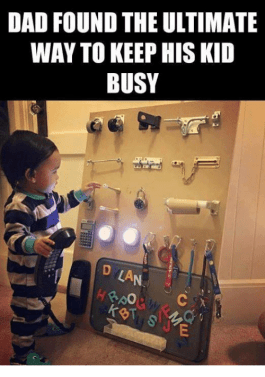 genius. Give the kid all those things he wants to explore, but in one safe location: a real-life busy board. Phones, switches, calculators, all those forbidden things, right in reach, and no one yelling. Finding myself the unexpected guardian and caretaker of an infant and starting all over again, I wanted one of those. As she started to crawl, I built one, too. Wheels for spinning, latches, jingly keys (and old dog license tags), a push-on closet light, a light switch that turns on an actual LED, a small baking sheet for magnets (we use photos of relevant family and friends), interchangeable carabiners with a pacifier, a fun keychain, a small measuring tape that retracts, a mailbox flag that goes up and down, a brush for sensory input, Velcro dots for sticking pictures to (and they feel fun), a light-up keychain, numbers for counting and matching clothespins, an old TV remote, and most importantly – the springy door stoppers that go BOING when you whap them. Fastened to the wood, they make
 a very satisfying sound. Another important item was a small grab bar fourteen inches off the ground. This allows the beginning stander and walker to hold on and pull, and feel secure while standing and playing. All this, on a 2 by 3 foot piece of plywood attached to the dining room wall. The only other thing we did was add three mirrored tiles at baby height on a different wall.



 The Cheshire Library Blog