2014 is shaping up to be an exciting year for books and movies! Whether you want to get ahead of the game and read the books before the films come out, or just want to know what you can expect to see hitting the cinema this year, here are our top picks for upcoming movies being adapted from books.
In March:
 Divergent by Veronica Roth. In a future Chicago, sixteen-year-old Beatrice Prior must choose among five predetermined factions to define her identity for the rest of her life, a decision made more difficult when she discovers that she is an anomoly who does not fit into any one group, and that the society she lives in is not perfect after all.
In the Heart of the Sea by Nathaniel Philbrick. In 1819, the Essex left Nantucket for the South Pacific with twenty crew members aboard. In the middle of the South Pacific the ship was rammed and sunk by an angry sperm whale. The crew drifted for more than ninety days in three tiny whaleboats, succumbing to weather, hunger, disease, and ultimately turning to drastic measures in the fight for survival.
A Long Way Down by Nick Hornby. Four people come together on New Year’s Eve: a former TV talk show host, a musician, a teenage girl, and a mother. Three are British, one is American. They encounter one another on the roof of Topper’s House, a London destination famous as the last stop for those ready to end their lives. This is a tale of connections made and missed, punishing regrets, and the grace of second chances.
In June:
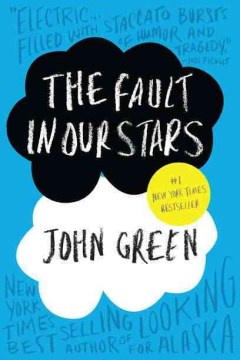
The Fault in Our Stars by John Green. In John Green’s mega-bestselling novel, 16-year-old Hazel, a stage IV thyroid cancer patient, has accepted her terminal diagnosis until a chance meeting with a boy at cancer support group forces her to reexamine her perspective on love, loss, and life.
In August:
The Giver by Lois Lowry. Jonas’s world is perfect. Everything is under control. There is no war or fear of pain. There are no choices. Every person is assigned a role in the community. When Jonas turns 12 he is singled out to receive special training from The Giver. The Giver alone holds the memories of the true pain and pleasure of life. Now, it is time for Jonas to receive the truth. There is no turning back.
In September:
The Maze Runner by James Dashner. Sixteen-year-old Thomas wakes up with no memory in the middle of a maze and realizes he must work with the community in which he finds himself if he is to escape.
In October:
Gone Girl by Gillian Flynn. On the morning of his fifth wedding anniversary, Nick’s wife Amy suddenly disappears. The police immediately suspect Nick. Amy’s friends reveal that she was afraid of him, that she kept secrets from him. He swears it isn’t true. A police examination of his computer shows strange searches. He says they aren’t his. And then there are the persistent calls on his mobile phone. So what really did happen to Nick’s beautiful wife?
In November:
 Mockingjay by Suzanne Collins. The final book in the Hunger Games trilogy. Katniss Everdeen’s having survived the Hunger games twice makes her a target of the Capitol and President Snow, as well as a hero to the rebels who will succeed only if Katniss is willing to put aside her personal feelings and serve as their pawn.
In December:
 The Hobbit by J.R.R. Tolkien. Bilbo Baggins, a respectable, well-to-do hobbit, lives comfortably in his hobbit-hole until the day the wandering wizard Gandalf chooses him to take part in an adventure from which he may never return. Peter Jackson turned Tolkien’s novel into 3 films, the final one hits theaters in December.
 Unbroken by Laura Hillenbrand. In 1943, while World War II raged on in the Pacific Theater, Lieutenant Louis Zamperini was the only survivor of a deadly plane crash in the middle of the ocean. Zamperini had a troubled youth, yet honed his athletic skills and made it all the way to the 1934 Olympics in Berlin. However, what lay before him was a physical gauntlet unlike anything he had encountered before: thousands of miles of open ocean, a small raft, and no food or water.














 The Cheshire Library Blog