Don’t Be Afraid of Color

Jacket.aspx“Color is your friend,” proclaims the first chapter of Bright Bazaar: Embracing Color for Make-You-Smile Style by Will Taylor.

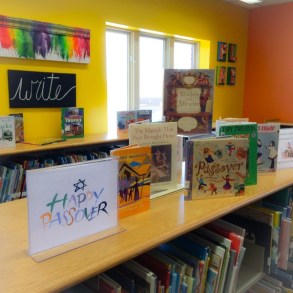
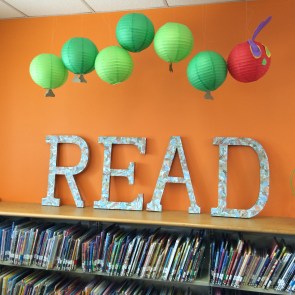
Maybe, but in a world where many folks play it safe with white or neutrals color schemes, color can be scary.  We know. We recently decided our plain white walls in our Children’s Department needed an upgrade. Knowing how much kids love color, we chose yellow, orange, and red for the walls. Gulp.

Well, the results were stunning.

From blah to bold.

       image

From boring to brilliant

Before 2       2016-04-15 13.10.16

From beige to bright.

Red wall

The Children’s Room is now a vibrant space filled with energy. And all for the price of a few cans of paint and some risk-taking in our color selections. We are now eyeing other areas of the library, deciding what we can “colorize” next.

If you’d like to take your decorating to a more colorful level but need a little help, try these titles.

Jacket.aspxNew Color Schemes Made Easy by Better Homes and Gardens

Color Idea Book by Robin Strangis

Can’t Fail Color Schemes for Kitchens & Baths by Amy Wax

The Color Scheme Bible: Inspirational Palettes for Designing Home Interiors by Anna Starmer

How to Throw Things Away

apartment-cleaningOkay, let’s get something straight right at the beginning. This is not a blog post about how to store your stuff more efficiently. This is all about having less stuff. That’s right, it’s about throwing stuff away.

Part of minimalism, which I’ve been exploring in my own life these last few months, is living with less. This doesn’t mean building more shelving or uber-organizing my books. It means LIVING WITH LESS.

A simple concept with life-changing implications and many questions, the biggest of which is, how do you even begin to get rid of all your stuff?

Frankly, you have to face your mountain of clutter and be ruthless.

Jacket1For instance, in the book, Simplify Your Space by Marcia Ramsland, she recommends the following tools to simplify your bedroom: a wastebasket, a recycling bin, and three boxes. One box is for things to keep. The other two boxes are for items to donate Jacket2and sell. In  For Packrats Only by Don Aslett, he outlines four steps to follow to ditch the junk.

  • Recognize that junk is bad.
  • Repent (Admit that your junk is hurting you, your energy, your bank account, and your relationships.)
  • Remove the junk. Yes, perform the physical act of throwing things away.
  • Refrain from bringing new junk into your life.

Get the picture?

Fortunately, there are dozens of titles that can help you on your way to a clutter-free life. These books outline plans of action, suggest tips for helping you decide what to keep and what to get rid of, and advice on how to deal with the emotional side of throwing things away. My favorites are listed below.

Personally, I found getting rid of stuff liberating, although, to be honest, so far my family is not quite on board yet. Stay tuned for the further adventures of a hopeful minimalist.

50 thingsThrow Out Fifty Things : Clear the Clutter, Find Your Life by Gail Blanke

Never Too Busy to Cure Clutter : Simplify Your Life One Minute at a Time  by Erin Rooney Doland

The Ultimate Guide to Clearing Your Clutter : Liberate Your Space, Clear Your Mind, and Bring in Success by Mary Lambert
Jacket.aspxThe Complete Idiot’s Guide to Decluttering by  Regina Leeds

The 100 Thing Challenge : How I Got Rid of Almost Everything, Remade My Life, and Regained My Soul by Dave Bruno

Clutter Control: Putting Your Home on a Diet by Jeff Campbell

Downloadable Audiobooks

Stop Clutter from Stealing Your Life : Discover Why You Clutter and How You Can Stop by Mike Nelson

Ebooks

Winning the Clutter War by Sandra Felton

Conquering Clutter : Getting To The Bottom Of Clutter by Megan Francis

Decluttering Secrets : Tips And Tricks To Becoming Organized by Sally Munroe

Homesteading and Sustainability Practices on the Rise

Prices for many necessities continue to rise, while pay and compensation for most people do not seem to be rising at the same rate. Homesteading, or making the attempt to live more self sufficiently, is becoming a major trend as people make an effort to save more and do more for themselves. Most of these things are things our parents or grandparents did as a matter of course, but more and more people are learning how to revive these methods of taking care of the environment and their families.

Some of the activities that are seeing a major come back for one reason or another that can be considered a step towards homesteading or sustainable living include, knitting or crocheting, sewing, canning, gardening, raising chickens or other livestock, and so much more.  I have done some of the traditional homesteading activities, but I will admit to cheating in some departments. While I might garden and crochet, I have not homesteading1started canning like my family did when I was growing up. Frankly, I still have nightmares of peeling steamed tomatoes from my childhood as we made sauce and stewed tomatoes among other things.  If you are interested in learning more about what exactly homesteading is, or you want to move towards living a more self sufficient lifestyle, here are some resources that can get you started and answer some questions.

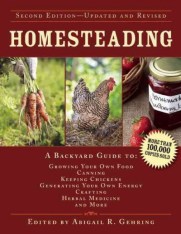
Homesteading: a Backyard Guide to Growing Your Own Food, Canning, Keeping Chickens, Generating Your Own Energy, Crafting, Herbal Medicine, and More edited by Abigail R. Gehring

Urban Homesteading: Heirloom Skills for Sustainable Living by Rachel Kaplan with K. Ruby Blume

Made from Scratch: Discovering the Pleasures of a Handmade Life by Jenna Woginrich

The Nourishing Homestead: One Back-to-the Land Family’s Plan for Cultivating Soil, Skills, and Spirit by Ben Hewitt with Penny Hewitt

The Urban Homestead: Your Guide to Self-Sufficient Living in the Heart of the City by Kelly Coyne & Erik Knutzen

You might also be interested in Homeward Bound: Why Women are Embracing the New Domesticity by Emily Matchar, Zero Cost Living: Explore Extreme Frugality by James R. Delcamp, Back to Basics: a Complete Guide to Traditional Skills edited by Abigail R. Gehring, The Complete Idiot’s Guide to Self-Sufficient Living by Jerome D. BelangerBarnyard in your Backyard: a Beginner’s Guide to Raising Chickens, Ducks, Geese, Rabbits, Goats, Sheep, and Cattle edited by Gail Damerow, The Backyard Homestead Book of Building Projects by Spike Carlsen, The Renewable Energy Handbook: a Guide to Rural Independence, Off-Grid and Sustainable Living by William H. Kemp, Mini Farming : Self Sufficiency on a 1/4 Acre by Brett L. Markham,  and Sustainably Delicious: Making the World a Better Place, One Recipe at a Time by Michel Nischan with Mary Goodbody.

How to Fold Your Clothes

I’ve been folding my clothes wrong all my life.

I discovered this when I began exploring minimalism. Minimalism is the idea that less is more. Owning fewer things makes your life easier. However, minimalism is not about getting rid of everything. Part of the concept of minimalism is putting things away properly.

Let’s take clothing as an example. When clothes are folded correctly, they take up less space. A simple concept, but I didn’t believe it until I saw it.

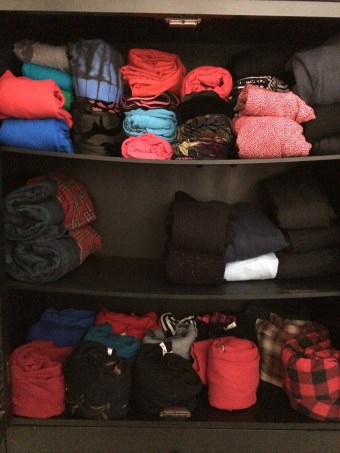
Here’s a before picture of my dresser. A pretty typical dresser, I’d like to think.

2016-01-24 11.37.47


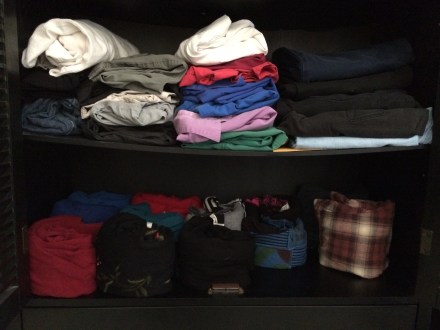
Now here is what one shelf looked like once I changed how I folded my clothes. Just look at that bottom shelf compared to the one above it.

2016-01-24 11.38.07


I was startled by how much less room my clothing took up. I emptied the dresser and refolded everything. This was the end result. (Yes, I have a little too much on that poor top shelf!)

2016-01-24 12.30.01


I did not discard one single item. In fact, I ADDED a few things that had been hanging in my closet.

Here’s how it works: Lay your clothes flat and fold them length-wise, twice. Then either fold or roll them so that they can be stored on end. The only exception I made was the pants, which I found hard to make stay folded and standing on end, so I stacked them. They still take up less space than they did before. I simply folded them length-wise as instructed and then folded them in half and then in half again.

I discovered this method of folding while reading The Life-Changing Magic of Tidying Up by Marie Kondo, where you can read a more detailed explanation of this method of folding. Kondo’s folding method is also detailed in her newly released Spark Joy.

Jacket.aspx            Jacket.aspx1

Get Gardening With the Whole Family

Spring is here. This means it is a perfect time to start researching and planning what you want to grow this year. I am already dreaming about sunflowers, lavender, fresh tomatoes, and a variety of other produce and herbs. I love to garden, and have always been spoiled with the gift of family with very green thumbs. I adore fresh flowers, herbs, fruits, and vegetables and am glad to grow or have access to a wonderful supply each year.

kidgardenDuring the garden planning and planting process do not forget that everyone can take part in gardening. No matter the age, we can all dig a hole to plant a seed or young plant, pick out a plant to grow, or help chose a container to plant in. A wonderful trick to getting children (or adults) to try new foods is to have them help grow, pick, and help wash and prepare them.

kidgardens44The library has a vast gardening section in the adult nonfiction section to help with the important planning and plant choices. However, do not overlook the books in the children’s room. These books can give gardeners of all ages some ideas and inspiration to garden as a family, or to give the kids their own special little container or garden space. Here are a few of the great gardening books about involving children and getting them excited in the process.

Garden to Table: A Kid’s Guide to Planting, Growing, and Preparing Food by Katherine Hengel with Lisa Wagner
Container Gardening for Kids by Ellen Talmage
The Family Kitchen Garden: How to Plant, Grow, and Cook Together by Karen Liebreich, Jutta Wagner & Annette Wendland
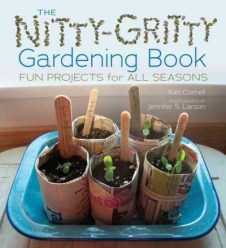
The Nitty-Gritty Gardening Book: Fun Projects for All Seasons by Kari Cornell
Gardening Projects for Kids: 101 Ways to Get Kids Outside, Dirty, and Having Fun by Whitney Cohen and John Fisher
Roots, Shoots, Buckets & Boots: Gardening Together with Children by Sharon Lovejoy
Kids’ Container Gardening: Year-Round Projects for Inside and Out by Cindy Krezel
How Does Your Garden Grow?: Great Gardening for Green-Fingered Kids by Clare Matthews
Gardening With Children by Monika Hannemann
A Kid’s Guide to How Herbs Grow by Patricia Ayers
It’s Our Garden: From Seeds to Harvest in a School Garden by George Ancona

This slideshow requires JavaScript.