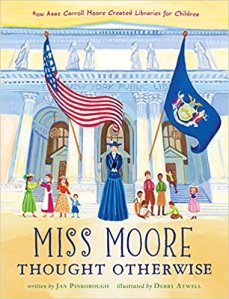
Miss Moore Thought Otherwise

Miss Moore Thought Otherwise by Jan Pinborough is a true children’s story about one of the first children’s librarians. Anne Moore grew up in a time where many libraries were not free, and they were certainly not meant for children. Usually, children were not even allowed inside, especially girls. But Miss Moore thought otherwise.

Anne Carroll Moore was an independent thinker ever since she was a child. While other girls stayed inside and sewed, Anne was outside sledding on the hills. When other girls got married, Anne was working in her father’s office, learning how to be a lawyer. When other women stayed home, Anne moved to New York City, went to college, and got a job in a library.

Anne Moore changed the ways in which libraries viewed children. Under her supervision, libraries no longer demanded silence from patrons, children were allowed to take books home, child-sized furniture was built, more children’s books were published, rooms became more colorful, and people were brought in to do children’s programming. Libraries all around the world followed her example, all because she always looked at things differently.

Genre: Children’s non-fiction

Setting: Maine and New York in the late 1800s-early 1900s

Number of pages: 40

Themes: History of children’s libraries, and independent women

Objectionable content? None.

Can children read this? Yes. This book is appropriate for all ages. There are interesting things for the older kids to read, and the younger kids will enjoy the beautiful pictures.

Who would like this? Anyone who is interested in how children’s libraries developed into their current focus on library users, and anyone who enjoys learning about strong women.

Rating: Five stars

Brief Histories of Everyday Objects

Brief Histories of Everyday Objects by Andy Warner is a hilarious non-fiction graphic novel that describes how many of the items that we take for granted have interesting, unusual, and sometimes downright silly origins. The author guessed when it came down to deciding what people looked like and what they said (unless they were quoted), but the facts are all true! Once you read this book, you will never look at the things you use on a daily basis in the same way again. The next time you go to a party, you’ll be able to tell people about the story behind the pull tabs on their soda cans.

Did you know that the woman who invented flat-bottomed paper grocery bags had to fight for her right to the patent when a man tried to steal it? She became the first woman to win a patent lawsuit.

Did you know that Earl Tupper invented Tupperware, but Brownie Wise made it sell? In fact, she was so successful that she became the face of the product. This greatly angered Mr. Tupper, so he fired her, sold the company, and purchased an island where he lived for the rest of his life.

Did you know that postcards were the results of an elaborate prank?

Did you know that roller skates were first invented in 1760 when John Joseph Merlin, a prolific inventor, built a pair so he could show off at a masquerade?

Genre: Non-fiction graphic novel

Setting: All over the world, throughout different times

Is this good for a book club? Only if the book club is interested in discussing previously unknown facts regarding everyday things.

How long is the book? 206 pages

Objectionable content? Barely. There are some references to bathing, bras, excrement, and violence, but there is nothing explicit. There are some illustrations of women wearing sports bras.

Can children read this? The humor and information are enjoyable for all ages, as long as they have a good vocabulary.

Who would like this? Anyone with a good sense of humor and a good appreciation for learning about how everyday objects were created.

Rating: Five stars

Save

Save

Sorting White Trash

indexIt was a hard call, but I’d say White Trash by Nancy Isenberg was my Number 2 Must Read of 2016 (after Chasing the Scream), but oh, have I put off writing about it because it played so much into last year’s politics it seemed as if it were written for it – but it couldn’t, because it was written before last year’s one-of-a-kind election year.

“White Trash” is a term that began just before the Civil War and became entrenched afterward, a term for the poorest white people who were absolutely uneducated, dirty, poorer than slaves – and had no desire to change their ways. They considered themselves perfectly fine and above anyone else. Rich people were to be sneered at, since they considered themselves better. Educated people were sneered at, because they considered themselves better. Yet as a class they were so despised for their lack of morals and work ethic, even slaves considered themselves above Poor White Trash.

Isenberg feels the concept goes back further than that. Who did England send over to1400306193764-cached America to pad out their colonies? Who would not be missed from the overcrowded prisons and cities? Not the landed gentry, but those persons who for whatever reason did not fit into society and were unsuccessful at supporting themselves. The Virginia Colony had to go so far as to set a death sentence for people who did not work and did not attend church on Sundays. Starvation was so bad that people resorted to cannibalism. The people sent over refused to work, preferring to run off to unsettled land (which was “owned” by others) and fend for themselves. Getting people to do the hard labor of setting up a colony was quite difficult.

Further, Isenberg says that as the country expanded, the first to move west were… the folk who refused to work for others, could not function in a society, and would rather starve than work. Each time, the ones who pushed west first were the dregs, seeking escape from prisons, debt collectors, tax men, and others who “infringed” upon them. The wild west was wild because the people who colonized it couldn’t get along with anyone.

“White Trash” has many names, depending on geography – Crackers, Okies, Rednecks, Hillbillies, Trailer Trash, Mud Eaters – all people who shun government, distrust education, live in abject poverty, and have a very flexible moral code. I don’t mean “flexible” as a pejorative but as a term to describe a juxtaposition of ideals: your baby out of wedlock is a sin, but it’s okay for me. Never take charity, but taking free stuff from this agency over here isn’t charity, it’s just free stuff. They have quite the knack for making things acceptable for them but a sin for anyone else.

Isenberg digs into both politics and popularism, citing Andrew Jack110932-004-3f4811e2son (the first person running for President who lost despite getting the most popular votes the first time he ran) as an uneducated, crass boor who appealed to the lowest masses and yet was elected President, and how he loved to flaunt that boorishness, to the distress of the American Gentry. She cites the 1970’s as a time when White Trash became hip – from Smokey and the Bandit, to the Dukes of Hazzard, to Tammy Faye Bakker and the  whole Televangelist craze. Today’s exploitainment shows like Duck Dynasty, Honey Boo Boo, and 16 and Pregnant continue to flaunt poverty, lawlessness, and lack of education as something chic and desirable.

Of course race and politics play into it. Much of the divide still stems from the Civil War, with Southern States blaming Northern States for the outcomes, and the Northern States holding the South in utter contempt. Isenberg shows how that all translates into votes, and political forums, and how those in turn affect our elections – including the recent one.

indexIsenberg is not alone in her observations. Numerous authors have also written similar observations, making her research more plausible. One is Deer Hunting With Jesus, by Joe Bageant, in which he talks about going home to rural Virginia, and why such places are becoming  a permanent underclass.  Lee Smith touches on a little of it in her dreamy autobiography Dimestore, about growing up in rural Appalachia.  Hillbilly Elegy by J.D. Vance does a fantastic job presenting the issues from the first-hand experience of growing up in 1980’s Kentucky.

No matter what your political leanings, White Trash815bv15ciol will open your eyes to why current politics are playing out the way they are and how people are being exploited in the process, why you can’t seem to educate people out of poverty, and how that poverty persists generation after generation – and no, it’s not due to Welfare. How do we change it? How do we shape it? Or should we allow an uneducated underclass to dictate policies it knows nothing about – and chooses not to learn?  There’s no easy answer to be had, but this book is a must read and will open your eyes to a lot of things you never learned in school.

What’s Happening at Cheshire Library in March

Two concerts this month, plus fun and informative programs on everything from Aromatherapy to  Starting a Business! Here are the highlights from our March Events Calendar:

rrpcwmScents and Sensibility

Thursday Mar 2, 2017, 6:30  –  8:00 PM

Learn about the medicinal benefits of various herbs and essential oils and create your own 8-ounce herbal reed diffuser. This 90 minute hands-on workshop includes all materials. Seating is limited and registration is required.

holaCuentos y Cantos

Friday Mar 3, 2017, 10:00  –  10:45 AM

¡Hola y bienvenidos a Cuentos y Cantos! Join Miss Lauren for a bilingual storytime in English and Spanish. We’ll read books, sing songs, learn new words, and have fun in two languages! For children ages 0-5 with a parent/caregiver. No registration required.

Atwater-Donnelly Trio

header02rev

Sunday Mar 5, 2017, 2:00 PM

Award-winning, internationally acclaimed performers, Aubrey Atwater and Elwood Donnelly  blend gorgeous harmonies and play an astonishing array of instruments, showcasing traditional American and Celtic folk songs and percussive dance featuring Irish step dancer Kevin Doyle. This concert is free to the public, no registration required.

small-businessStarting and Running a Small Business

Tuesdays,  Mar 7, 14, 21, 28 2017, 6:00  –  8:00 PM

The basics of starting and running a small business will be presented in a series of four programs to be hosted by SCORE, a network of business mentors, at the Cheshire Public Library, in the month of March.  The sessions will take place on Tuesday evenings – March 7, 14, 21, and 28, from 6:00 to 8:00 p.m.  Space is limited, please register early!


difference-between-noodles-and-pastaCookbook Club: Pasta and Noodles

Wednesday Mar 8, 2017, 6:30  –  8:00 PM

March is Noodle Month!  Bring your favorite pasta/noodle cookbooks (from the library or home) to discuss, and a pasta/noodle dish to share with the group. Must be at least 18 years of age or older to participate.  By attending the program, participants acknowledge that they may choose to consume food that has not been prepared in a commercial kitchen. Registration is required.

11140269_574342509385891_2126848489443040348_n-e1446648369259Adult Knitting Night

Wednesdays Mar 8 and 22,  2017, 6:30 PM

Come socialize, learn, and share your techniques with other knitters.  Experience the relaxing and calming effect of knitting. Advanced adult knitters welcome, no supplies or instruction will be given. We will meet the 2nd and 4th Wednesday every month, no registration required.

logo-cwhf300 Years of Connecticut’s Remarkable Women
Thursday Mar 9, 2017, 6:00 PM

Please join us as we celebrate Women’s History Month with a tribute to 300 Years of Connecticut’s Remarkable Women presented by The Connecticut Women’s Hall of Fame. This multi-media program will discuss well-known figures like Ella Grasso, Katharine Hepburn and Marian Anderson and lesser known heroines like Maria Sanchez, Barbara McClintock and Hannah Watson. Registration is required.

caldecottCelebrate the Caldecott!

Saturday Mar 11, 2017, 11:00 AM  –  12:00 PM

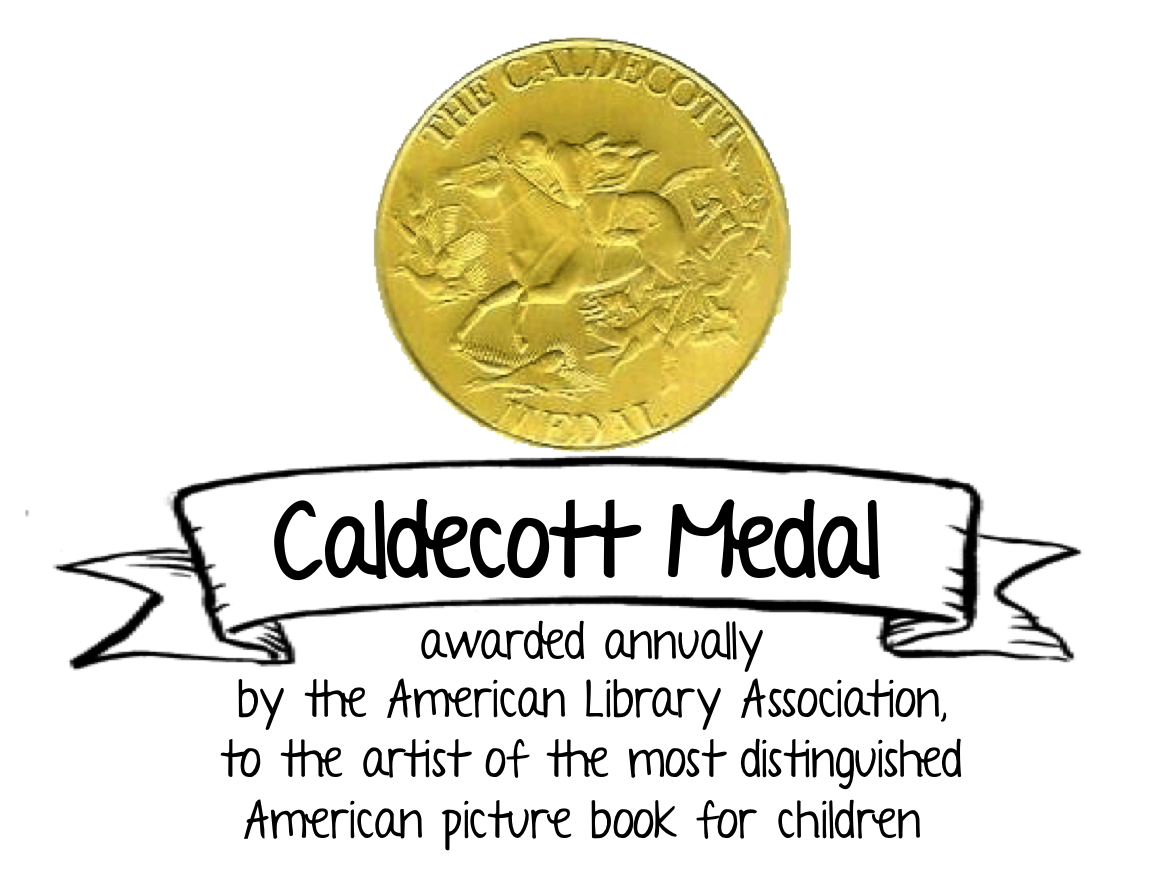
Join us as we celebrate some of our favorite Caldecott Medal books! The Caldecott Medal is awarded annually to the artist of the most distinguished American picture book for children published that year. This hands-on family friendly program will include art activities and games featuring some of the past award winners. For all ages, registration is required.

imagesFood Your Kids Will Eat!

Monday Mar 13, 2017, 6:30  –  7:30 PM

Do you have a favorite recipe that your family loves?  Do you have a recipe that freezes well that you can heat up after a long day at work?  Well this program is for you.  Bring a sample of your favorite dish, and the recipe to share with the group. We’ll share ways of getting kids to eat the food you prepare! Must be at least 18 years of age or older to participate.  By attending the program, participants acknowledge that they may choose to consume food that has not been prepared in a commercial kitchen. Registration is required.

Microsoft PowerPoint

3-part class, Wednesdays Mar 15, 22, 29, 1:30-2:30 PM

This class will provide introduction to Microsoft PowerPoint and is divided into three powerpoint-2013-logo-iconsessions.
You will learn how to:
– Create a new presentation.
– Modify presentation themes.
– Add and edit text.
– Add new slides to a presentation.
– Insert clipart images and shapes to slides.
– Add sound and video to a slide presentation.
– Insert and edit animations and slide transitions and much more.   Registration is required.

img_0623READ Photo Week

Monday Mar 20 – Saturday Mar 26, 2017

Kids, show off your love of reading! Stop by the Children’s Room any time from Monday, March 20th to Saturday, March 26th to get your photo taken with a favorite book. Take a book from our shelves or bring a book from home, select a snazzy background, then smile and say “read”! During National Library Week from April 10-16, come pick up your photo and enjoy our brand-new display featuring all the readers at Cheshire Library.

screen-shot-2017-02-15-at-4-07-09-pmSAT/ACT Preparation

Thursday Mar 23, 2017, 6:30  –  7:30 PM

Want to learn about free resources such as practice SAT/ACT tests and eBooks available to you free 24 hours a day, 7 days a week?  Attend this free session and learn about Learning Express a digital service that will help you master the SAT/ACT.  Registration is required.

baerman-squaredNoah Baerman Trio

Sunday Mar 26, 2017, 2:00 PM

Noah Baerman is an acclaimed jazz pianist/composer, educator, author, and Artistic Director of the non-profit Resonant Motion. For this program, Noah and his trio will demonstrate some of the nuts and bolts of instrumental jazz in lay terms, but without watering down the music itself.  This concert is free to the public, no registration required.

26832947885_23920e0bc2_bAuthor Talk : The Brass Valley by Emery Roth

Monday Mar 27, 2017, 6:00  –  8:00 PM

They called the steep valley of Connecticut’s Naugatuck River, “Brass Valley,” because from the time the world began running on steam and bearings, trolleys and soot, the Naugatuck Valley came to be where most of the world’s brass manufacturing happened.  Author and photographer, Emery Roth will talk about his new book, Brass Valley: The fall of an American Industry,  a book of pictures and stories about how it all happened.


Save

Save

Save

Understanding Urban Issues

Here is a group of books – some of them very good – that are sure to fuel political fire, no matter which fence you sit on regarding the issues of the blighted inner cities.

indexGhetto is a brand-new book by Mitchell Duneier on the term “ghetto,” which dates back to the 1400’s when Jews were forced to live in isolation from Christians. They were free to come and go, except at night, and anyone could do business with them. This led to a flourishing if separate culture for hundreds of years. Enter the Nazis, who isolated Jews into Ghettos with barbed wire. No one was allowed in or out. Here, people had no jobs, severe overcrowding, no public services, and as the ghettos decayed and residents grew desperate, people accepted the fact that Jews lived like animals, and it helped fuel antisemitism. Why would people live like that if they didn’t deserve it, forgetting that to cross the wire was not just banishment, but death. By the 1940’s the term expanded to the narrow neighborhoods that African-American people were allowed to live in. There was no barbed wire, but an invisible barrier that they weren’t allowed to cross except for work. As their neighborhoods became overcrowded because no one could move out, they fell victim to the same issues faced in Germany. Duneier presents facts throughout the last century – the 40’s, the 60’s, the 80’s, and today, on the current use of the term vs. the historical one, and how the stagnation and forced living creates the discord we see today. The book is far too long and detailed – it could be half and still be excellent – but even if you have to skim it, it is serious food for thought.

Easier to read, if not more infuriating, is Family Properties:  Race, Real Estate, and the5190mOD8p3L._SX329_BO1,204,203,200_ Exploitation of Urban Black America by Beryl Satter. Satter details the blatant racist policies of 1940’s Chicago, where Real Estate agents were threatened if they sold houses to African Americans past the “White” line, and people who did buy in would find the houses disassembled by the neighbors to prevent it. It took many years and many lawsuits to get things to change. This book will make you angry.

514dyV2l3KL._SY479_BO1,204,203,200_A head scratcher is All Souls: a Family Story from Southie by Michael Patrick McDonald. Mrs. McDonald is Irish, unmarried, and pumps out children like party favors (11 in all), living in the infamous projects of South Boston – an area run by no less than Whitey Bulger himself. Michael tries to sort out his childhood as his siblings fall victim to gangs and drugs and forced busing. Entertaining and tragic, even if you can’t relate to their lifestyle.

Death at an Early Age, Savage Inequalities, and Fire in the Ashes, all by Jonathan Kozol, are heart-rending books about the disparities in Urban and Suburban education. They are excellent reading that will break your heart. The realities of urban living will block most of these kids from ever achieving, and it is not their fault.

Jacket.aspxI cannot recommend the book The Corner: A Year in the Life of an Inner-City Neighborhood by David Simon and Edward Burns enough. I could not put it down. It covers the grim streets of Baltimore, a place so bad it’s where trauma surgery originated. It is compelling and reads like a novel. And they made a TV Miniseries out of it. One of my top-50 favorite books.

51BHwvQwVbL._SX331_BO1,204,203,200_If you’re really, really, really into sociology, then go back to the original: How the Other Half Lives by Jacob Riis. This is one of the first sociological studies on the slums of 1886 New York City, and the issues seen there – discrimination, overcrowding, street children,  gangs, alcoholism, domestic violence, prostitution – paint a familiar story as European immigrants try to find a way to survive in a hostile new world. It’s dry reading at times, but interesting in the patterns that appear.

Lyndon Johnson took decisive moves to improve our urban areas; 50 years later, not much has changed. The issues brought up in these books are just as relevant today as then, and we have more than enough information to make positive changes. These books will open your eyes.