This post comes to us from our Head of Adult Services, Bill:
“Slow down, you move too fast You got to make the morning last Just kicking down the cobblestones Looking for fun and feelin’ groovy” ~ from The 59th Street Bridge Song (Feelin’ Groovy) by Paul Simon (1966)
Our world in 2020 indeed moves too fast for many of us! This can have negative effects on our mental and physical well-being. What can we do to counteract these negative effects? Maybe try a little mindfulness…

Mindfulness is a form of meditation and its magic comes in the form of improved concentration and happiness, and physiological improvements that often include lower heart and blood pressure rates. It can also reduce stress and chronic pain as well as improve sleep.
A few years ago, Forbes Magazine published and article detailing 6 Scientifically Proven Benefits Of Mindfulness And Meditation:
- Mindfulness reduces anxiety
- Mindfulness meditation reduces implicit age and race bias
- Mindfulness-Based Cognitive Therapy (MBCT) may prevent and treat depression
- Mindfulness meditation helps increase body satisfaction
- Mindfulness meditation improves cognition
- Mindfulness meditation helps the brain reduce distractions
 Though the practices of mindfulness and meditation have been around for centuries, the science behind it has only recently become more understood. Health practitioners, and even the business world, have begun taking the concept of mindfulness quite seriously as more and more evidence comes to light on how the practice can actually change the “wiring” of our brains.
Want to learn more about the practice of mindfulness and what it can do for you? This month Cheshire Library is presenting a 3-part Mindfulness Series:
- Intro to Meditation, Monday. March 16, 2:00 p.m.
- Nature as Mentor, Wednesday, March 18, 6:30 p.m.
- Sound Healing Bath, Wednesday, March 25, 6:00pm
Check out these books for even more information:


Mindfulness and Meditation : Your Questions Answered by Blaise Aguirre
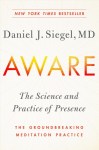
Aware : The Science and Practice of Presence by Daniel J. Siegel, M.D
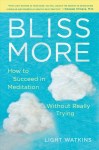
Bliss More : How to Succeed in Meditation Without Really Trying by Light Watkins
Meditation for Fidgety Skeptics by Dan Harris and Jeff Warren, with Carlye Adler
 Perhaps one of the fastest ways to pick a fight with a stranger is to comment on their parenting style. Around the country, let alone around the world, each culture or region is convinced only their way is right. Yet, American education has been in decline for years, currently ranking 27th in the world.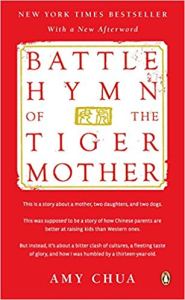
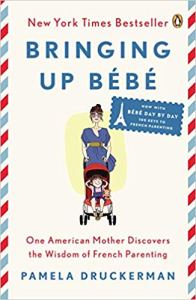
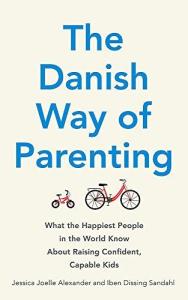


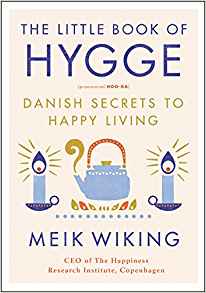
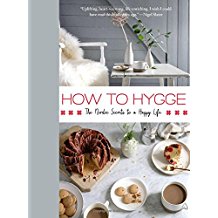

 Early literacy programs at public libraries have changed significantly over the years. Early literacy is everything a child knows about reading and writing before he or she can read or write, typically between the ages of 0-5. Traditionally, children’s library programs focused on the education of children. Today, these programs focus on the education of the parent or caregiver. If you attend
  You can sing in the car whenever you’re traveling and you never have to worry about other people hearing your singing voice.
 Caregivers have the most important role in developing a child’s reading skills, so it is important that you practice these techniques as often as possible. I encourage you to visit the library and check out some of the early literacy programs and resources that we have. To see our full events calendar, you can go to


 And don’t forget to sign up for our summer reading program for kids and adults :
  the board and keeping track of piles of colorful money never really engaged me. In reality, I spent the next three hours curing diseases in Pandemic, creating train tracks that spread the globe in Ticket to Ride, and trading spices in Century: Spice Roads. I was floored that board games had evolved so much since I had played as a kid, the art was more engaging, the stories richer, and the play more involved. In the months following this revelation I’ve added over thirty board games to my list, and I’ve expanded my idea of what a board game can be.
 resources in a library that encourage community and collaboration. At a time when parents and educators are concerned about the rise in digital media and isolation, board games get people of different backgrounds engaging with each other across a table, solving problems, improving a number of practical skills, and having a good time. When you look at it that way, it’s no surprise that board games are a critical part of a libraries community, and a lifelong pursuit of learning.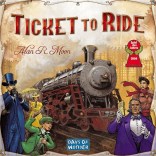

 Let’s face it. Toddlers are adorable, but they’re a pain in the kneecaps when you have to keep getting up to chase them. Like an overcaffeinated octopus in a waterpark, they get into EVERYTHING. Once a baby starts to creep, your time to sit and relax evaporates. So what do you do to keep them busy long enough to check your email without having to hold them, yet manage to keep them from banging on the keyboard?
 parked in front of a TV or – and I see this every day in one store or another – a cell phone. Babies and toddlers need to DO. They need to use their bodies – crawling and climbing and running for gross motor, and touching, poking, pulling, pushing to develop not only fine-motor skills, but tactile, sensory integration, mental mapping, visual-motor integration, social expectations, and spatial memory – things they cannot develop from passive observation of a flat screen.
 than a cell phone or endless Dora. But the toys that ARE geared for actual learning are not usually found in stores but educational catalogs, and those are often overpriced because they expect a school system to pay for them –
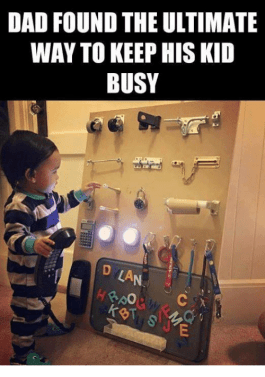 genius. Give the kid all those things he wants to explore, but in one safe location: a real-life busy board. Phones, switches, calculators, all those forbidden things, right in reach, and no one yelling. Finding myself the unexpected guardian and caretaker of an infant and starting all over again, I wanted one of those. As she started to crawl, I built one, too. Wheels for spinning, latches, jingly keys (and old dog license tags), a push-on closet light, a light switch that turns on an actual LED, a small baking sheet for magnets (we use photos of relevant family and friends), interchangeable carabiners with a pacifier, a fun keychain, a small measuring tape that retracts, a mailbox flag that goes up and down, a brush for sensory input, Velcro dots for sticking pictures to (and they feel fun), a light-up keychain, numbers for counting and matching clothespins, an old TV remote, and most importantly – the springy door stoppers that go BOING when you whap them. Fastened to the wood, they make
 a very satisfying sound. Another important item was a small grab bar fourteen inches off the ground. This allows the beginning stander and walker to hold on and pull, and feel secure while standing and playing. All this, on a 2 by 3 foot piece of plywood attached to the dining room wall. The only other thing we did was add three mirrored tiles at baby height on a different wall.

 The Cheshire Library Blog