Today’s guest post is by Harold Kramer, our go-to sci-fi guy!
While his works are usually categorized as science fiction, author Neal Stephenson’s novels span many genres, since they interweave politics, religion, archaeology,  philosophy, technology, computer programming, and cryptography. His novels take place the past, present, and future and often include actual historical characters. His early, innovative cyberpunk novel, Snow Crash was named one of Time magazine’s 100 best English-language novels.
My favorite Neal Stephenson book is Cryptonomicon. It takes place during two distinct periods, World War II and 1997. The main characters are from the same family, but they are from different generations. It’s a novel for people who like science-based, thought-provoking, fiction. The plot focuses on the British government’s efforts at code breaking during World War II. If you are familiar with the movie The Imitation Game, many of the real-life characters in that film appear in this work of fiction.
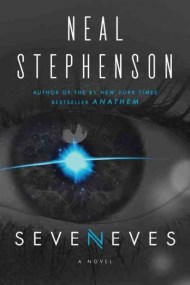 I recently read Stephenson’s latest novel Seveneves. In this book, Earth becomes uninhabitable when an unidentified object strikes the moon that bursts into fragments. These fragments eventually surround and smother the earth. Humans survive by migrating to “space arks” where they must live for thousands of years. Through various circumstances, political squabbles, and other unforeseen events, seven women, the seven Eves, are left to re-populate mankind. However, five thousand years later, humans have been discovered still living on earth resulting in complications between those who are earthbound and those who are space- bound. While this topic has been covered by many other science fiction novels, Stephenson’s book has a unique perspective and it is based on hard scientific facts that make it stand out from the usual “earthlings migrate to space” novels.
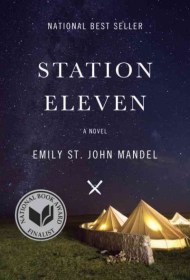 Another dystopian novel, with a radically different point of view is Emily St. John Mandel’s Station Eleven. It was a National Book Award Finalist and won the 2015 Arthur C. Clarke Award. In this book, the earth is ravaged by a mysterious plague that wipes out much of mankind. Earth has become a world with no technology – not even electricity. The story focuses on a group of survivors who are musicians and actors and are called The Traveling Symphony. They travel from town to town performing works of art from the past. The book concerns their amazing journey and is full of colorful characters who end up at an abandoned airport called “The Museum.” There is a villainous “prophet” who provides an interesting plot element.
Thanks to the readers who responded to my first blog post with some suggestions for authors worth considering. I’m happy to mention Larry Niven, author of The Ringworld series, a classic work of science fiction and Anne McCaffrey, author of the Dragonriders Series and the first woman to win both a Hugo Award and a Nebula Award. Let me know if you have more science fiction or fantasy authors worth noting.
 January began as one of the last months of year, not the first. The start of the Roman calendar (and the astrological one) was March. Back then there were only ten months to the year, totaling 304 days. Between was a miasmic 66 monthless days of “winter.” According to legend, Numa Pompilius, the second King of Rome (after Romulus himself), added January and February to codify that winter term (along with a catch-up month every other year of 22 days).
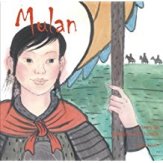
 to have lived somewhere between 386 CE and 620 CE (if you’re not up on your history, Common Era has replaced the Anno Domini). She takes her aging father’s place in the army, and serves for twelve years without her fellow soldiers realizing she’s a woman. Depending on the source, her name might be
 The steel-driving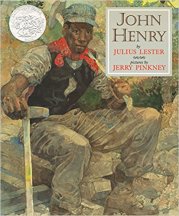

 under control of the Habsburgs, a magistrate put his hat on a pole and demanded all citizens bow before it, or be imprisoned. While in town with his son, Tell refused to bow, was arrested and sentenced to death – though, since he was such a marksman, the Magistrate would let him go if he could shoot an apple off his son’s head. Tell did so, was arrested anyway, escaped, and the people rose up in rebellion, in an act considered the founding of the Swiss Confederacy, around 1307. Some historians believe Tell is merely a new twist on an old Danish fable.


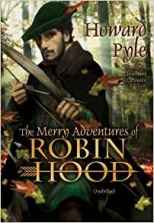



 there isn’t a lot of swearing, gore, or sex. Think “



 x Benedict
 travel novels. These include
  If you’re looking for coffee in Cheshire, you don’t have to stray far to find a good cup. You can go to one of what seems like fifty Dunkin Donuts (or is it just Dunkin now?) or stop in to Cheshire Coffee for one of their seasonal pumpkin spice blends. But as crafty and creative person, I’ve always wanted to perfect the art of brewing my own cup at home. Usually I just pop a pod in the Keurig, and add some overly sweet creamer. But if you’re looking to learn a bit more about coffee, or add some books to your late night reading list, you’ve come to the right place. I’ve gone through the shelves and picked out a healthy selection of books on the art of brewing, and a few thrillers for library night owls like myself.