Library Journal Reviewers List Their Top 10 Books of 2013

Librarians rely on a lot of resources when deciding which books to purchase for their libraries. At the top of the list is Library Journal’s Book Review, which provides prepublication reviews for hundreds of books each month. When you read books for a living, so many will blur together, but every year there are standouts. Here are LJ’s picks for the best books of 2013:

Claire of the Sea Light by Edwidge Danticat (fiction). Claire Limyè Lanmè (“Claire of the Sea Light”) goes missing on her seventh birthday, soon after her destitute fisherman father makes the wrenching decision to give her away so that she can have a better life. As townsfolk search for her, painful secrets, haunting memories, and startling truths are unearthed among the community.

The Panopticon by Jenni Fagan (fiction). Anais Hendricks, 15, is in the back of a police car. She is headed for the Panopticon, a home for chronic young offenders. She can’t remember what’s happened, but across town a policewoman lies in a coma and Anais’s school uniform is covered in blood.  Raised in foster care from birth, Anais has been let down by just about every adult she has ever met. Now a counter-culture outlaw, she knows that she can only rely on herself. And yet despite the parade of horrors visited upon her early life, she greets the world with the witty, fierce insight of a survivor.

Five Days at Memorial: Life and Death in a Storm-Ravaged Hospital by Sheri Fink (non-fiction). Pulitzer Prize winner Sheri Fink’s landmark investigation of patient deaths at a New Orleans hospital ravaged by Hurricane Katrina — and her suspenseful portrayal of the quest for truth and justice.

The Searchers: The Making of an American Legend by Glenn Frankel (non-fiction). Explores the true-story-become-legend underpinning John Ford’s film, and the making of the film itself.

NOS4A2 by Joe Hill (fiction). Charles Talent Manx has a way with children. He likes to take them for rides in his 1938 Rolls-Royce Wraith with the NOS4A2 vanity plate. With his old car, he can slip right out of the everyday world, and onto the hidden roads that transport them to an astonishing–and terrifying–playground of amusements he calls “Christmasland.” Now Vic McQueen, the only kid to ever escape Manx’s unmitigated evil, is all grown up and desperate to forget. But Charlie Manx never forgot. He’s on the road again and he’s picked up a new passenger: Vic’s own son.

A Constellation of Vital Phenomena by Anthony Marra (fiction). In a rural village in December 2004 Chechnya, a failed doctor Akhmed harbors the traumatized 8-year-old daughter of a father abducted by Russian forces and treats a series of wounded rebels and refugees while exploring the shared past that binds him to the child.

How To Create the Perfect Wife by Wendy Moore (non-fiction). Go back before the Regency and the romances it still inspires. Enter the Enlightenment, but don’t assume its adherents were all enlightened as we’d understand the term. Meet Thomas Day, an 18th-century aristocrat free to study and practice Enlightenment philosophies. Watch him go to an orphanage and adopt a girl for long-term training to be his wife. Twice.

Cooked: A Natural History of Transformation by Michael Pollan (non-fiction). Pollan’s latest details his adventures exploring the four elements of food preparation: fire, water, air, and earth. In the course of his journey, he discovers that the cook occupies a special place in the world, standing squarely between nature and culture.

Bleeding Edge by Thomas Pynchon (fiction). New York City, 2001. Fraud investigator Maxine Tarnow starts looking into the finances of a computer-security firm and its billionaire geek CEO and discovers there’s no shortage of swindlers looking to grab a piece of what’s left of the tech bubble.

The Woman Who Lost Her Soul by Bob Shacochis (fiction). When the humanitarian lawyer Tom Harrington travels to Haiti to investigate the murder of a beautiful, seductive photojournalist, he is confronted with a dangerous landscape of poverty, corruption, and voodoo.

Spotlight: Author Kristan Higgins

Kristan Higgins

Kristan Higgins

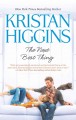
Kristan Higgins is a New York Times and USA Today best selling author and two-time winner of the Romance Writers of America RITA Award.   She’s a Connecticut girl, living in Durham.  She is married to a firefighter(who also happens to be a fantastic cook) and has two children, a cat and a dog.  In addition to being an award winning author, she is an award winning baker.  Previously a copywriter, Kristan took her lifelong love of romance novels and began writing when her kids were little and napping.  Her stories are infused with humor, focused on relationships and her characters are just regular, everyday people.

Her latest book is The Pefect Match.  Honor Holland has just been unceremoniously rejected by her lifelong crush. And now—a mere three weeks later—Mr. Perfect is engaged to her best friend. But resilient, reliable Honor is going to pick herself up, dust herself off and get back out there.

Charming, handsome British professor Tom Barlow just wants to do right by his unofficial stepson, Charlie, but his visa is about to expire. Now Tom must either get a green card or leave the States—and leave Charlie behind.

In a moment of impulsiveness, Honor agrees to help Tom with a marriage of convenience—and make her ex jealous in the process. But juggling a fiancé, hiding out from her former best friend and managing her job at the family vineyard isn’t easy. And as sparks start to fly between Honor and Tom, they might discover that their pretend relationship is far too perfect to be anything but true love….

The Cheshire Library has a wonderful collection of Ms. Higgins’ books.  You can find them in our catalog.


Sharon Reads: The Naturals by Jennifer Lynn Barnes

The Naturals by Jennifer Lynn Barnes is a young adult novel. Cassie is seventeen and living with her father’s extended family. Her mother was a stage psychic, before being murdered. Thanks to her mother’s lessons Cassie excels at reading the body language and little details about the people around her. Cassie is approached by the FBI to join a special team of other teens with natural abilities. Joining the team would mean moving to Washington D.C. and helping to solve cold case files. Cassie cannot pass up the chance to solve her mother’s murder. However, no one on the team is quite what they seem and danger is close to home. Cassie and the unique team need to solve this case before one of them becomes the next victim.

The Naturals has just about everything you could want from a young adult novel. There is a cast of quirky and well fleshed out characters that still defy categorization, a mystery or two to solve, action scenes with life and death scenario, teenage ‘I do not fit in’ angst, and romance (a triangle of course). There are strong characters that while flawed hold true to their values and an ending that had resolution but still left me wanting more.  Cassie is an independent, caring, and strong character. She is willing to risk herself to help others, but does not take foolish risks. Michael is snarky and seems overconfident but seems to be wearing that personality as a mask to protect himself, he is naturally skilled at reading emotions. Dean, a profiler like Cassie, is the strong silent type who isolates himself and tries to control his temper. Lia is a vain, pretty teen who can tell when others are lying and the ability to lie to anyone. Sloane is a statistical genius and is more than a bit quirky. The team work with the FBI agents and are under the watchful eye of a caretaker while in the house. Of course, you throw this many teens in the house and there will be power struggles and romantic entanglements- however for the most part this is secondary to the set up of the plot and the mysteries that need solving. Cassie does spend a significant amount of time over-thinking everything, but that is part of being a sixteen year old girl.

The Naturals is at its heart a teen drama and a thriller. The danger is slow to evolve, and I was completely surprised by the final answer, even though I  had the ‘bad guy’ narrowed down to just three people by the time the full story was revealed. While readers might need to suspend their disbelief as they deal with the idea of people with the innate abilities or the idea of the FBI working with a teen of talented teens, others will just be able to shrug and move on.

The Naturals is a good start to a new series and I gave it four stars on Goodreads. I really enjoy Barnes’ writing style, and everything I loved about the characters in the Raised by Wolves series is here as well. Readers that like Cold Case, Criminal Minds, or any of the shows with a psychological look at crime solving will see something that they like in this series. I have not seen anything about the sequel to this book yet, but I will definitely be reading it when it is released.

This review was originally published on Sharon the Librarian.

Louise Reads: The Good House by Ann Leary

I happily dove into into The Good House. I’ve been a fan of Ann Leary (wife of comedian/actor Denis Leary) since her 2004 memoir, An Innocent, a Broad.  Her 2009 fiction debut, Outtakes From a Marriage, was equally enjoyable., and her blog, with peeks into her life with her family and menagerie of animals  in rural Connecticut, is a lot of fun to read. I am happy to report The Good House did not disappoint.

Leary’s second novel is told from the point of view of Hildy Good: 60-year-old realtor extraordinaire, alcoholic-in-denial, and lifelong resident of the quaint seaside town of Wendover, MA. Having lived more than half of my life on Massachusetts’ North Shore (where fictional Wendover is located), I was pleasantly surprised by how authentic the author’s portrayal of the area felt, the town is almost another character in the story.  As Wendover’s most successful businesswoman, Hildy knows how to work a room, bend the truth, and keep a secret. And there are secrets aplenty in Wendover. Soon, those secrets have Hildy drinking again (albeit alone, at home), and things spiral out of control from there.

As the novel progresses the story takes a dark turn, yet this book made me laugh out loud several times. Hildy’s voice has a dry wit that softens the sometimes difficult subject matter. Despite the fact that she gets less and less reliable as the novel progresses, Hildy can be quite a bit of fun (at first) when she’s off the wagon.  When she enlists a lonely newcomer in town as a covert drinking buddy, however, it sets off a series of events with dire consequences.

The Good House is a fantastic read, especially if you are partial to character-driven novels. The character portrayals in the book are so vivid you truly feel like you know this small town and its quirky but relatable inhabitants. Hildy is a fascinating, flawed character, and an interesting choice as narrator.  If you are an audiobook listener, I highly recommend the audio version read by Mary Beth Hurt – she was perfection as the voice of Hildy. On a related note, it’s been announced that The Good House is being adapted for the screen with Meryl Streep and Robert DeNiro set to star.  Not too shabby!

A recent review by The Examiner said of The Good House, “…humor meets harsh reality in this irreverent look at a non-recovering alcoholic navigating the murky waters of small-town Massachusetts. The Good House is a paragon of New England Fiction.” I would have to agree, it was wicked good – it gets 4 ½ out of 5 stars from me.

Susan reads: The Queen of Katwe

Wow – two books on chess in the same year?  Odd, yes, but this book fed my brain AND my sense of social welfare at the same time. In The Queen of Katwe, Phiona Mutesi is the poorest of the poor – poorer than the Indian children of Behind the Beautiful Forevers, poor as only the poor of war-torn Uganda can be, yet through her own uneducated analytical mind, she rises above everything as a sort of chess savant, traveling to Siberia to compete on a world level – at the age of 15, a girl who has never even seen a flush toilet, who does not even know when her birthday is.

Much of the book is taken up not with Phiona – how I wish more of the book focused on her, her thoughts, etc. – but with everyone around her, and just how the circumstances formed for her to shoot her star so incredibly high. Throughout, Phiona is a shadowy figure, almost a mentally disabled girl who for a few brief moments is able to see and understand clearly, and then is sent back down to the depths of her dull & hopeless life. Is it crueler to leave her mindless in the mud of the streets or to show her the glory of the rest of the world, and then send her back to nothing? I’m not sure. It’s a real “Flowers for Algernon” conundrum.

And I can’t help but wonder what the author could/did do for some of these people – you see them trying to teach chess with boards missing pieces, so crudely carved you can’t always tell a knight from a rook – did you buy them a few chess sets, when what to us is $10 and to them is a year’s salary? Did you donate so the club could continue to feed the starving children who come there to learn? I myself could not look upon such conditions without trying to help, but the author is silent as to how he himself was moved by the situation. A good book, an incredible story, but I wanted so much more, both for me and for Phiona.