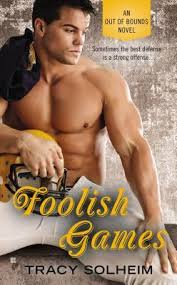
Linda Reads: Foolish Games by Tracy Solheim

foolishFoolish Games  is a wonderfully written sports romance.  The author gives us great insight into the NFL with a believable storyline and a wonderful cast of characters.  This is actually book two in the Out of Bounds series.  Book one is Game On. 

Bridal gown designer Julianne Marchione has an uncharacteristic one night stand at a client’s wedding that results in a surprise pregnancy.  Julianne plans to raise her son, Owen, on her own, until he is born with a life-threatening blood disorder that requires a transfusion—and Julianne is not a match.

Will “William the Conqueror” Connelly is an NFL star that grew up a bastard child born on the wrong side of the tracks.  He is blindsided with the news that he has a son that needs a blood transfusion from him.  He quickly takes charge of the situation, insisting on a marriage of convenience so his son will not have to endure growing up a bastard.

Will has a lot of insecurities stemming from his childhood and he is also dealing with a scandal involving his college coach that could bring an end to Will’s NFL career.  Julianne has had to sell her bridal design company to pay Owen’s medical bills and has lost her ability to design.  She is also struggling with issues from her past.  With so much conflict going on in their lives, they almost miss the fact that they are falling in love with each other.

The book is multilayered with a wonderful cast of supporting characters.  There is a secondary romance between Will’s mom and his boss that intertwines beautifully with the main story.

A realistic storyline told with passion, humor and wit with wonderful interaction between characters and how they grew to be a true family.

Jenn Reads: A Tale For the Time Being by Ruth Ozeki

I love Japanese history. I loved it so much I wrote my senior history thesis in college on the court culture during Lady Murasaki’s time (Lady Murasaki wrote the first ever novel, Tale of Genji in the 900’s).

I was pleased therefore when my friend selected A Tale For the Time Being by Ruth Ozeki as her pick for my girlfriend’s book club. A Tale For the Time Being takes place partially in Tokyo, with a 16 year old narrator named Nao and on a small island off British Columbia, with Ruth.

A Tale For the Time Being, by Ruth Ozeki

A Tale For the Time Being, by Ruth Ozeki

Ruth discovers while walking on the beach, a plastic bag filled a Hello Kitty lunchbox and other seemingly garbage-like items. Upon opening the bag, Ruth finds that these items are from Japan, and likely floated over after the 2011 tsunami. What ensues is a non-climatic story of Nao finding her place in the world, and Ruth figuring out if Nao was a victim of the tsunami.

There is a lot of word manipulation and double meaning in this book. For example, Nao’s name in English would be pronounced now. Time beings all happen in the now. It goes on and on like this, until you’re almost ready to scream at the book, “OK! I get it!”

It should be mentioned that this book was long-listed for the Booker Prize and is very literary. Perhaps almost too literary for the particular stage I was at in my life while reading this book. It should also be mentioned that everyone LOVES this book. I can’t say I loved it, but I didn’t hate it either.

Ozeki, a New Haven native, crams a lot into this book, which is over 400 pages. There is life in modern Tokyo, life on a small Canadian island, Zen buddhism, extreme bullying, Alzheimer’s, kamikaze, physics, time travel, philosophical theory… it just had too much. After a while there were so many issues and concurring themes I wanted to give up. There were several themes I thought could have been saved for another tale, another day.

There were times when I felt Ruth’s storyline was too personal. For me, it was a look into the real life of Ruth Ozeki, without this being an autobiography. Her husband, Oliver, is a secondary, but main character in Ruth’s narrative, and at times I wanted to cringe at the interactions between the two. It was almost a place for her to air her grievances, but not the right forum.

I did however love Nao’s narrative. Being almost the exact same age as her, I could relate to the pop culture references she referred to, and the difficulties of being a teenager in the 2000’s. Nao’s life was not easy, and she had no one, except her Zen Buddhist nun great-grandmother Jiko, who completely understood her. The scenes with Nao and Jiko are the best in the story- Nao is not judged by Jiko, who listens, provides guidance, and parental affection lacking in her life.

If this book had been just Nao’s story, or we found out what happened to Nao, which to me is the great mystery of the book, I would have rated it higher. I partially read and listened to this book, read by Ozeki herself. I enjoyed listening to her inflections and pronunciations, which can be difficult for those not acquainted with the Japanese language.

Rating: 3 stars out of 5

See you in the stacks,
Jenn

Susan Reads: The Year Without Summer: 1816 by William Klingaman

Think winter’s lasting too long?  Imagine 18 straight months of cold and snow.

I’ve always liked books on natural disasters, and exploding volcanoes are about the biggest you can get. They spawn earthquakes and tsunamis, send pyroclastic flows racing down hillsides to poison and bury entire towns (Pele, Vesuvius, Pinatubo), blow entire islands away (Thera, Krakatoa), appear overnight (Parícutin), or ooze for years (Kilauea). They can also create spectacular sunsets for months afterward, or, if they’re really determined and throw huge amounts of ash too high into the air, they can change the climate of the entire Earth in a matter of weeks. This is what happened in 1816, when Mount Tambora, a fiery grumbling volcano, blew up in Indonesia, with the largest volcanic eruption in recorded history. The Year Without Summer: 1816 tells how this single volcanic eruption in the tropics had far-reaching effects around the world.

Mount Tambora didn’t just explode, like Krakatoa. It blew like a fountain, throwing so much ash into the air that it blackened the sky for thousands of miles and created a cloud of dust that blocked out the sun. This just happened to occur while the sun was at its coolest point in its cycle anyway (the Maunder Minimum). The resulting cooling of the ground (a 7-degree difference) brought on dire climate changes (parts of New Hampshire didn’t receive a drop of rain for more than 3 months, while Switzerland experienced horrific flooding), wild swings in temperature (July temps would hit 95 one day and it would snow the next), but mostly an unrelenting cold that prevented seasonal changes and destroyed most crops as far south as the Carolinas. It created dire famines and unrest through most of the British Isles and western and central Europe that lasted through 1818, beginning a wave of immigration that helped spread America westward.

Klingaman explores in great detail the effects of the climate change on political structures  in America and Europe, from the election politics of young America to disruptions in France, England, and Ireland. He spends a great deal of time discussing the travels of  Lord Byron, Percy Bysse Shelley, and Mary Wollstonecraft Shelley through Europe and Switzerland, who all wrote oodles of letters fretting about the weather. The darkness and seclusion caused by the weather gave rise to Mary Shelley’s famous masterpiece, Frankenstein.

Myself, I did not care for the book. Unlike Winchester’s Krakatoa, Klingaman barely discusses the volcano; it’s a cause for the book, not a main character, more like a shadowy villain behind the scenes. Instead, most of the book is about the American and European political fallout because of the climate change. I understand most of the voluminous information comes from primary sources, and because it’s 1816 there is a lot of relevant written information of the time, but I picked up the book wanting to read about a volcano. If you like history and politics, or biographies of Mary Shelley, you might enjoy the book.  If you’re looking for stories of volcanic glory and the birth and death of islands, go read Krakatoa.

Sharon Reads: The Abominables by Eva Ibbotson

The Abominables by Eva Ibbotson is a children’s chapter book. This is a previously unpublished work from a well known author, following a family of yetis who are forced to leave their home in the Himalayas and make their way across Europe to a possible new home. Siblings Con and Ellen shepherd the yetis along their eventful journey, with the help of Perry, a good-natured truck driver. Through a mountain rescue in the Alps and a bullfight in Spain, the yetis at last find their way to an ancestral estate in England—only to come upon a club of voracious hunters who have set their sights on the most exotic prey of all: the Abominable Snowmen.

The Abominables is a fun story full of crazy incidents that keep the reader turning pages. As a child, Abigail is stolen from her father’s tent while on an expedition. Her kidnapper means no harm, only needs some help raising his young adominables. This introduction to the world of the adominables brings readers to a place where what most consider imaginary monsters, to be very much like man. Abigail teaches the adominables that she lives with to read, speak, and have good manners. When tourism threatens their home, Abigail sends her ‘family’ to her original home in search of safety. The journey is much more exciting than the travelers were prepared for. Just think about a long trip in the back of a truck with four adominables and a very confused yak. The illustrations scattered throughout the book from Fiona Robinson add a level of humor and aid the imagination perfectly, without overwhelming the reader.

I would highly recommend The Abominables to readers that are fans of the late, great Eva Ibbotson. Readers that enjoy animal stories, humor, and adventure will greatly enjoy the story. I am a little unsure on my age recommendations as I think readers around 8 and older would be my best guess. However, there is quite a bit about animal rights and cruelty so some of the youngest set might be upset by. However, (spoiler) every character gets their happy ending so that might be enough to make the mild upset worth the big happy that is sure to follow. I gave this book 4 stars on Goodreads.

Jenn Reads: Dark Places by Gillian Flynn

Hey there old friends. Been a while.

Sorry for leaving you for so long, but I’ve been caught up in DVD land for quite some time now, with little time to write a proper post. And I really haven’t read anything worth writing a review for, until the past week, when I’ve finished two books in a row. Yay me!

I must be one of the ten people in the reading world who has not yet read Gone Girl by Gillian Flynn. I like to keep those super popular, everyone-and-their-grandmother-has-read-it-right-now books until the popularity has worn off. Since Gone Girl is still going strong, I’ll hold off.

However, Dark Places fell into my lap due to the mystery book club I belong to. Our youngest member selected it as her choice for January, and I was finally introduced into the twisted and weird world of Gillian Flynn.

I’ll start off right away by saying that I give this book 3.5 stars out of 5. It had the potential for 4 stars, but there were several serious flaws. I listened to DP,

Dark Places, by Gillian Flynn

Dark Places, by Gillian Flynn

which was masterfully read by a full cast, with voices for Libby Day, Patty Day, and Ben Day, it was easy to breeze through this book.

A brief premise: Libby Day is now in her early 30’s, but as a seven year old, her mother and two older sisters, Michelle and Debbie, were allegedly murdered by her 15 year old brother, Ben. Libby’s life is a mess- she’s never worked a day in her life and has no money left. Libby herself is a mess- she’s rude, snapping, surly, angry, and just nasty. She would never be your best friend, or a bridesmaid at your wedding.

Libby receives a letter from a college-aged guy named Lyle, requesting her to appear at a group he belongs to. The group is called The Kill Club, and they are intent on proving that Ben did not kill Patty and her two daughters. If that isn’t weird enough, they agree to pay Libby to talk with people from her past who may know more about the story and who was the actual murderer.

The story flashes between present day (2009) Libby and 1985 Patty and Ben, and the events that occurred that fateful January day. As the story progresses, it becomes clear that Ben is not the killer- but who is?

That to me, was the biggest flaw of the book. I’m not one of those mystery readers who sets out from the very beginning to figure out whodunnit. I’d rather take the journey along with the main character and discover with them who the culprit is. Unfortunately, from almost the very beginning, I had figured out who the killer was.

And that was a big bummer.

This is not a book for those who do not like reading books with violence against children, violence, unpleasant circumstances, or those who are easily scared. DP is a dirty, filthy, foul book, with a scenario that could happen in real life. I wasn’t bothered by the violence or foulness of this book, but rather by the lack of depth in the main character, Libby. Only after her life is threatened again (spoiler!) does she finally start to grow as an adult, and the potential to move out of the dark places is opened.

Rating: 3.5 stars out of 5

See you in the stacks,

Jenn

PS- DP is being made into a film, starring Charlize Theron as Libby Day.