Today’s post is by our sci-fi-guy, Harold Kramer.
 Mars, our nearest planetary neighbor, has always fascinated science fiction writers here on planet earth. Science fiction about Mars began with Jules Verne and his 1865 novel From Earth to the Moon. This novel, like many others by Verne, was accurate in concept, although technology in his day made many of his ideas impossible to execute.
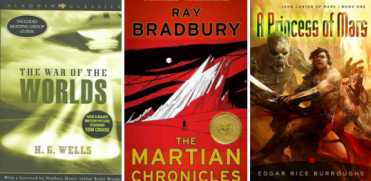
During the first half of the 20th century, science fiction writers were obsessed with Martians. Belligerent Martians invaded earth in H. G. Wells’ novel The War of the Worlds. Orson Welles’s 1938 radio broadcast of War of the Worlds even caused a nationwide panic. Written in 1950, The Martian Chronicles, a collection of strange and haunting short stories by Ray Bradbury were about an expedition to the red planet. Another early Mars novel was A Princess of Mars by Edgar Rice Burroughs who was a master of fast-moving adventure stories, whether in the jungle with Tarzan or on the moon with the Princess. I have recently re-read some of these early science fiction novels and, while definitely not scientifically accurate, they still are good reads.
 Beginning in the 1970s, the first NASA and Russian probes and rovers obtained real scientific data about Mars. Once sci fi writers realized that there were no little green men on Mars, science fiction tackled more realistic Martian topics and focused on the challenges of human colonization on the red planet. A major sci fi theme was terraforming Mars to make it into a self-sustaining environment that was fit for life that developed on earth. Another major theme was what type of society and governmental structure might exist in a Mars colony.
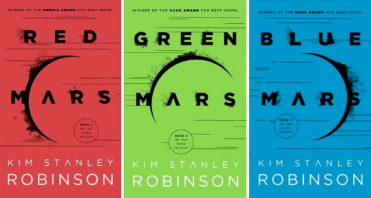
One of the first works that explored these ideas was The Mars Trilogy by Kim Stanley Robinson. This series consists of three books: Red Mars, Green Mars, and Blue Mars. Red Mars won the Nebula Award for Best Novel in 1993. Blue Mars won the 1997 Hugo Award. The trilogy begins with Red Mars when the first colonists arrive on Mars and simply try to survive. Green Mars and Blue Mars and continue the story one hundred years in the future when Mars has been terraformed into a green and politically independent world. My favorite of the three is the first book, Red Mars.
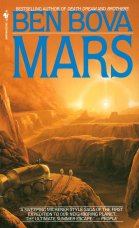 Ben Bova has written four related novels about Mars: Mars, Return to Mars, Mars Inc. and Mars Life. The planet Mars is the fourth stop on his Grand Tour – a series of related novels that take place in the 21st Century and that focus on exploration and colonization of every planet in our solar system. I enjoy reading Ben Bova’s books because of his clear writing, scientific imagination, and expansive ideas.
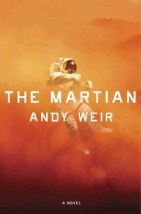 The Martian by Andy Weir, written in 2011, is my favorite book about Mars. I couldn’t put it down once I started reading it. It won the Goodreads Choice Award for Best Science Fiction in 2014 and the Audie Award in 2015 for best science fiction audio book. The Martian is a modern-day Robinson Crusoe story about an American astronaut who is presumed dead but who is actually alive and stranded on Mars. What makes it so interesting is that the technology is highly credible, and the writing is taut. It was made into a movie in 2015 that was directed by Ridley Scott and starred Matt Damon.
Many other great science fiction novelists have written about Mars. These include Greg Bear’s Moving Mars and Arthur C. Clarke’s The Sands of Mars. Also notable are Larry Niven’s Rainbow Mars and Robert Heinlein’s classic, Stranger in a Strange Land.
Although this is a science-fiction blog post, I would like to mention a non-fiction book about Mars and planetary exploration and colonization. It is called The Future of Humanity: Terraforming Mars, Interstellar Travel, Immortality, and our Destiny Beyond Earth, by physicist Michio Kaku. This scientifically based work is an extraordinary projection of the future of humanity as it moves from earth to the stars.
 The first Earth Day was celebrated on April 22, 1970, with the intention of bringing awareness to environmental issues. The first Earth Day events drew millions of participants across the U.S. and around the world. This was the scene in New York City. Since 1970, celebrations have grown, with Earth Day becoming a global event in 1990.
 The library is a vital place for citizens to become educated and informed about environmental issues, from fracking, to plastic bags and straws, to carbon emissions, so that that they may approach their elected representatives with their concerns. The environmental impact of plastic straws is a topic that has been in the news a lot recently: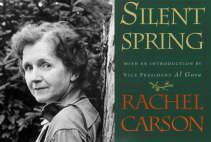







 2. Check out Open Library and Librivox.

 If you’re like me, you’re cringing every time you turn on the news, ope
 ure, Clinton’s affair caused a major row, but flings among presidents are almost as common as presidents eating cheeseburgers. John F. Kennedy’s affairs were kept out of the press, but half the country was winking at his activities.
 America in 1893 was caught in a severe Panic – the pre-1930 name for a Depression. Cleveland felt that a president with a potentially life-threatening issu
 Men of power get to the top position by wielding their power, and the office of the president is no different (I suppose we could let Jimmy Carter off the hook. He’s an anomaly to the rule, and no doubt why he was a somewhat wishy-washy President and often considered not strong enough during the
  In our 24/7 society, life moves pretty fast. You meant to stop by the library on your way into work, or perhaps on your way home, but…
 The Cheshire Library Blog