November is NaNo Month!

It’s NaNoWriMo season again!

NaNoWriMo is National Novel Writing Month, run by a non-profit group aiming to help young, new, and aspiring writers to find their voice and learn to hone the craft of writing. It began in 1999, with a challenge to write 50,000 words in the month of November. Hundreds of thousands of writers participate each year. Once you sign up and log in, your progress is tracked in real-time, and you can reach goals and earn reward stickers.

Hundreds of thousands of people will try and may actually succeed in completing the challenge, but does it really get you anywhere?  Mmm, depends on how good you are. Water for Elephants began its first draft as a NaNoWriMo project. It was picked up, sold more than four million copies, and in 2011 became a major motion picture. So yeah, dreams do happen.

I must make this perfectly clear: Dreams do happen, after LOTS AND LOTS OF EDITING. Please don’t send your finished first draft to any non-family member to read. Poor editing will kill your chances before you even think of your book cover. Edit, edit, edit. If you can’t pay for a professional editor, then check out some books and learn to do it yourself.

But have no fear!  Cheshire Public Library can help you with that as well. Join us once a month for Cat Tales, an open group for writers of anything, beginner to published, playing with a rough idea or finished draft in hand. Talk about the ins and outs, the how-tos, editing, publishing, development, and more. Read us something you’d like feedback on, or maybe try a writing prompt.  Subject doesn’t matter – Memoir, non-fiction, fiction, romance, science fiction, action-thriller, young adult (Who doesn’t love Hunger Games?) – we can talk about them all. Learn how to take that NaNoWriMo novel and beat it into shape.

Cat Tales has been meeting virtually during the pandemic, but will be returning to in-person meetings this winter. Check the calendar for the next meeting!

Bundle Up With a Good Book

Do you like certain types of books – stories about dogs, or maybe vacations in Italy? Perhaps you like adventure stories, or space opera, or a good forensic mystery, but don’t know what to read next.  Do you like binge-reading a good series? 

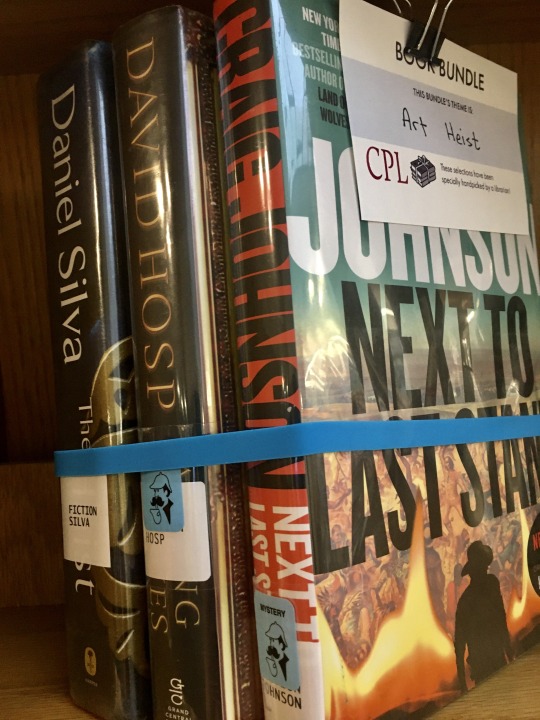
Have you noticed the case of bound books in the middle of the lobby?

Take a closer look at our Book Bundles.

Book bundles are three books of a common theme bound together, so you can binge-read on a topic you enjoy. It might be outdoors, kidnappings, or WWII stories. It could be autism, award winners, westerns, Book Club Favorites, art heists, robots, or gothic horror. There’s always something new on the shelf, so check it frequently. Intrigued by a category? Check out the bundle and explore!

But not all of the titles seem interesting to me – what if I only want to check out one or two?

You can check out one or all three, whatever you’d like. Just return the unwanted ones to the desk and we’ll find them new partners. 

Don’t see anything to your liking? Prefer existentialist graphic novels? Right now you’re only reading novels that have cats in them? Trying to catch up on real-life medical stories? Let us know! We’d be happy to take requests!

There’s nothing like finding a good book, and it’s even better when you find three new favorites at once. A whole new world of reading adventures awaits!

The Long and Short of It

Music and its forms have always been in a state of flux. While operas often dragged for hours, recording them, when the means became available, was a different problem. When temperamental wax cylinders gave way to 78 rpm shellac discs, you had 5 minutes of music before you ran out of groove and had to turn it over.  Post-WWII, when brittle shellac gave way to more forgiving vinyl, record speed dropped to 33 rounds per minute, allowing up to 22 minutes per side on a 12” “long-playing” record (or LP, for short.). When the 45 rpm single – cheaper to produce, cheaper to purchase – became standard, music averaged 3-5 minutes a side.

If you wanted to get airplay on a radio, music had to be submitted on a 45, thus most popular songs were limited to around 3 minutes in length (Hence Billy Joel’s line from The Entertainer: “If you’re gonna have a hit, you gotta make it fit, so they cut it down to 3:05”). Albums could play for as long as 20 minutes a song on each side. Jump up to CD, and you can now go to 100 minutes. Streaming? The only limit is your tolerance.

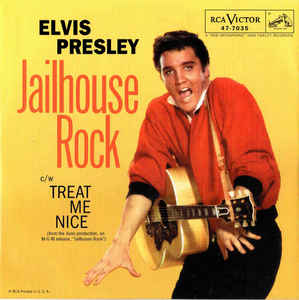
So what’s the long and short of it? What are the longest and shortest songs on the road to success? The 50’s and 60’s, with the advent of transistor radios to make music portable, saw an explosion of short catchy tunes, meaning more could be crammed onto the radio, which meant more airtime, more commercials, and thus more money all around. Elvis consistently comes in under two minutes (Let Me be Your Teddy Bear1:43, Are You Lonesome Tonight, 1:25) as do the early Beatles ( From Me to You, 1:56, Please Please Me, 1:59), Summer Time Blues by Eddie Cochrane (1:58), and Hit the Road, Jack by Ray Charles (1:58).  

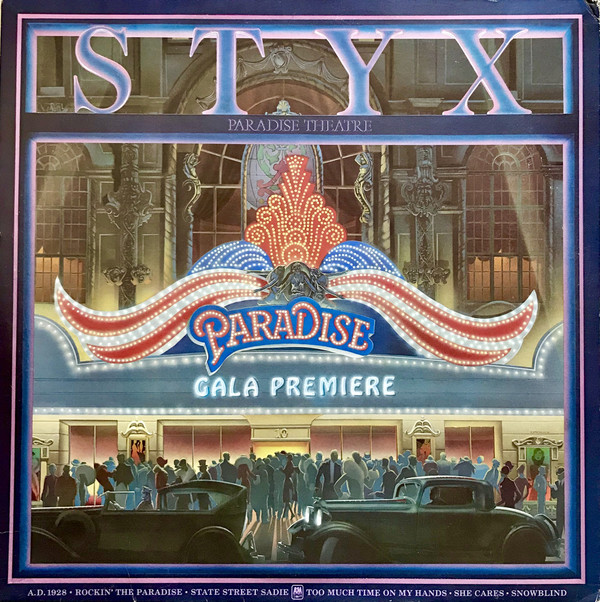
Albums play around more – If you’ve got 18 minutes of music, but can squeeze one more short track in, you fill it. Styx’s legendary Paradise Theater album has 3 blink-and-they’re-over tracks (AD 1928, 1:07, State Street Sadie – a flash at 33 seconds, and AD 1958, 1:06). Pink Floyd, who loves to drag out a tune, logs in at 1:25 with Pigs on the Wing, a beautiful melody on the Animals album. Frankie Goes to Hollywood’s legendary Welcome to the Pleasuredome album clocks in two blips – Snatch of Fury, at 36 seconds, and The World is my Oyster, which is 1:02, perhaps 45 seconds longer than the track needs to be. 


But just how long can you carry a tune? Well, outside of perhaps an opera or symphony (Beethoven’s 9th is about 70 minutes long). American Pie takes up both sides of a 45 at 8 minutes 32 seconds, and Hey Jude clocks in at 7:11, perhaps the longest singles on 45s. But when you hit albums and their longer tracks, if you count all nine parts of Pink Floyd’s ethereal “Shine On You Crazy Diamond” from the album Wish You Were Here, it totals 26:01, the longest segment being over 13 minutes. You could add Rush’s 2112, at 20:33, Yes’s Close to the Edge at 18:30, or the legendary In a Gadda da Vida by Iron Butterfly at 17:05 – three songs that can carry you clear across the state.  Meatloaf’s I’d Do Anything For Love (But I Won’t Do That) made it to Number One on the Charts with a time of more than 12 minutes, so length does not affect popularity at all. 

With the pandemic, streaming of music and even live concerts has increased in popularity. While the current trend is to make shorter songs for the attention-short listener, it will be interesting to see in the next five years or so if, freed from the limits of physical media, musicians will increase the length of their songs or not. Genres are losing their hold as streaming crosses boundaries (ie, Jimmy Buffett gets mixed with a lot of country), 24-bit audio capacity has lead to quieter music (less digital noise on soft tracks and streaming services even out loud tracks anyway), music labels are losing importance as musicians self-release songs, and songs are even breaking up their ages-old format and frequently starting with the chorus instead of a verse. We might cringe at the pace of the changes, but in the end, for the musicophile, it’s a wonderful time for variety and a widening range of music.

My Favorite Android: The Murderbot Diaries

The first use of the word “robot” dates back to the 1920’s (robotnik or similar being a term for factory worker in many slavic languages), but the word “android,” meaning a miniature human-like automaton, is older, as far as 1863. A robot – a disembodied piece of machinery – does work for you – like a Roomba, or the useless rolling pest in the grocery store that spies on people who might steal things (at least Roomba can clean up a mess it finds, and doesn’t cost $35,000). An android looks like a human, moves like a human, interacts like a human (more or less), but inside is a machine.

That fact has led to a huge amount of introspection – how do we define Human? Is a self-aware, English-communicating Gorilla a person? What about our AI creations? When a computer becomes self-aware, does it have a soul? Is it “human”? At that point, is the use and ownership of an android slavery?  That question was battled in the Star Trek: The Next Generation episode “Measure of a Man,” where Starfleet claimed to own Data the android and control him like equipment, while the case was made he was sentient and free. The movie(s) Blade Runner also focused on that question. 

I’m not a techie. Computers are great if they do what I need,  but I couldn’t care less about future tech, AI interfaces, androids, or streaming. Anyone who knows any science fiction knows you never trust AI or give it too much power. I like Data, I don’t love Data. C3PO is annoying. I hated Marvin the Paranoid Android. No matter how many times I watch Blade Runner, I think it’s one of the most boring movies ever (I still love The Six Million Dollar Man, but he was a bionic human, not android). So I was really, really surprised that I even picked up the book All Systems Red by Martha Wells, also known as The Murderbot Diaries #1. Not my kind of book. But from the first page, I could not put the book down. I read it while cooking. I read it while my kids were in the tub. I read it while walking. I had to finish it in one day. Thankfully, it’s a short novella, and that’s entirely possible.

Murderbot, as it calls itself (it has no gender. Murderbots are not built for sex; that’s a sexbot), is a Security Unit (SecUnit), a partly organic robot/android construct built to provide security detail for whoever rents or buys it. Of course, mostly what security entails is killing whatever might harm the persons it’s hired to protect, hence the term Murderbot. Murderbot, however, manages to hack its own governor module, releasing itself from control by the company who owns it. 

This starts Murderbot on a soul-searching (or soul-developing?) quest to find out exactly who or what it is now, all while working hard not to let anyone realize it’s free, because an uncontrolled killing machine is a very, very dangerous thing (to quote Kyle Reese from Terminator, “That terminator is out there, it can’t be bargained with, it can’t be reasoned with, it doesn’t feel pity or remorse or fear, and it absolutely will not stop… EVER, until you are dead!”).  But Murderbot isn’t fond of killing. He’s fond of soap operas and TV serials (like The Rise and Fall of Sanctuary Moon). All he wants is to be left undisturbed to watch his shows while he tries to figure out the human race. Life never lets him, and he feels obligated (like the heroes in the soaps he watches) to help while trying to solve the mystery of who is trying to kill the people he was hired to protect.

Murderbot is sarcastic, droll, funny, depressed, almost autistic in his stilted approach to emotion and interaction with people. He’s a fast thinker and an opportunist. He says s**t a lot more than Data. He doesn’t want to be human, yet is fascinated by them and can’t stop studying them. And he makes mistakes, just like a human. The innovative – and logical – adaption/hijacking of computer systems has opened my eyes to issues I’ve never given a thought to, such as the power of drones. With all the issues currently happening via ransomware, spying, and breaches, and the mass-market and miniaturization of drones, maybe we should be thinking more along the lines of Murderbot, as our military is also controlled by computers, and nothing but nothing is hack-proof. People mistrusted the NYPD robodog so much they had to send it back.

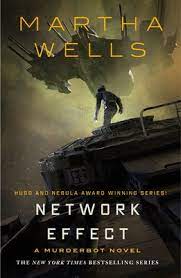
I had to read the second book Artificial Condition (possibly my favorite, because of ART, Murderbot’s name for the “A*****e Research Transport” ship computer), whipped through the third, Rogue Protocol , flew through the fourth Exit Strategy, (also possibly my favorite), and am now reading the fifth, Network Effect. The sixth and current volume is Fugitive Telemetry, with three more commissioned by the publisher, and a TV version is in the works (please, please don’t mess it up!). All Systems Red has won the Nebula Award, the Hugo Award, the Alex Award, and the Locus Award. Yes, the stories are simple (good guy must take down bad guy) but the humanity and humanism throughout the series will keep you emotionally invested to the very end. 

Pure enjoyment, with no other agenda. Murderbot is my favorite android ever. 


9/11 – Twenty Years Later

There are several points in US history that are “fixed points,” dates and events which become so embedded in the minds and hearts of the people that they become part of our universal consciousness, whether or not we experienced them ourselves. July 4, 1776, the signing of the Declaration of Independence. April 15, 1865, Abraham Lincoln is assassinated. December 7, 1941, the Bombing of Pearl Harbor, “The Day That Will Live in Infamy.” November 22, 1963, the assassination of President John F. Kennedy.

And September 11, 2001, known simply as 9/11, when foreign nationals who had trained here in America, who bypassed airline “security,” hijacked four American jetliners and crashed them into the Twin Towers in New York City, the Pentagon in Washington, DC, and a field in Pennsylvania. The entire world stopped. On that day 2,983 Americans died, including 343 Firemen, 60 police officers, and 8 medical personnel – not counting the people who died from breathing in all the toxins released from the burning rubble. If you remember the day, you remember exactly where you were when you heard about it. People stayed glued to their TVs for days, hoping beyond hope that someone had survived the horror. So many people knew someone, or had ties to someone, who died that day. A friend of mine at Morgan Stanley by chance happened to be sent to a meeting at a different office that morning. Every one of his coworkers died. My husband’s cousin was just blocks away on her way to work when it hit, and wound up having to evacuate her apartment.

This year is the 20th anniversary of 9/11, a somber day for reflection. An entire generation has now grown up in a post-9/11 world, knowing the date as something only in a history book, no emotional ties to the day at all. Millions of New Yorkers are new to the city, with no experience of the unity the catastrophe created. Perhaps this is the most important memorial yet. 

The 9/11 Memorial and Museum at 180 Greenwich St. in New York City will be holding a ceremony for the families of the victims on that day. There will be six moments of silence, one for each of the tragedies that happened. Churches are encouraged to toll bells. The ceremony is private, but the museum will be open to the public from 1 pm until midnight. At sundown, the annual tribute in lights will commence. 

9/11 is a day that is going to be with us for a very long time, whether you remember it or not, whether you had any connection to it or not, whether you care about it or not. It’s still hanging over us, a Damoclean Sword we cannot take our eyes from. 

To honor the date, Cheshire Public Library invites you to share your 9/11 memories through our 9/11 Reflections project. As we approach the anniversary date, we are compiling the stories of local residents – where they were, what they remember, how they were affected that day. You can click on the link here, or pick up a paper form at the library. Select stories and photos will be displayed on our website on September 10. The deadline for submissions is September 3.

Be considerate about the date, even if you feel it doesn’t affect you. Hold that moment of silence, if not for the past, but for the future, that we – or anyone else – won’t have to suffer such an attack again. 

To learn more, check out some of these books and films:

Inside 9/11

Fahrenheit 9/11

In Memoriam: NYC 9/11/01

Zero Dark Thirty

The Only Plane in the Sky

Fall and Rise: The Story of 9/11

The 11th Day

The Looming Tower

Kill Bin Laden

A Nation Challenged