Getting Cult-ured

We’ve all heard the term, “It’s a cult classic,” “It’s a cult film,” but what actually is a cult film? For one thing, it has zero to do with charismatic leaders or brainwashing. Cult films can be weird, but some are wildly popular.

While the definition itself is elusive, and films can theoretically lose their cult status if they become mainstream, there are several factors that help define which films can fall in that category. For one, it has to bomb at the box office. This doesn’t mean it was a bad film – Donnie Darko did lousy because the film revolved around a plane crash, and it was released just weeks after 9/11, and all the advertisers pulled out. The Princess Bride became a wildly popular film that did poorly in the theaters, mostly because the studio didn’t know how to market it – kid flick, or adult? Love story, fantasy, or comedy? With no marketing, it didn’t fare well.

A second common requirement is the movie has to be unconventional. It’s not something that will appeal to everyone. Quentin Tarantino films are widely lauded, but Pulp Fiction and Reservoir Dogs aren’t for everyone. Neither are David Lynch films. I love Eraserhead, but it’s a bizarre, trippy, nightmarish film of a man trapped in a dystopian Philadelphia, caring for his grotesquely deformed infant. It is not going to be a runaway hit. Lynch’s TV series Twin Peaks falls in this category, too.

A third is a wildly loyal fan base, who not only quote the film but can often recite most of the dialogue. Many films, of course, fall in this category, but don’t meet the other criteria. Thousands of people are rabid Star Wars fans, or Wizard of Oz fans, or Casablanca fans, but those are mainstream films that appeal to the masses. Fight Club can fall in here. Also Jim Henson’s Labyrinth and The Big Lebowski.

Some claim a cult film must be subversive – this opens the door to a host of horror (Human Centipede, Nosferatu), exploitation (Freaks), pornography, over the top documentaries (like Reefer Madness), and more, but that’s not always the case. Traditionally, cult films gained their popularity from midnight movie showings. Now thanks to streaming, any film on the internet can become a cult film.

Other films fall into the campy, grade-B (or -C) genre films under the guise of “It’s so bad, it’s good.”  Jane Fonda’s Barbarella can fall under here. Attack of the Killer Tomatoes was written specifically that way. Also Attack of the 50-foot Woman, Forbidden Planet, and Plan 9 From Outer Space – a movie credited with being the worst motion picture of all time. You have to laugh at how bad it really is.

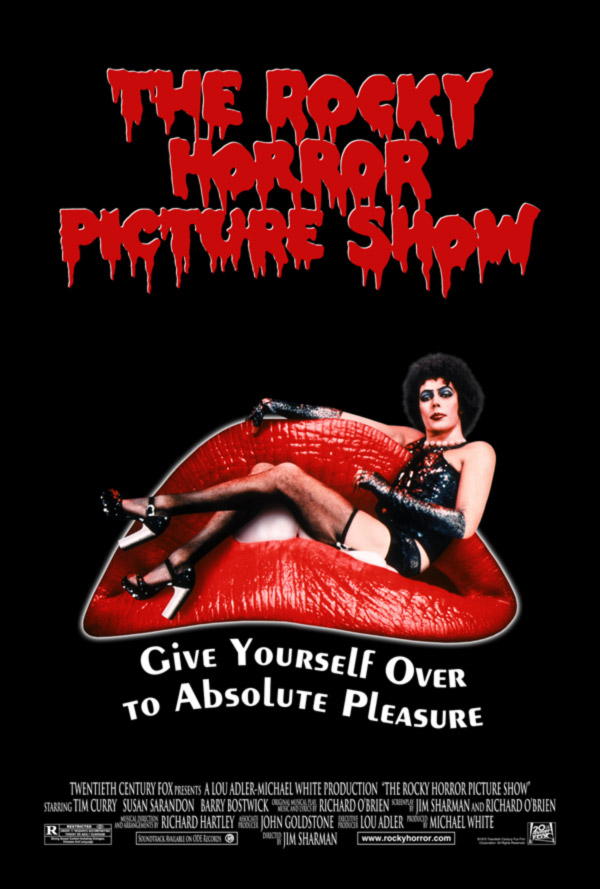
The Granddaddy of all “Cult” films, of course, is Rocky Horror Picture Show. It checks every box – subversive (open sexuality!), midnight showings, camp (Tim Curry vamping it up in leather and lace), a guilty pleasure, definitely not mainstream, and a rabidly loyal fan base who can sing and quote the entire movie from memory, while throwing toast and raising umbrellas depending on the scene. It’s a great, if strange, film with a fabulous soundtrack, but not family friendly. It struggled in theaters initially, but Rocky Horror is currently the seventh highest grossing rock film when adjusted for inflation, and at 49 years old, it is the oldest continuously released movie in history – you can still find it playing in a theater somewhere. It now on the National Registry of films as culturally important.

So much for non-mainstream and subversive.

TV shows can be cult as well.  The original Star Trek would qualify – a show with such poor ratings it was cancelled after two seasons, only to have a huge outcry from a fanbase that got it renewed for a third season … and then a mega-empire of movies and TV series. Firefly too – a show of only 14 episodes with a fan base so active it spawned a motion picture (Serenity) – as are Buffy the Vampire Slayer, Lost, Arrested Development, South Park, and The Simpsons. While both South Park and The Simpsons were wildly popular, they’ve been in production for 26 and 36 seasons, respectively, which puts them into cult status.

You probably already love a “cult” film, but give some of these a try and see if you agree!

Eraserhead

The Man Who Fell to Earth

Plan 9 from Outer Space

Princess Bride

Barbarella

Big Lebowski

Big Trouble in Little China

Boondock Saints

Brazil

A Clockwork Orange

Elephant Man

Escape from NY

(TV) Firefly

Freaks

Harold & Maude

Kill Bill

Labyrinth

Monty Python and the Holy Grail

Napoleon Dynamite

Night of the Living Dead

Pulp Fiction

Reservoir Dogs

Rocky Horror Picture Show

This is Spinal Tap

Tommy

Kung Fu/ martial arts films such as Enter the Dragon

Hocus Pocus

Mondegreens

Say What?

We’ve all been there, singing along with Elton John on the radio:

“Hold me closer, Tony Danza. Count the head lice on the highwaaaayyyy….”

Right?

But the song is Tiny Dancer, and they count the head lights on the highway.

Mishearing lyrics is as common as listening to music – and popular music is full of garbled lyrics open to guesswork. Does anyone really know (or understand) Springsteen’s (or Manfred Mann’s cover) Blinded by the Light? For years I swore Dolly Parton said Jolene had Ivorish skin and eyes of Bilbo green. Made no sense, but try as I might, that’s what I heard. Other people swear The Beatles are singing about the girl with colitis going by, Creedence Clearwater Revival wails about being “Stuck with an old diaper pin,” or “There’s a bathroom on the right.”

Mishearing lyrics like that is called a Mondegreen, a term coined by Sylvia Wright in 1954, when she insisted the lyrics to “The Bonnie Earl o’ Moray” were not “laid him on the green” but “Lady Mondegreen.” If you continue to insist your misheard lyrics are correct, even when given the correct ones, it’s called a mumpsimus (in case you needed a new word today). Of course, sometimes the misheard lyrics are just more fun to sing (such as headlice on the highway), and you sing it that way anyway.

Mondegreens aren’t limited to modern music. One of the more common ones is hearing “Gladly the cross-eyed bear” for the line “Gladly the cross I’d bear” in the hymn Keep Thou My Way. Mondegreens are made by our own brains by substituting things that make more sense to us, whether by word or experience. If you don’t know the actual word, your brain substitutes one it already knows that is similar. If you’ve got no experience with something, you might automatically substitute something you do know: the folksong Golden Vanity talks about the lowland, lowland sea, but if you’re from Appalachia, and have no idea what a lowland sea is, the words became lonesome sea. Thankfully more of us are familiar with head lights than head lice.

Some mondegreens were so popular and universal that the bands themselves started singing them that way. ELO’s Don’t Bring Me Down is almost universally sung as “Don’t bring me down. Bruce!” but the word was originally groose, which was a nonsense placeholder word during the writing that was liked so much, it was left in the final song. Eventually they, too, sang it as bruce. Jimi Hendrix and John Fogerty also embraced and sang their own mondegreens.

Mondegreens bleed over into books – Vivian Walsh’s book, Olive, the Other Reindeer plays on misheard lyrics of Rudolph the Red Nosed Reindeer, and A Monk Swimming by Malachy McCourt is taken from the misheard prayer line, amongst women. The Lonely Planet travel guides are taken from the misheard lyric lovely planet from Joe Cocker’s rendition of “Space Captain.” Ed McBain has a mystery novel, Gladly the Cross-Eyed Bear.

Here are some of the more common mondegreens in modern music. Check out the songs, and listen for yourself. Can you hear both versions? What are some lyrics you mishear all the time?

Purple Haze, Jimmy Hendrix: I want to kiss this guy, is really, I want to kiss the sky.

Lodi, Creedence Clearwater Revival: Stuck with an old diaper pin for Stuck in Lodi again.

Bad Moon Rising, Creedence Clearwater Revival: There’s a bathroom on the right/ There’s a bad moon on the rise.

Lucy in the Sky with Diamonds, The Beatles: A girl with colitis goes by/ A girl with kaleidoscope eyes.

Stairway to Heaven, Led Zeppelin: And there’s a wino down the road/ And as we wind on down the road.

Blinded by the Light, Bruce Springsteen: Wrapped up like a douche with a Corona in the night/ Wrapped up like a deuce, another runner in the night.

Higher Love, Steve Winwood: Bake me a pie of love/ Bring me a higher love.

Dancing Queen, ABBA: See that girl, watch her scream, kicking the dancing queen.
/See that girl, watch that scene, digging the dancing queen.

Joy to the World, Three Dog Night:  Joy to the visions that the people see/ Joy to the fishes in the deep blue sea.

The Sidewinder Sleeps Tonite, R.E.M.:  Calling Jamaica/ Call me when you try to wake her (Wait – it’s NOT Jamaica?)

Smells Like Teen Spirit, Nirvana: Here we are now, in containers/ Here we are now, entertain us

Blank Space, Taylor Swift: Got a lot of Starbucks lovers/Got a long list of ex-lovers

THIS is a deuce coupe, running in the night

Save Your Memories

In December of 1983, we didn’t have internet. We barely had personal computers – a 256k machine cost $500, and you had to program it yourself. You couldn’t just save to disk, you had to format the darned thing before you could even use it. Video tape machines cost $600, and DVDs were still a dream. We were on the cusp of the CD player, but the real world still ran on cassette tapes. 

I was no different, with a cassette tape built into my stereo, eagerly recording songs and programs off the radio as they played live. Yes, we still listened to live radio programs back then, whether Casey Kasem’s American Top 40 Countdown, or Radio Mystery Theater, or, on Sunday nights, Dr. Demento, the leading program for off the wall parody and novelty music.

What’s novelty music? Novelty music is a humorous song that doesn’t fit in any other category but entertainment. You know it well. Alvin and the Chipmunks is novelty music. Barnes and Barnes’ Fish Heads. The Purple People Eater. The Monster Mash. Itsy Bitsy Teeny Weeny Yellow Polka Dot Bikini. Steve Martin’s King Tut. Anything by Tom Lehrer or Weird Al Yankovic. While it’s a serious industry with all the requirements of mainstream music, and such songs can hit high on the pop charts (The Monster Mash hit #1), novelty music isn’t considered “serious” music. 

On that Sunday, it was the Christmas edition of Dr. Demento, and I threw a cassette in the player and hit record, because, back then, Grandma Got Run Over by A Reindeer was just a basement tape on Dr. Demento, it hadn’t gotten a contract yet. Weird Al wasn’t mainstream, and hadn’t gotten permission from the Kinks yet to record his Lola parody Yoda. On that tape, I happened, by luck, to record a song that in the history of radio may only have been played one time. It was a “bonus” track to fill space, and it was the only time it ever appeared on Dr. Demento. It hasn’t even been uploaded to his website. And it is one of my absolute favorites of underground tapes. In the era of the cold war, that song scared the living daylights out of me.

Cylent Night, by the Scrooge Brothers, tells a short story of the start of World War 3 to the tune of Silent Night, while air raid sirens start in the background and grow slowly louder. Off went the bomb at a quarter to three/ It’s the end of you and the end of me….  Have that hit you out of nowhere when you’re listening to the radio at 10 at night in your basement. In 40 years, I’ve never forgotten a line. And I just happen to have that song on tape. 

But cassette tapes are fragile things. They demagnetize. They fade. They tangle. My very rare basement tape has been bouncing around drawers and basements for 40 years. So what did I do? With the equipment at the Cheshire Public Library AV Studio, I very easily threw that cassette into the player and transferred that song to digital Media. Now I can store it digitally, share it with other Dementoids and Dementites who have never heard it (if you didn’t hear it live, you truly never heard it), even send it back to Dr. Demento. 

We all have those things kicking around our homes. Media changes so rapidly, from reel to reel tapes to 8 Track to cassette to CD to memory stick. We all have Grandma’s vacation slides of the Old Country, with relatives no one ever met. Dad’s wedding videos. That old LP you have that’s never been released on CD (or singles, like Rolf Harris’s Two Buffalos, which Bob Steele used to play on WTIC-AM). Your personal video of MTV’s top 100 countdown of 1985, when music videos were short stories of their own. You can transfer all of them to digital media, right here.

Beware, though – transfers occur in real-time. If you’re planning on transferring that 12-hour MTV countdown, it’s going to take 12 hours to put it onto digital. You might want to do it over a few weeks. But that LP? 40 minutes, you’ll be done.

Call (203) 272-2245 ext. 61245 to schedule an appointment at the AV Studio!

Movie Magic

When we talk about the powerhouses of music, we think of The Beatles or Michael Jackson or Reba MacIntyre or Beyonce, among others. People who have multiple-decade careers, whose very touch seems to turn to gold, who sell records just walking down the street. Everyone knows their name.

So if I said, Guess which musician has won four Oscars, four Golden Globes, seven BAFTAs (the British equivalent of the Oscar), 25 Grammys, was Knighted by Queen Elizabeth even though he was born in Queens, and has had 52 Oscar nominations – second only to Walt Disney, who would you pick?  Someone with a net worth of between $300 million and $50 billion, depending on how many assets you count?

Would you believe it’s composer John Williams?

Williams, who is 91 and still going strong, has a Master’s touch when it comes to composing music, and he’s written more film and television music than you realize. An alumni of the prestigious Juilliard School, Williams’ career has spanned more than six decades, and he’s written the scores for everything from the pilot of Gilligan’s Island and Lost in Space  to Schindler’s List (his fifth Oscar for score).  Although he didn’t write the music or win the Oscars, Williams played piano for the score for Bernstein’s West Side Story. His scoring of Jerry Bock’s music for the film adaption of Fiddler on the Roof won him his first Oscar. That iconic Jaws DA-dunt, DA-dunt that scared everyone from the water, won him his second. Spielberg then recommended him to his buddy George Lucas, who needed a composer for the movie he was working on. Star Wars became Williams’s third Oscar, a soundtrack among the most widely recognized music in history, and remains the highest grossing non-popular music of all time (interactive fun fact: you can dance the Macarena perfectly to Darth Vader’s theme music. Go ahead. Try it.). Williams went back to Spielberg for his fourth Oscar – the soundtrack to E.T.  Harry Potter? Yep, Williams wrote that. Superman? Home Alone? Jurassic Park? The Post? Sometimes, it seems as if a movie is destined for greatness if Williams writes the score.

March is Oscar month, and this year John Williams is the oldest Oscar nominee for the score to Spielberg’s The Fabelmans. So cheer for Williams on March 12, and in the meantime, check out one of his dozens of utterly amazing scores on the following films:

The BFG / Star Wars / Raiders of the Lost Ark / Schindler’s List / ET / Jaws / Harry Potter and the Sorceror’s Stone /

Superman / Jurassic Park / Saving Private Ryan / Towering Inferno / Close Encounters / Hook / JFK /

Memoirs of a Geisha / Minority Report


Learn a Little, Live a Little

Do love learning? Do you dream of taking college classes, but the cost and the time is too much? Are you taking a high school or college class and struggling to understand the material?  Did you cut your cable, and can’t find anything decent to watch anymore?

Fear not! The Great Courses are here!

Cheshire Public Library has always had a handful of these delightful media, but through a generous donation, we’ve been able to greatly expand our holdings to more than 70 titles.

What are the Great Courses?  Professional college-level lectures on audiobook or DVD on a variety of topics, given by actual college professors and experts (like Neil DeGrasse Tyson!), that will give you the equivalent of an entire college class in the comfort of your car or living room. Some come with study guides and questions to think about, but you will never have a test or a grade at the end!

The Great Courses was the brainchild of Thomas M. Rollins, the former Chief Counsel of the US Senate Committee on Labor and Human Resources (1985-89). Inspired by a 10-hour video lecture series he watched as a student at Harvard Law, he set about creating his own video series under the business label The Teaching Company. He recruited professors to record lectures on topics people were interested in learning about. Because the lectures were chosen by customers, they caught on quickly. There are currently more than 900 lectures available in a wide variety of topics. Some are short – four hours – while others (like the Civil War) can run to 14 discs.

Great Courses are expensive – that Civil War set is more than $500 to purchase yourself, but in 2016 the company began a $20/month streaming service, and then in 2021 rebranded itself under the name Wondrium. Wondrium not only offers more than 280 of the Great Courses, but also content from Magellan TV, Craftsy, and Kino Lorber, which carries art films, documentaries, world cinema, and classic films (silent films like Metropolis, Charlie Chaplin, and more).

If you don’t feel like yet another subscription to a streaming service, check out the library’s offerings downstairs in the adult department. We have more than 30 titles on DVD, and more than 35 on audiobook for learning on the go. As Fat Albert used to say, “If you’re not careful, you may learn something!”

Did you know that if you’ve already studied the material, you can often exempt a college class? It’s called the CLEP program – College Level Examination Program.  Basically, if you can pass the exit exam for a class, you can get college credit for that class. Not every school offers it, not every class is covered, but if a Great Courses lecture can help, you can save several hundred dollars!

Check out these great titles and more!

Some of our Audiobook titles:

Ancient Greek Civilization

Beethoven’s Sonatas

Books that Have Made History

Broadway Musicals

The New Testament

Italian Renaissance

Native People of North America

Rise and Fall of the British Empire

Some of our DVD titles:

The American Civil War

Einstein’s Relativity

Monet to Van Gogh

When Rome Ruled

Photography

The Louvre

Geology

Human Language

The Vikings