Susan Reads: Room 1219

One of the fun things about reading non-fiction is you learn things about subjects you never knew anything about. Such is what happened when I picked up Room 1219: The Life of Fatty Arbuckle, the Mysterious Death of Virginia Rappe, and the Scandal That Changed Hollywood by Greg Merritt.

I am not a silent-movie fan; my tolerance for old films extends to occasional forays into Marx Brothers comedies, so I knew nothing about Fatty (Roscoe) Arbuckle but his name, and a vague notion he’d committed a crime. I discovered a story that could have easily been ripped from today’s headlines, perhaps with far more scandal but as much unfounded public shredding of a popular figure as happens today.

Roscoe Arbuckle was one of the biggest names and biggest money-makers in the silent films of the early industry (1913-1921). He earned the equivalent of millions when the average worker made a thousand dollars a year. His persona was of a sweet, bumbling round man and his movies full of slapstick gags and stunts that made people laugh, and his box-office receipts were consistently high. His enduring and close relationship with Buster Keaton didn’t hurt. He was charitable with his time and money, showing up unannounced for appearances, in parades with his custom-built cars (in an era where a car cost $800, Arbuckle’s cost $34,000), and was fond of children (he had none of his own). He was cinematic royalty.

Until 1921. Arbuckle, estranged for several years from his wife, was on vacation in San Francisco with several lackeys. An impromptu party erupted, including Prohibition-illegal alcohol and several second-rate actresses, friends of friends. At some point during the party, Virginia Rappe (pronounced Rappay), disappeared into Arbuckle’s bedroom and was struck ill, so ill she died in agony several days later. Autopsy results showed a ruptured urinary bladder.

Wild rumors erupted about what Arbuckle did, most of which revolved around bizarre sexual tactics involving icicles and Coke 208338_413443485386136_805008784_nbottles, none of which were physically possible based on the autopsy, and spoken lines worthy of the worst film noire. What was known for fact was that Rappe had a long history of bladder infections and gonorrhea, in a time before antibiotics had been discovered. Arbuckle was arrested for murder. The country erupted in scandal, and Arbuckle, right or wrong, was immediately deemed guilty of extreme perversion and his movies banned in every theater in the country.

It took three trials to finally win an acquittal, but the damage was done. A star was destroyed, and Arbuckle was banned from films for several years. He never regained his royalty status. Out of the ashes rose an effort to censor movies, lest they corrupt the morals of the country. While a huge backlash rose in the industry against it, eventually we did wind up with the current rating system (G, PG, R, etc) to warn viewers what they might expect, a direct result of his scandal.

Roscoe Arbuckle was tried and found guilty in the court of uninformed and vindictive public opinion and died a heartbroken, and most likely innocent, man. A hundred years later, are we any smarter and more forgiving?

Cast in Bronze – No Ordinary Ring a Ding


Everyone’s heard bells before, but have you ever heard a carillon? A carillon is a set of at least twenty-three bells in a belfry, which can be played singly or in concert with each other to make harmonies and chords. Carillons are played like a giant keyboard, with both hands and feet pressing on levers that pull wires that ring the bells. Because of their great size, carillons are considered the heaviest of all musical instruments (one low bell alone can weigh several hundred pounds!).

No one, of course, would ever think of traveling with an entire bell tower to give a concert – or, uh, would they? Enter the musical group Cast in Bronze, who do exactly that on the first carillon with a portable frame. Cast in Bronze’s carillon consists of thirty-five brass bells, with a total weight of four tons. Founded by master carillonneur Frank DellaPenna, Cast in Bronze actually tours around the country. They have played at Disney’s Epcot center, played a concert in New York for Pope John Paul II, played as part of Alice Cooper’s “Christmas Pudding” show, and played for NBC’s Today Show. I saw the bells in action myself at the New York State Renaissance Festival in Tuxedo, New York, several years ago. As a college bellringer who spent three years throwing levers in a tower, adapting music by Elvis and Journey to an octave of bells, I was enchanted.

Before you can say “Ho hum – ding, dong, ding, who cares,” Cast in Bronze is not just a churchbell ringing. The bells are just a highlight, with full orchestration and in some cases (like their fabulous rendition of O Fortuna, the same song currently on the Nutella commercial), with the backing of a choir as well. Here’s an excellent sample of their music, along with a great video of the bells in action:

Wait – what’s with the mask, you ask? DellaPenna’s philosophy is that the bellringer was never seen in the tower; all you knew was the beauty of the music, so he remains hidden beneath his phoenix mask, to draw your attention to the music, not the player.


Cheshire Public Library recently purchased two albums by Cast in Bronze – Best Day Ever, and The Voyage. My favorites to check out are of course “Tubular Bells,” the fabulous “O Fortuna,” and the ever-lovely “Carol of the Bells.” If you like music by Trans-Siberian Orchestra, David Garrett, 2 Cellos, any of the London Philharmonic playing Pink Floyd, Jethro Tull or similar pop-rock, if you like light instrumentals, bells, or even piano music, give Cast in Bronze a listen!


Susan Reads: Nothing to Envy

Rarely have I come across a book so haunting.

If you Google Earth for North Korea at night, you will see South Korea as brightly lit as a coast of the US. Above it is a greatC0044096-Korea_at_night,_satellite_image-SPL big blackness. This is North Korea. It is not black because they block out satellites, or by treaty.
It’s because there is no electricity.

In an entire country.

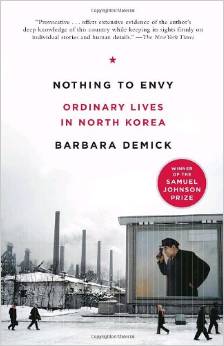
Author Barbara Dimick’s book, Nothing to Envy: Ordinary Lives in North Korea won the 2010 Samuel Booker prize, with good reason. Dimick has seen the “official” places of North Korea, but moreso spent years tracking down people who managed to escape the deadly iron fist of North Korea and interviewing them extensively. She follows several families, some of them die-hard party loyalists, through their unwavering patriotism, their questioning, their suffering, to their desperate do or die escape.

indexDimick traces some of the history, from World War II, when things started to go flaky, through the Korean conflict, when things got really wacky, to the insane tyranny of Kim Jong Il, and now Kim Jong Un. North Korea, until the 1960’s, actually had a better standard of living than South Korea, but began to fall apart in the 70’s. But, unlike Russian Communism, instead of saving itself, North Korea became even more hard-nosed, more dictatorial, more insane. By the 90’s, there were no jobs, no wages, no food, no manufacturing. People began starving to death in great masses, with children so stunted by malnutrition they barely topped 4’7” as adults. Trees died, because people stripped the bark to eat.  As many as three million people died, and there were many reports of cannibalism.

Imagine a place where radios and televisions are set by the government to one single official channel. Where the government doles out the very food you are allowed to eat, and the quantity, and the clothes you wear. Where everything is in black and white except the propaganda posters, which are in red, the only color people can look to with cheer. Where every home must display a photo of the dictator, and clean it daily with a special cloth, where the picture can be inspected at any time and you can be sent to the Gulag for disrespect. North Koreans are so isolated, so indoctrinated, so starved, so cowed, that they are not only  utterly brainwashed against the outside world, but cannot imagine what the outside world is like. After three generations of this, they’ve never known anything else.

Perhaps the saddest, most poignant moment is when the once-loyal mother makes a desperate swim across the river into China,article-north-korea-hunger crawls to the first house she sees, starved, frozen, exhausted, desperate, pushes open the garden gate, and discovers a bowl of meat and rice and  vegetables set outside waiting for her, and she is utterly amazed, not having seen meat or even rice in months. Then the family’s dog comes around the corner of the house, and the woman realizes that in China, even dogs eat better than North Koreans.

Read this. Really, read this book. It’s short. It will painlessly explain so much of the insanity, the politics, the danger that is North Korea, and will help you separate the Korean government from the Korean people, who have as much control over their situation as an ant has over an elephant. You will not forget it.

DVD vs. Blu-ray

Is there really a difference between Blu-ray and regular DVDs, or is it all just a marketing ploy to get you to buy something else, a planned obsolescence that will cost you money for nothing?

Yes and no. It depends on how much you love technology, and how clear you want your movies. Permit me a little technobabble:
burn-cds-dvds-hive   DVDs came out around 1997. They encode data in microscopic bands that are 650 nanometers wide (for comparison, a strand of DNA is 2.5 nanometers wide). Each disc holds about 8 gigabytes of information, which translates out to about three hours of movie time at a resolution of 480 pixels – pixels being a measurement of visual detail. DVDs are read with a red laser. They’ve been out long enough that they are very cheap to manufacture and purchase.

Blu-rays came out around 2006 after a battle with High Definition video format (remember the battle of Betamax?). Blu-rays are read with a blue gallium nitride laser (hence the blue ray). A Blu-ray reads from a band that is only 405 nanometers wide, which means it holds more data – up to 50 gigabytes, or, depending on how it is bluraycoded, between 5 and 23 hours of video on one disc! The resolution, or clarity of picture, on a Blu-ray is 1080 pixels, which means, if you’re watching a blu-ray on a large screen and have good cables connecting the box to your TV, the picture is so clear you start to see the grains of makeup powder on the actors’ faces, or the lines of the edges of the contacts in their eyes. The downside of Blu-rays (other than cost)? They take longer to boot up than a conventional DVD, because they have all that extra data. Blu-ray players can read regular DVDs, but those regular red DVD lasers cannot read blu-rays, so if you do choose to upgrade to a blu-ray player (which can now be bought for as little as $30), your old DVD collection isn’t in any danger.

So how do you like your movies? If you’re a casual watcher who just wants to say “Yes, I saw that,” then carry on with your regular player. DVDs are still very much in the market and aren’t going anywhere very fast. If you live and breathe your movies, nitpick them scene by scene for trivia or like a freeze-frame that’s clear enough to hang on a wall, you may prefer Blu-ray. My husband himself thought it was all hype until he watched Star Wars in Blu-ray, and suddenly saw things he never noticed before. The larger your TV screen, the larger the difference in clarity you will notice with Blu-ray, because of the increased resolution. The picture won’t look like you want to adjust the antenna.

Yes, Blu-ray will be the standard of the future, but it’s not going to happen overnight. Cheshire Library currently purchases as many new releases in both formats (standard DVD and Blu-ray) as the budget will allow. No matter which type of disc player you have, you should be able to find plenty to check out at CPL!

Search our video collection here.

Eye on the Spy: Happy Birthday, Ian Fleming

Ian Fleming

Ian Fleming

Happy birthday to Ian Fleming, born May 28, 1908!

*
Fleming is the author behind the James Bond series of thrillers, but did you know he also wrote the children’s classic Chitty Chitty Bang Bang? He also wrote several non-fiction books, some of which, like The Diamond Smugglers, arose from his background research for his stories, in this case, Diamonds are Forever.

*
Fleming was not necessarily the inspiration for James Bond, but he had more than enough experience to rely on for creating his character. Educated not only at English prep schools but in Munich and Geneva as well, he was pulled into the British Naval Intelligence during World War II. He worked on several secret missions – including one code-named Operation Goldeneye, the name he would give to his home in Jamaica.

**
Fleming’s 1950’s, post-war design of Bond was to have a dull, every-man character that events seemed to the-10-highest-grossing-james-bond-films-of-all-timehappen to. He stole the name James Bond from the author of an ornithology manual he owned, a name he thought was as dull and plain and ordinary as could be. It wasn’t even until the second film that he began to give Bond a nationality and sense of humor. His books have had mixed reviews over the years, yet sold more than 30 million copies before his death. Two were published posthumously – Man With the Golden Gun and Octopussy and the Living Daylights. He ranks number fourteen on the list of “50 Greatest British Authors since 1945.” Fleming was a notoriously heavy smoker and drinker, and died of a heart attack at age 56.

Although he wrote only twelve novels and 10 short stories, his stories have inspired more than 23 major films spanning fifty years. Their total adjusted gross is more than $10 billion, placing them behind only the Harry Potter series as most profitable film series in history. Fleming, however, left little family to benefit from his fortune. He had a daughter who died at birth, and his son Caspar, for whom he wrote Chitty Chitty Bang Bang (also a classic film), died in 1975 at the age of 23. His widow, Ann, died in 1981.


For a dull, middle-aged nobody, James Bond continues to entertain us for more than 50 years, 25 films, and 7 actors and inspire generations of authors and fans. In addition to his original novels and films, there are several licensed tie-in series, such as Charlie Higson’s “Young Bond” children’s novels.

Who is your favorite Bond?

50-years-of-james-bond250px-Young_Bond_2012_Covers