Do any of these things sound familiar?
- Someone falsely accuses you or one of your coworkers of making errors
- You have been subjected to stares, glares and other nonverbal intimidation tactics
- Someone at work refuses to speak to you
- A coworker exhibits a wide-range of mood swings, including yelling and throwing tantrums
- A coworker thinks the rules don’t apply to him
- Someone at work is harshly and constantly criticizing you, disregarding any satisfactory or exemplary work you do
If you have witnessed or been subjected to any of these behaviors, then you have a bully in your workplace.
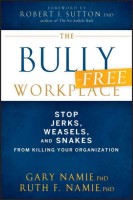 According to Gary and Ruth Namie, authors of The Bully-Free Workplace, bullying in the workplace is fairly common. Nearly half of all Americans have either witnessed bullying at work or been the target of a workplace bully.
The big question, the Namies assert, is not why bullying happens (the reasons are many) but what can be done about it. And the answer is fairly simple: There must be consequences for those who are bullies.
Turning the other cheek does not work. Mediation does not work. Anger management does not work. These traditional methods of dealing with workplace conflict are not effective because bullies thrive on exploiting any perceived weaknesses in their targets.
Walking away makes the bully think you fear him. Forcing a target of bullying to sit across the table from his tormentor in a mediation session gives the bully power because he is usually able to make it seem that the target is the problem. The target is portrayed by the bully as being too sensitive, or incompetent, or having no sense of humor. The mediation is actually a reward for the bully, who gets to portray his target as weak before their supervisors. And anger management presupposes that the bully is likely and able to change his behaviors, something not borne out by numerous studies on the subject.
So, what can you do? The authors of the Bully-Free Workplace suggest:
If you are an employee:
- Confront the bully the very first time he attempts to target you. To quote the Namies, “To turn one’s back to walk away to fight another day proves very costly for targets.” Waking away is perceived by bullies as weakness, making them go after you all the more.
- Don’t be an enabler. This means if you witness a coworker being bullied, either speak up or take the target by the arm saying, “I need to speak with you” and then lead them away from the bully.
- Report the bullying, whether you are the target or the witness.
- Stop rumors. Rumors about other employees are a form of bullying. If you hear them, tell the gossiper you don’t want to listen to negative talk. If you are spreading rumors, even if you are not the bully, you are enabling the bully. Shut up. Seriously.
If you are a manager:
- Be willing to recognize bullying. Bullies often present their best faces to management. They agree with you, they praise you, they “always have your back.” Thus, when managers hear complaints, they cannot associate the talk with the picture they have of the accused bully. Take a step back and assess the situation as objectively as possible.
- If you hear a report of bullying, investigate with the assumption that the report is true. This is especially important if the bully is in management. Studies show that other managers are usually reluctant to believe one of their upper-level coworkers is a bully, since, as noted above, the bully will often not show that side of his nature to equals or superiors in the workplace hierarchy.
- Intervene when you see bullying or hear about it. An intervention from management will often stop a bully in his tracks.
- Create an explicit policy against bullying because policies are enforceable and vague values statements are not.
And, oh yes… Warning signs that YOU are the bully:
- In meetings, you are rarely ever challenged.
- The final decision, even after getting input from others, is yours because it is more expedient.
- Others do not understand or appreciate your management/teamwork style.
- If a decision you made was a failure it was because you received incomplete or inaccurate information from someone else.
- It takes a special type of person to work with you. Your staff changes often. Coworkers seem reluctant to work with you.
- You believe fear motivates staff to optimal performance.
- You believe leaders must demonstrate resolute certainty and unwavering principles.
- You are surprised when other staff do not have the same high standards you have.
In addition to The Bully-Free Workplace, there are several other titles that can help you deal with workplace bullies:
 The no asshole rule : building a civilized workplace and surviving one that isn’t / Robert I. Sutton, PhD.
A gem. I may write another post just about this book.
 Bullies : from the playground to the boardroom : strategies for survival / Jane Middelton-Moz, Mary Lee Zawadski
Follows bullying from childhood through adulthood and analyzes what works and what doesn’t when dealing with a bully.
 Bullies, tyrants, and impossible people : how to beat them without joining them / Ronald M. Shapiro & Mark A. Jankowski with James Dale.
A 4-point plan, called the NICE method (neutralize, identify, control, explore) for dealing with bullies.
 The bully at work : what you can do to stop the hurt and reclaim your dignity on the job / Gary Namie and Ruth Namie
The prequel to The Bully-Free Workplace.
 Overcoming mobbing : a recovery guide for workplace aggression and bullying / Maureen Duffy, Len Sperry
Discusses the difference between mobbing ( when individuals, groups, or organizations target a person for ridicule, humiliation, and removal from the workplace) and bullying.
 The Paradox of Choice: Why More is Less by Barry Schwartz
 The Organized Mind: Thinking Straight in an Age of Information Overload by Daniel J. Levitin
 Blur: How to Know What’s True in the Age of Information Overload by Bill Kovach and Tom Rosenstiel
 Mindful Tech: How to Bring Balance to Our Digital Lives by David M. Levy
 The Distraction Addiction: Getting the Information You Need and the Communication You Want, without Enraging Your Family, Annoying Your Colleagues, and Destroying Your Soul by Alex Soojung-Kim Pang









 Okay, let’s get something straight right at the beginning. This is not a blog post about how to store your stuff more efficiently. This is all about having less stuff. That’s right, it’s about throwing stuff away.


 The Cheshire Library Blog