How to Fold Your Clothes

I’ve been folding my clothes wrong all my life.

I discovered this when I began exploring minimalism. Minimalism is the idea that less is more. Owning fewer things makes your life easier. However, minimalism is not about getting rid of everything. Part of the concept of minimalism is putting things away properly.

Let’s take clothing as an example. When clothes are folded correctly, they take up less space. A simple concept, but I didn’t believe it until I saw it.

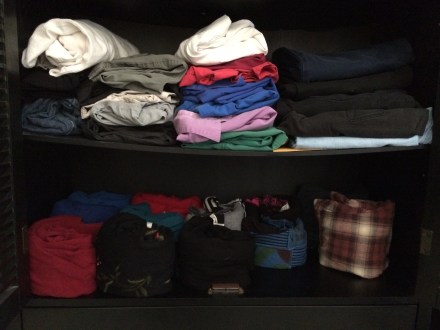
Here’s a before picture of my dresser. A pretty typical dresser, I’d like to think.

2016-01-24 11.37.47


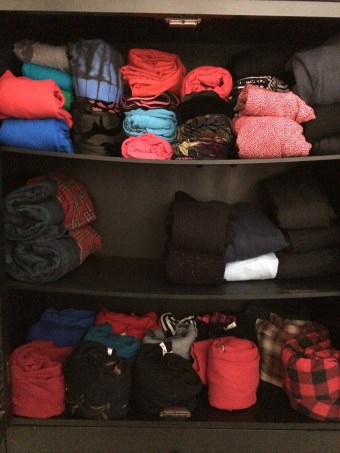
Now here is what one shelf looked like once I changed how I folded my clothes. Just look at that bottom shelf compared to the one above it.

2016-01-24 11.38.07


I was startled by how much less room my clothing took up. I emptied the dresser and refolded everything. This was the end result. (Yes, I have a little too much on that poor top shelf!)

2016-01-24 12.30.01


I did not discard one single item. In fact, I ADDED a few things that had been hanging in my closet.

Here’s how it works: Lay your clothes flat and fold them length-wise, twice. Then either fold or roll them so that they can be stored on end. The only exception I made was the pants, which I found hard to make stay folded and standing on end, so I stacked them. They still take up less space than they did before. I simply folded them length-wise as instructed and then folded them in half and then in half again.

I discovered this method of folding while reading The Life-Changing Magic of Tidying Up by Marie Kondo, where you can read a more detailed explanation of this method of folding. Kondo’s folding method is also detailed in her newly released Spark Joy.

Jacket.aspx            Jacket.aspx1

Draw A Bird Day

Last year the Cheshire Library celebrated Draw a Bird Day by having staff make their own bird drawings. This post appeared a few weeks later, describing the experience and the significance of Draw a Bird Day. Here it is again, for those who wish to know the story behind Draw a Bird Day.
__________________________________________________
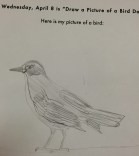
2015-04-09 18.27.16In 1943, Dorie Cooper was a 7 year old living in England. Her mother took her to a hospital to visit her uncle who was wounded in the war. While they were there, Dorie’s uncle was very distraught, having lost his right leg to a land mine. In an attempt to cheer him up, she asked him “Draw a bird for me, please.” Even though he was unwell, he decided to do as Dorie asked. He looked out his window and drew a picture of a robin.

On April 7, 2015 the director of the Cheshire Library put a piece of paper into everyone’s mailbox. The page was blank except for one sentence across the top: Wednesday, April 8th is “Draw a Picture of a Bird Day” followed by the line: Here is my picture of a 2015-04-09 18.25.46bird.2015-04-09 18.25.57
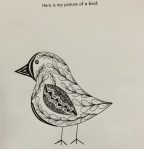
What fun, I thought and took my paper home to plan a drawing for the next day. On April 8th when I arrived at work, several staff had created bird drawings. There were all types from simple line drawings to colorful sketches. Owls, doves, robins, swans, and hummingbirds found their way onto the wall of our staff room.

After seeing her uncle’s bird picture, Dorie laughed out loud and proclaimed that he was not a very good 2015-04-09 18.26.34artist, but that she would hang the picture in her room nonetheless. Her uncle’s spirits were lifted by his niece’s complete honesty and acceptance. Several other wounded soldiers also had their day brightened by the event and every time Dorie came to visit thereafter, they held drawing contests to see who could produce the best bird pictures. Within several months, the entire ward’s walls were decorated by bird drawings.
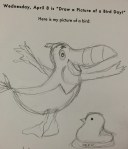
2015-04-09 18.26.12The next evening, as I was standing there looking at the pictures, I became curious about the source of Draw a Bird Day. So, I did some research and discovered the Draw a Bird Day website. I read with interest about Dorie and her uncle. And then came the third paragraph.

3 years later, Dorie was killed after being struck by a car. At her funeral, her coffin was filled with bird images that had been made by soldiers, nurses and doctors from the ward where her uncle had been. Ever since then, those men and women remembered the little girl who brought hope to the ward by drawing birds on her birthday, April 8th.
2015-04-09 18.26.25

I was stunned. Dorie, the girl who had loved bird drawings, died at age ten? That was not the way I was expecting the tale to end. And then I read a little further.

Draw a Bird Day was never declared an official holiday, but it grew through those soldiers and medical personnel and their families. Today, it is celebrated world wide as a way to express joy in the very simplest of things in life.

2015-04-09 18.26.07I went back into the staff room and looked at the bird drawings again. I had enjoyed making my drawing and viewing the drawings of my coworkers. It had lifted my spirits to make that picture and to see the creativity of the people I worked with. It had, in fact, the same effect that it had in that hospital ward all those years ago.
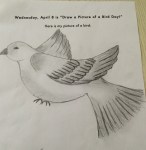
2015-04-07 16.45.35Seventy-two years after a little girl asked her uncle to draw her a bird, people all over the world are still drawing birds on her birthday. Still celebrating hope and happiness. Still celebrating joy in the simple. Still sharing the fun.

Would you like to learn how to draw a bird? Try these titles:

Drawing Birds     Colored Pencil     Laws guide

Book Recommendations from Beyond

No, this isn’t an April Fool’s joke.  New Books Alerts brought a surprise to my inbox recently.

Screen Shot 2016-03-02 at 9.37.31 AM


Did you catch it? Not the book itself, although I did rush out to the shelves to see if it was there. The review. It is 2016 and a New Book Alert showed up with a review by none other than the great (and very late)  Dorothy L. Sayers, author of the beloved Lord Peter Wimsey mysteries.

Jacket2      Jacket3      Jacket4     Jacket4

Now those who are not devotees of British crime fiction may never have heard of Miss Sayers, but to me her name was as eye-catching as a five-star review. She wrote the Lord Peter series between 1923-1937, twelve books in all. (If you are interested, author Jill Paton Walsh added four more titles to the series, bringing the Lord Peter tales to sixteen.)

JacketBy the way, the book, Death of an Airman by Christopher St. John Sprigg, was on the shelf, so now I have a new story to read, recommended by an author, long gone but yet, still very much here. And that is one of the things I love about books. Old friends, both authors and characters, never completely leave us.


Have You Thought about Being Mortal?

Have you thought about dying? It’s such a scary topic, fraught with so much emotion. We like to think we’ll always have more time ahead of us. But what happens when something–an illness, an accident, a disease–sets a limit on our time? What happens when we are forced to confront the end of our lives?

Jacket.aspxBeing Mortal: Medicine and What Matters in the End by Atul Gawande explores this issue, an issue that we all must inevitably face.

Many folks first confront mortality when dealing with their aging parents, but illness can strike at any time of life. Then we are forced to make decisions about treatments. About living wills. About how we want to live the remainder of our lives. We want to live longer at all costs and we’d do anything to achieve that goal, right? Perhaps not. As Doctor Gawande discovered in his research on aging and dying, what most people want is not necessarily a longer life, but a quality life.

Gawande, a practicing surgeon, notes that doctors are often committed to extending life at all costs. This can mean painful and expensive procedures, even for those for whom there is no cure. Gawande questions this rationale, while admitting he himself has often advised patients to pursue treatments that he knew would not extend their lives by more than a few months or year. However, patients, he came to realize, wanted procedures that would guarantee them ten or twenty more years of life.

But medicine often cannot deliver such outcomes. The exceptions, the people who do survive for years in spite of the odds, are just that–exceptions. Gawande equates it with winning the lottery. Everyone believes they will be lucky but very few actually are. Gawande also noted that, in the case of terminal illness, the trade-offs of pursuing treatment–time, money, pain, recovery–were often not worth the small extension of life to most people.

What the mortally ill or infirm person really wants is a meaningful life, even if there is only a few months left of that life. The terminally ill desire to retain independence and control, as much as they possibly can. They desire to stay in their homes. They want their loved ones around them. They fear prolonged and painful deaths. They fear bankrupting their families.

Gawande illustrates the importance of these issues with depictions of  traditional nursing homes, which place safety and monitoring of vitals above the fulfilling lives people need and want. He counterpoints these with illustrations of models of care that take patients out of hospitals and nursing homes for a variety of assisted living facilities and hospice services.

I was especially intrigued by his description of hospice, a service I had (erroneously) believed was only for the last few weeks of life. Hospice gives the aged and terminally ill choices. Hospice workers ask what your goals are. They ask you to think about what you want. They ask you what you don’t want. They talk about your fears. And they address every issue.

And that is the gift of this wonderfully written book. It makes you ask those questions, of yourself and perhaps of those around you. For someday you may be in a position to have to make choices for a loved one, or in the position of having a loved one making choices for you.

Giving Minimalism a Try

messydeskCan getting rid of stuff make you happy? Does paring down possessions lead to a higher quality of life? Do downsizing and minimalism really bring contentment?
Honestly, I have no idea. But I thought I would give it a try, and since it all begins with getting rid of stuff, I turned to the library shelves for some guidance on the subject.

It turns out downsizing, getting rid of clutter, and minimalism are hot topics nowadays. Ironically, there are hundreds of books and blogs all trying to help people learn how to live with less and love it. And, as they all claim, having too much, whether it is stuff or information, is not helpful. The number of titles was overwhelming, and I didn’t want to clutter up my life with them while I was trying to unclutter my life!

Since the underlying spirit of minimalism is quality, not quantity, I decided to see if I could come up with a short list of  titles that were interesting and genuinely helpful for anyone who truly wants to get started simplify and downsizing her life.  Listed below are the titles I found most helpful. I will also be reporting back on how my efforts go, so stay tuned!

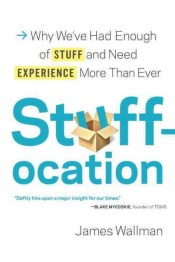
Wallman interviews anthropologists studying the clutter crisis, consults with scientists who have linked ‘stuffocation’ to rising cortisol levels and declining psychological well-being, and introduces the concept of choosing experience over stuff.  He examines the pluses and minuses of minimalism, voluntary simplicity, and materialism, giving a fair look at each concept. Useful for those who are wondering if they should give minimalism and simplicity a try.

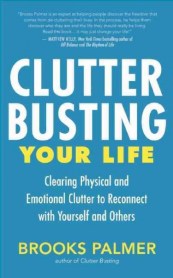
Jacket.aspx Clutter Busting your Life by Brooks Palmer.  In these pages, Palmer shows how we use clutter to protect ourselves, control others, and cling to the past, and how it keeps us from experiencing the joy of connection. With insight-prompting questions, exercises, and client examples, this book is a how-to, self-analytical spiritual journey. It will help you deal with clutter and the reasons behind all the clutter. For those wishing to remove both physical and emotional baggage.


From basement to bedroom, kitchen to car, and into every corner of life, Mellen’s system yields lasting results. Discover how to: Never lose your keys or wallet again, stop mail, magazine, and paper pileups for good, feel empowered to tackle bills and budgets, reclaim space and time once dominated by clutter. For those who love having a step-by-step plan of action.

This best-selling guide to decluttering your home from Japanese cleaning consultant Marie Kondo takes readers step-by-step through her revolutionary KonMari Method for simplifying, organizing, and storing.

And the ultimate space-saving sources of info: ebooks!
 

 E-Book 5 days to a clutter-free house : quick, easy ways to clear up your space by Sandra Felton and Marsha Sims.