 Barry Neil Kaufman’s son Raun was born in 1973, only to be diagnosed with severe autism by the age of one and a half. Refusing to believe the prognosis, the Kaufmans spent hours observing their son, and created their own special program for him long before anyone beyond Lovaas and Bettleheim were making any attempt to teach autistics. Three years later, their son showed no symptoms of autism, not even Aspergers. They named their program the Son-Rise Program, now taught at their foundation, the Autism Treatment Center of America in Sheffield, Mass. You can read their incredible story in Kaufman’s book Son-Rise, or the newer version, Son-Rise: The Miracle Continues, which includes the development of their foundation and follows Raun when he’s older. I warn you, however, the newer version gets a little heavy in the New-Agey/Hippie feel.
To prove that you didn’t need to start with an infant to get results, Kaufman also wrote up his work with a five-year old boy named Robertito, in the book A Miracle to Believe In. Again, Kaufman’s methods produced a child who came back from the depths of Autism to be a happy, intelligent, socially-adjusted verbal child.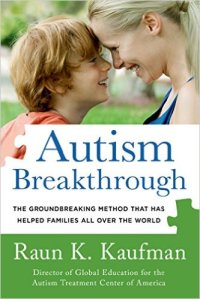
Now Raun Kaufman himself, the director of Global Outreach for the ATCA, has written Autism Breakthrough, a book that details the process the Son-Rise program uses, so you can try it yourself. The basis for the program goes against modern practices – and Kaufman’s explanations make very good sense. In short, autism is a disorder of social-relational behavior; if you can’t fix that, then all the educational training in the world isn’t going to help. The program focuses intensively on connecting with the child by entering their world, and then drawing them out into yours. Once you have social interaction and communication, then education can fall into place easily and logically.
While I am a Kaufman guru – I’ve used many of their methods with a number of “throwaway” kids and made connections like no one else – there are places we’ll have to agree to disagree. Diet is one of them. If your child’s autism is cured by diet, then chances are it wasn’t autism to start with. While organic diets are wholesome and ideal for everyone, I do not recommend “assuming” your child has a difficulty with a food just because someone said so. I do not recommend filling your child with probiotics or supplements unless a doctor has proven there is a serious deficiency. Too much of the wrong thing can be just as bad as a lack of something, and certain vitamins can be toxic in large doses. He doesn’t mention honest-to-goodness physical issues, such as brain disorders, genetic issues (such as Rett’s or Fragile X, often lumped with autism), or seizure disorders. While he does mention that you should not allow your child to do anything unsafe, he makes no attempt to give guidance to parents whose children are severely hyperactive, sleepless, or self-injurious. It’s wonderful, it works, but he glosses over the amount of time it takes to make the program work and have even the most minimal semblance of a life. His own “cure” took a team of people working almost around the clock for more than three years. Most people can’t do that.
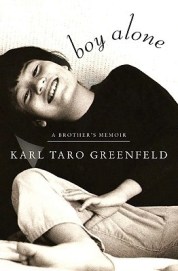
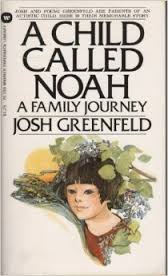
On the opposite side of the spectrum (no pun intended), hunt down A Child Called Noah, by Josh Greenfeld. Greenfeld’s son Noah was born in 1966, just a few years before Raun Kaufman. Noah was also born severely autistic, and his story is much more typical. His father, a screenwriter, documented their family struggles through three volumes, and the other year his brother, Karl Greenfeld, wrote Boy Alone: A Brother’s Memoir, on what it’s like to live in the shadow of an autistic sibling. What he chronicles is much more typical of a family with extreme autism. If your child is not or will not be a miracle, the Greenfelds will let you know you are not alone.
Soak yourself in the Kaufman’s program (he does have a chapter just for dealing with Aspergers). Of all the programs out there, this is one I can stand behind, but like everything else, take it with a grain of salt. Critics complain it is not possible to scientifically measure the program, therefore no aspect of it can be considered valid, others complain it is still a gentle teaching/ABA program under a different name; other parents have not seen such miracle results. Nothing is perfect, nothing works all of the time. But in the land of Autism, even a thirty-percent increase in functional ability is a landmark indeed.

 The Cheshire Library Blog
