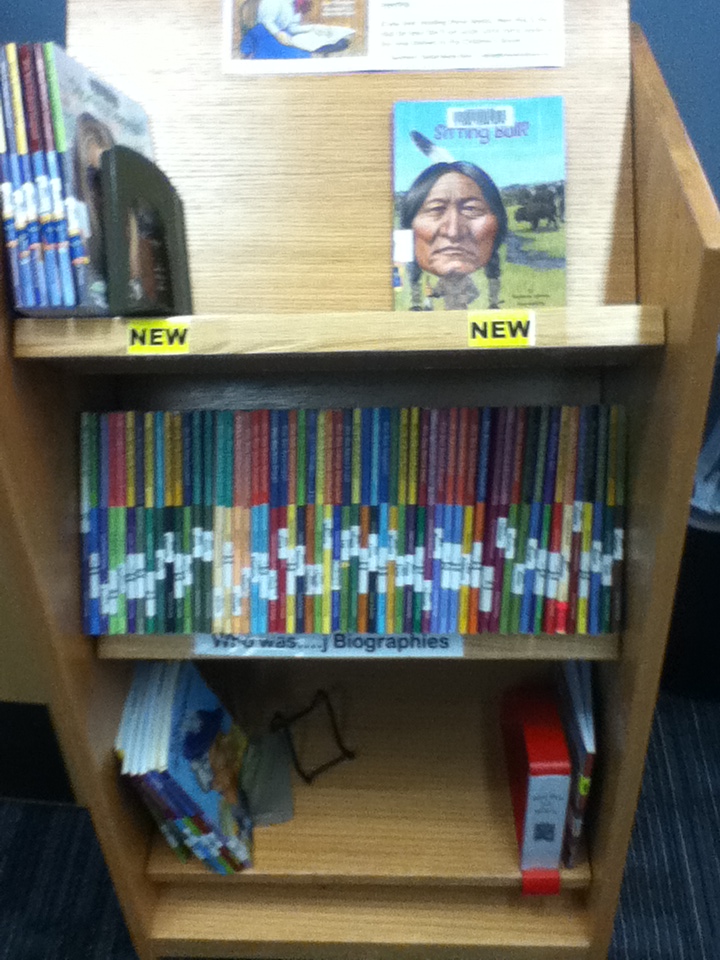
 When biography and nonfiction book reports are assigned in school, there is one series that most middle grade readers go to first. Most will head straight for the Who Was biographies and the What Was and Where Is nonfiction series. These books cut straight to the important facts about the subject matter, while making the reading both fun and interesting. In fact, these books are so popular that it is hard to keep them on the shelf even when there are no school projects looming. To see just how few of these popular books actually are in the library right now, check out the small wooden stand outside the Teens Room.
 This series is published by Penguin, and covers an extensive list of people, places, and events that are important historically or are currently relevant in pop culture. The books are easily recognizable by the caricature style drawing of biography subjects and bold cartoon work of all their covers. There are also illustrations throughout the books and extra bits of information that make the reading more fun. For big fans of the series Penguin has a website where readers can keep track of which books they have read and test their knowledge.
 There is a book club here at the library that meets once a month and focuses on the Who Was series. About a month before each meeting, a librarian will select a book from the series for everyone to read. At the meeting, readers chat about what they discovered in the book and do one or more fun activities inspired by that person’s life. For more info on when the group is meeting check out our events calendar.
 Here is a small sampling of the wide variety of people, places, and events this series explores; Who is Jane Goodall? by Roberta Edwards, What is the World Series? by Gail Herman, What was the Battle of Gettysburg? by Jim O’Connor, Who was Dr. Seuss? by Janet Pascal, What was Hurricane Katrina? by Robin Koontz, Who was Betsy Ross? by James Buckley, Where is Mount Rushmore? by True Kelley, Who was Frederick Douglass? by April Jones, What is the Panama Canal? by Janet B. Pascal, Who is Stan Lee? by Geoff Edgers, What was the March on Washington? by Kathleen Krull, and Where is the Great Wall? by Patricia Brennan Demuth.
 The Cheshire Library Blog