 The Book of Lists – a wonderful book of eclectic knowledge by David Wallechinsky – lists Moby Dick, by Herman Melville, as the Number One Most Boring Classic of all time.
I can’t disagree.
It’s not an easy read, combining flowery Miltonian prose, poems, sea shanties, Shakespearean asides, and some detailed exposition on whaling. The only way I made it through at all was by looking for the thematic and quote references used in Star Trek: The Wrath of Khan for a term paper (and there are a long list of them).
Don’t judge me. An easy English credit with an A is still an English credit.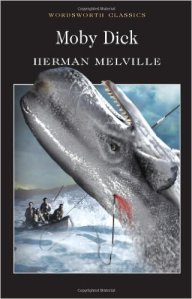
Moby Dick, the story of Captain Ahab’s obsessive pursuit to revenge the loss of his leg to a white whale, was based on a number of true stories – an actual white whale named Mocha-Dick, and the sinking of the whaling ship Essex in the Southern Pacific in 1820. The book was first published in 1851, but never gained ground. By the time of Melville’s death more than 30 years later, only 3,000 copies had been sold.
When cut up and rehashed to a sensible, modern vernacular, Moby Dick is a good, straight adventure novel at heart, the story of a man who feels wronged by a whale and will do anything, risk anything or anyone, to have his revenge, and a giant marine mammal who’s been around enough not to fear a wooden fish filled with pesky mariners. And there have been a number of decent movie adaptions to capture that fatal showdown.
 The most recent, and most intriguing, is In the Heart of the Sea. This one gives the story a twist by going back further, to tell the tale of the Essex, as Melville is learning the facts and trying to write Moby Dick. Starring Chris Hemsworth, current action-hero, it’s a worthy film that covers all the points without getting bogged down in Melville. It’s the story behind the story, so to speak.
The “classic” Moby Dick tale comes from 1956, starring Gregory Peck, with a screenplay by Ray Bradbury. A masterpiece of its time, it’s dated for today’s audiences.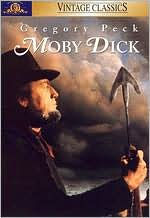
A longer but more modern version is 1998’s Miniseries, starring Patrick Stewart as Ahab (and Gregory Peck as Father Mapple, originally played by Orson Welles). Running four hours, it won Gregory Peck an Emmy award for Best Supporting Actor.
If you’ve hacked through Moby Dick, or enjoyed watching one of the films, there are similar books and films certain to keep your whaling interest. Leviathan, by Eric Jay Dolin, will give you a history of whaling in America. In the Heart of the Sea began as a book by detailed historian Nathaniel Philbrick. War of the Whales by Joshua Horwitz uncovers the true story of an ultrasonic submarine detection program run by the US Navy that was causing whales to beach themselves. To learn more about several different types of whales, try The Grandest of Lives : Eye to Eye with Whales by Douglas H. Chadwick. For stories that mimic Moby Dick but aren’t about whales, try Ray Bradbury’s Leviathan 99, or, of course, Star Trek: The Wrath of Khan. If you want to go for the thematic stretch, you could include the musical Sweeney Todd here, too. “To seek revenge may lead to Hell/ but everyone does it and seldom as well.” Of course, the perfect summer trip is to recreated whaling village Mystic Seaport, where you can walk the decks of the whaler Charles W. Morgan and feel the wind of the sea in your hair.
Whales  aren’t fish. They’re aquatic mammals: they breathe air, give birth to live young (ones that weigh a full ton), and feed them off milk just like any other mammal. They are known to be intelligent, and the scenario of Moby Dick, of such a mammal remembering who may have harmed it and seeking out revenge of its own, is entirely in the realm of possibility.
 Abraham Lincoln by Thomas Keneally
 Marcel Proust by Edmund White
 The Cheshire Library Blog