When it comes to epic book series impossible to film, first came Lord of the Rings, (which was done marvelously at last but needed more than 10 hours of screen time).
Then came Dune.
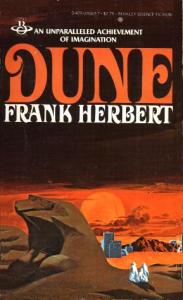
Dune, by Frank Herbert, is considered the best-selling Science-Fiction novel of all time (though it’s far more Game of Thrones than space ships), with more than 12 million copies sold in 14 languages. It tied for the 1966 Hugo Award. And like Lord of the Rings, getting it to film is a Holy Grail of filmmakers.

Dune tells the far-distant-future story of Duke Leto Atreides, who is given the stewardship of the desert planet Arrakis, also known as Dune. Dune is the only place in the universe where the spice Melange exists – a spice that not only can alter your mind, in some species it lets them fold time and space, creating almost instant space travel. “He who controls the spice, controls the universe.” Thus, Dune is a hotbed of politics and backstabbing. When the Duke is murdered, his son Paul, deemed an abomination by a powerful religious group, is seen as a prophesied savior by the natives of Dune. So begins the battle for control of Dune. The book is an immersive, detailed, visionary epic of grand scope (there’s a dictionary in the back). When you read the book, you are on Dune. This is a book that sticks with you for years to come.

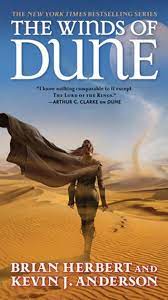
Herbert wrote five books to the series; his son Brian added another twelve after his death. Dune – even just the first installment – is a novel of such grand scope (like GOT and LOTR) that putting it to film has been almost laughable – think of Rankin Bass’s 90-minute adaption of The Hobbit. Game of Thrones took 8 years and more than 73 hours to tell – can you imagine it as a three-hour theater film and have it make sense? It was tried in the 70’s, but after 3 years of attempts, the budget just couldn’t be managed. In 1984, David Lynch did make it, condensing much of the book to ethereal voiceovers, changing major points to condense action, and adding some now-cheesy early computer effects (the blue contacts of the Fremen didn’t work, and every frame of the film had to be colored by hand). It’s a film you either love or hate, with musician Sting as Feyd Rautha famously flexing in a winged bikini.
In 2000, SyFy channel did two Dune mini-series, which were much better received, won several awards, yet seemed to fade into obscurity faster than Lynch’s version, with the chief complaint it stuck too close to the source material, and dragged. Now, thanks to Warner Bros and HBO, we have a $165 million dollar spectacle by Denis Villeneuve that covers – only half the book, with a sequel (hopefully the second half) due in 2023.

While the film has been viewed favorably, the scenery and cinematography spectacular, Villeneuve took many liberties with the material that once again changes the focus and depth of the story. To modernize it, he gender-swapped characters (which goes against the society Herbert wrote) and changed the roles of other women (no, the Bene Gesserit. He left out much of the religious aspect, the mysticism, even avoided the word jihad, used by the Fremen. It gives a sanitized, whitewashed view of the story, afraid of offending anyone. Herbert believed that modern societies will always decay back to a feudalistic society, and that the desert cultures, especially those of the Middle East, were more prone to messianic complexes and religious wars (remember, he’s writing in 1964 or so, when the Middle East was still rather bland politically. Think Star Wars and Tatooine, or The Great Humongous in Road Warrior, etc. There’s a lot to be said for that theory). To remove the root of the story – is it still the same story? Can anyone ever make a decent, book-abiding video version of Dune?
If you can’t wait for the new film to come out on DVD (or, rather, the first half of the book), check out the book series itself. Few things are better than the source material.

I can give up Sting in his bikini (though I thought he was a perfect Feyd), but there is no better Gurney Halleck than pre-Captain Picard Patrick Stewart. That’s my opinion, and I’m sticking to it!






 Not every book becomes a movie; not every movie started out as a book, but the two feed off each other like peanut butter and chocolate. Many of the top Oscar-winning films started out as books (



 The Cheshire Library Blog