Today’s post is by Bill, Head of Adult Services.
 The first Earth Day was celebrated on April 22, 1970, with the intention of bringing awareness to environmental issues. The first Earth Day events drew millions of participants across the U.S. and around the world. This was the scene in New York City. Since 1970, celebrations have grown, with Earth Day becoming a global event in 1990.
2019 marks the 10th year that Cheshire Public Library has commemorated Earth Day by offering programs on the environment, outdoor activities, gardening, wildlife and more. This year we offer six programs in April, among them, speakers who are highly esteemed in their fields – from butterflies to birds to “gardening as if the world depends on us.”
 The library is a vital place for citizens to become educated and informed about environmental issues, from fracking, to plastic bags and straws, to carbon emissions, so that that they may approach their elected representatives with their concerns. The environmental impact of plastic straws is a topic that has been in the news a lot recently: The Last Plastic Straw website, Shoreline Town to Consider Banning Plastic Bags, Straws, State of Connecticut Research Report ‘Banning Plastic Straws.
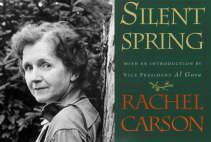 Rachel Carson’s book, Silent Spring, published in 1962 and available in multiple formats at Cheshire Library, expressed her passionate concern with the future of the planet and all life on Earth, and inspired the modern environmental movement. In addition, CPL also offers many other materials for those interested in learning more about taking care of our environment:
- American Earth : Environmental Writing Since Thoreau edited by Bill McKibben; foreword by Al Gore
- Nature and Culture in the Northern Forest edited by Pavel Cenkl; foreword by John Elder
- Forest Bathing : How Trees Can Help You Find Health and Happiness by Dr. Qing Li
- Slick Water : Fracking and One Insider’s Stand Against the World’s Most Powerful Industry by Andrew Nikiforuk
- Friends of the Earth : A History of American Environmentalism by Pat McCarthy
- Rachel Carson and Her Sisters : Extraordinary Women Who Have Shaped America’s Environment by Robert K. Musil
- On a Farther Shore : The Life and Legacy of Rachel Carson by William Souder




- Sustainable Happiness : Live Simply, Live Well, Make a Difference edited by Sarah van Gelder and the staff of YES! Magazine
- Food is the Solution : What to Eat to Save the World : 80+ Recipes for a Greener Planet and a Healthier You by Matthew Prescott
- Climate of Hope : How Cities, Businesses, and Citizens Can Save the Planet by Michael R. Bloomberg and Carl Pope
- An Inconvenient Truth : The Planetary Emergency of Global Warming and What We Can Do About It by Al Gore
- An Inconvenient Truth / [presented by] Paramount Classics and Participant Productions ; a Lawrence Bender/Laurie David production ; produced by Laurie David, Lawrence Bender, Scott Z. Burns ; executive producers, Jeff Skoll .. [and others] ; co-producer, Leslie Chilcott ; directed by Davis Guggenheim
- An Inconvenient Sequel : Truth to Power / Paramount Pictures and Participant Media present ; an Actual Films production ; produced by Jeff Skoll, Richard Berge, p.g.a., Diane Weyermann, p.g.a. ; directed by Bonni Cohen & Jon Shenk
We’ll end this post with an audio link to Before the Deluge by Jackson Browne. The song was released 45 years ago and remains relevant today.
 In January 1969, off the shores of
  Earth in 1970 was a very sorry place. We knew we were in trouble since Rachel Carson’s
  1972. Leaded gasoline was phased out in 1973. Lead-based household paint was banned in 1978. Flame retardants were phased out of infant clothing (because babies have such capacity to spontaneously combust after sunset). Pesticides were examined, and many were quickly banned from use. And amazingly, the Earth began to recover. Today the Bald Eagle is off the endangered species list, with more than 5,000 nesting pairs noted – I almost drove off the highway when I saw one sitting on a light post in the Catskills. A living, wild, Bald Eagle. A few California Condors have been re-released into the wild, with more than 400 individuals now living wild or in captivity. New trucks and buses have 99% fewer emissions than those in 1970. The Hudson River now has fish again.
 little things, combined, make a big impact. Recycling aluminum cans saves 95% of the energy needed to produce new ones from ore. One ton of recycled paper saves 17 trees, lessening the greenhouse effect. One ton of recycled plastic saves 16 barrels of oil – $1,000 per ton. Multiply that by all the people in your town, your state, your region – and think how that snowballs. So celebrate your cleaner environment on April 22. Plant a tree. Pick up garbage on the side of the road. Recycle your bottles. Take a walk and look at all the diversity of trees and flowers and birds around you, and breathe deep of air that doesn’t burn your nose and eyes and make you cough (does anyone else remember the stink of the





 Cloning seems new, but it’s technically been around longer than man – identical twins can be considered clones, splitting a single fertilized egg into two or even four genetically identical individuals from that one egg. Modern cloning, wherein cells are taken from a living donor and a primitive cell is induced to become an organism traces back to just 1996, when Dolly the Sheep was cloned from a mammary cell of another sheep, the first time a body cell was used instead of a sex cell – an egg or sperm.
 your pet, so that when it dies you can have an exact

 tter-preserved specimens every year, the chance of finding usable DNA grows ever closer. Both of these books present a balanced side to the argument. Of course we WANT to bring back mammoths. The question remains: should we?
 The Cheshire Library Blog