A couple of months ago, I fielded a reference question about 1410 Highland Ave, the current location of The Butcher Bros Steakhouse. This patron wanted to know which restaurant was there about 35 years ago.
Questions like these are not uncommon, but there’s usually enough information online to find a quick answer. Searching online, I uncovered what many Cheshire-ites already know: 1410 Highland Ave became The Butcher Bros in 2023, Bone in Prime opened there in 2021, and Perfectly Prepared Catering had a run from 2018-2020, closing due to COVID-19. At some point before Perfectly Prepared, that location was Cugino’s Pizza (a fact some helpful staff members were able to help me out with). Everything before Cugino’s was a dead end, so I turned to our local history collection on the library’s lower level. It was time for some good old-fashioned research!
My reference resources of choice were the local directories. These directories were published yearly and our collection includes most editions from 1965 to 2020, covering Cheshire, Hamden, North Haven, and the entire New Haven County at various points in its publication history. These books, and our entire local history collection, are available for anyone to use in-library on the lower level.
The directories are filled with all kinds of fun information. Did you know Cheshire had 3,253 telephones in 1956? And 8,404 telephones by 1968?! Okay, maybe not the best example of how fun this information can be… Still though, quite a few telephones!
But back to the research question: What’s the history of 1410 Highland Ave? I flipped to the Cheshire section of these directories and searched by street name. I was thrown for a loop in 1984 and 1983, which is when that portion of Highland Ave was still called Milldale Rd. You’ve got to be on your toes with this kind of thing.
I narrowed my search between the years of 1983 and 1997 to get a comfortable range around the “35ish years ago” goal. Even within this 15 year period, there’s a lot of action!
I got in touch with the patron who requested this information and we decided the restaurant they remembered was likely Vigilio’s. The best kind of mysteries, however, only lead to further questions—this one is no different. What happened between 1991 and 1993 when there was no information submitted to the directory? What is Spindrift? Where is Michael Anthony now? And most importantly, what is Twilight Zone? A coworker vaguely remembers a club called Twilight Zone, but I can find no information to back that up. Whatever the case, this research shows that even the most unassuming of questions can be an adventure.
There are several ways to save money at the Cheshire Public Library. If you want to learn budgeting, investment, and retirement skills, come browse our large collection of personal finance books, magazines, and e-books. For more immediate savings, check out our museum passes. We offer discounts and free admission to some of the best museums in the state.
But today, I’d like to zoom in on our Research page, where you can get free access to websites that normally require a paid subscription. A recent CNET study found that the average US adult spends $91(!) on subscription services each month. We can’t help with Costco or Netflix, but you may find something here that will come in handy…
The New York Times
Normally $24.99 per month, free from the library
You can access the digital version of The New York Times both inside and outside the library. This means access to articles, reviews, podcasts, recipes, and games (so you can impress your friends with a Wordle streak). If you’re more of a “print” kind of person, we have both The NYT newspaper and magazine available on the lower level of the library.
*Note: Only the “News” portion of the website is available outside the library
Consumer Reports
Normally $10.00 per month, free from the library
Consumer Reports is a nonprofit organization that helps consumers gauge the value, quality, and authenticity of goods and services. It’s a trusted resource for unbiased reviews of cars, appliances, electronics, and lots more. Like The NYT, we also have the print version of the Consumer Reports magazine on the lower level of the library.
Ancestry allows users to access a massive database of genealogical and historical resources. Search through Census records; military records; court, land, and probate records; vital and church records; directories; petitions for naturalization… The list goes on and on. This service is only available at the library itself so make sure to visit our public computers on the lower level.
Mango Languages
Normally $19.99 per month, free from the library
Chances are you’ve heard of Duolingo. I use it myself and like that it keeps me responsible for learning every day. On the whole, though, it feels somewhat lacking in actual education. Duolingo’s focus is on gamification can make it feel more like Candy Crush than French 101. Mango Languages is a great alternative that provides structured lesson plans that cover vocabulary, grammar, and culture. What’s more, Mango Languages boasts 70+ world languages and courses for English learners as well.
I recently took a class on archives and manuscript management- as one does- and learned about a problem in the world of museums and archives. Many of them have large numbers of old documents they have scanned into their digital collections for preservation, but they’re not searchable. What do I mean by “searchable?” Let’s say you’re doing research online, looking for information on feral pigs in North America in the 19th century. Now, it turns out the Library of Congress had a bunch of letters donated to them that discuss precisely this, and you could read all about the problems Matilda had on her farm in Cheshire as she writes to Cletus in Middletown. Unfortunately, you’re not likely to find these letters by blindly sorting through the images that make up the archives’ massive collection. Those letters first need to be transcribed, where someone looks at the pictures taken of the letters and types what is written there. Once this text has been typed, the computer is able to match your search for “feral pigs, North America, 1800s” with the text that was entered via transcription.
Here’s the problem: it takes a lot of time to transcribe all those old historical records. The solution? You.
That’s right! There are all kinds of archives and other historical organizations looking for volunteers to transcribe and review old documents. What does this look like in action? Here’s an example from a transcription I did on the Library of Congress’s We the People website:
Above is an article written by Frederick Law Olmsted, the “father of landscape architecture in the United States,” best known for designing Central Park in New York City. Here, he enthuses about the “Lungs of London,” another term for London’s Royal Parks. Even within this brief two-page document, there is so much to sink your teeth into. He describes the necessity of public parks that do not exclude the working class:
Money, and their legs, will carry [genteel people] whither they will; but with the poor artisan or labouring man it is not so. He cannot afford time or means to set out with his wife and children on a Sunday voyage of discovery – and to find the shades of night, perhaps, falling around him just as he has succeeded in refreshing his eyes with a bit of anything green.
Poetic! And relevant 185 years later… When opening up a new document to transcribe, there’s no telling what you may find.
This kind of project is perfect for history buffs, puzzle hounds, those interested in volunteering their time, or anyone who has ever thought, “Gee, I bet I’d make a good code cracker.” Each organization has slightly different guidelines for transcription, so definitely peruse those before you get started. Generally, these institutions want to make it easy for volunteers to provide their help, so it doesn’t take more than a few minutes before you’re transcribing your first document.
Here are a few of my favorites:
The Library of Congress– Probably the quickest to get started, with the easiest-to-use interface. You don’t have to have an account to transcribe, but if you create one (it’s free), you can track your hours.
National Archives– Volunteers here are called “Citizen Archivists,” and have more options outside of straightforward transcription like their “Outside the Box Missions.” This one wins for coolest branding.
Historic New England– They’re focusing on transcribing the Casey Family Papers right now, and from what I can tell this is a family with decent handwriting, great for beginners.
There are also many other smaller institutions looking for transcription help, along with international archives. Try googling “archives transcription volunteers” or “digital transcription volunteers” if none of the above suggestions tickle your fancy.
Ancestry Library Edition is the library version of Ancestry.com and is available free to Cheshire Library cardholders. Originally available only inside the library, access was expanded to include home use when the Covid-19 pandemic closed libraries down in the spring of 2020. Ancestry has continued to allow expanded access during these times of social distancing. CPL staffer Lauren took full advantage of Ancestry’s resources to research some old photos she came across:
When my grandmother cleaned out her house, I inherited a collection of old photos, documents, and books. Many items were of unknown origins, collected by a long-dead relative and placed in a series of boxes and bags, which in turn was tucked into a closet until it emerged one Sunday afternoon. I was fascinated. I spent hours going through the pages of the books and turning over the photos to see the names. I grew to recognize them, even if I couldn’t exactly connect them to me. Here in this local history book is a Balliet: the name I carried for most of my life. This photo, a Bloss. Here’s a Schneider, a Kern. But nothing haunted me quite like the handwritten inscription that prefaced a photo album: “Presented to Kate E. Haines by her Affectionate Mother, July 18, 1866.”
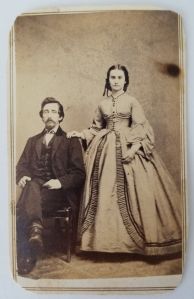
There were two such photo albums, small, sturdy, and so elegant they seemed out of place. Inside the albums, the trading card-sized cartes de visite showed women in dark corseted dresses and bearded men in somber coats, all sitting or standing in professional studio settings. Unlike the faces in the black-backed scrapbook, framed in glossy three-by-fives and looking out candidly from lawns and stoops, I found no familiar features in these posed men and women. They were a complete mystery. Who were they? Who was Kate? And how did my family come to possess the remnants of her life?
Lillie, my second-great-grandmother, as a young woman in the 1890s
There are no Haineses in my family. At least, not according to the hefty History of the Counties of Lehigh and Carbon in the Commonwealth of Pennsylvania. It’s one of the books in my collection, published in 1884, and it sits on a shelf with the first and third volumes of the 1914 History of Lehigh County, Pennsylvania, and a Genealogical and Biographical Record of Its Families. Inside their pages I traced my sixth-great-grandfather, Paulus Balliet, from his 1717 birth in Alsace-Lorraine, to his 1738 arrival in Philadelphia and his quick rise to small-town gentry in Lehigh County. The Balliet branch of my family is heavy with documents and stories. The Bloss branch isn’t as full, but I know it by its physical pieces. I have photos of my second-great-grandmother, wearing tiny wire-framed glasses and the hint of a smile. Her name was Lillie. We shared birthdays, first initials, imperfect eyesight. She married a Balliet. I have a composition book full of her handwritten recipes. The black-backed scrapbook has photos from her father’s slate quarries, captioned by her son. I put those objects in one archival box, and the Haines albums went into a separate box of photos with unknown subjects.
Another tintype probably from Kate.
Once, I removed the cartes de visite from the Haines albums. I flipped them over one by one, turning up three handwritten notes with unfamiliar, untraceable names. I tried pinpointing the time period by looking at their clothing. I googled “Kate E Haines,” hoping for the same luck I’d had with the Balliets in my family. I even documented which studios took each photo, hoping that the series of names, addresses, designs, index numbers would somehow suddenly open up a revelation. But, like the single mirrored daguerreotype in my collection of photos, Haines was a ghost.
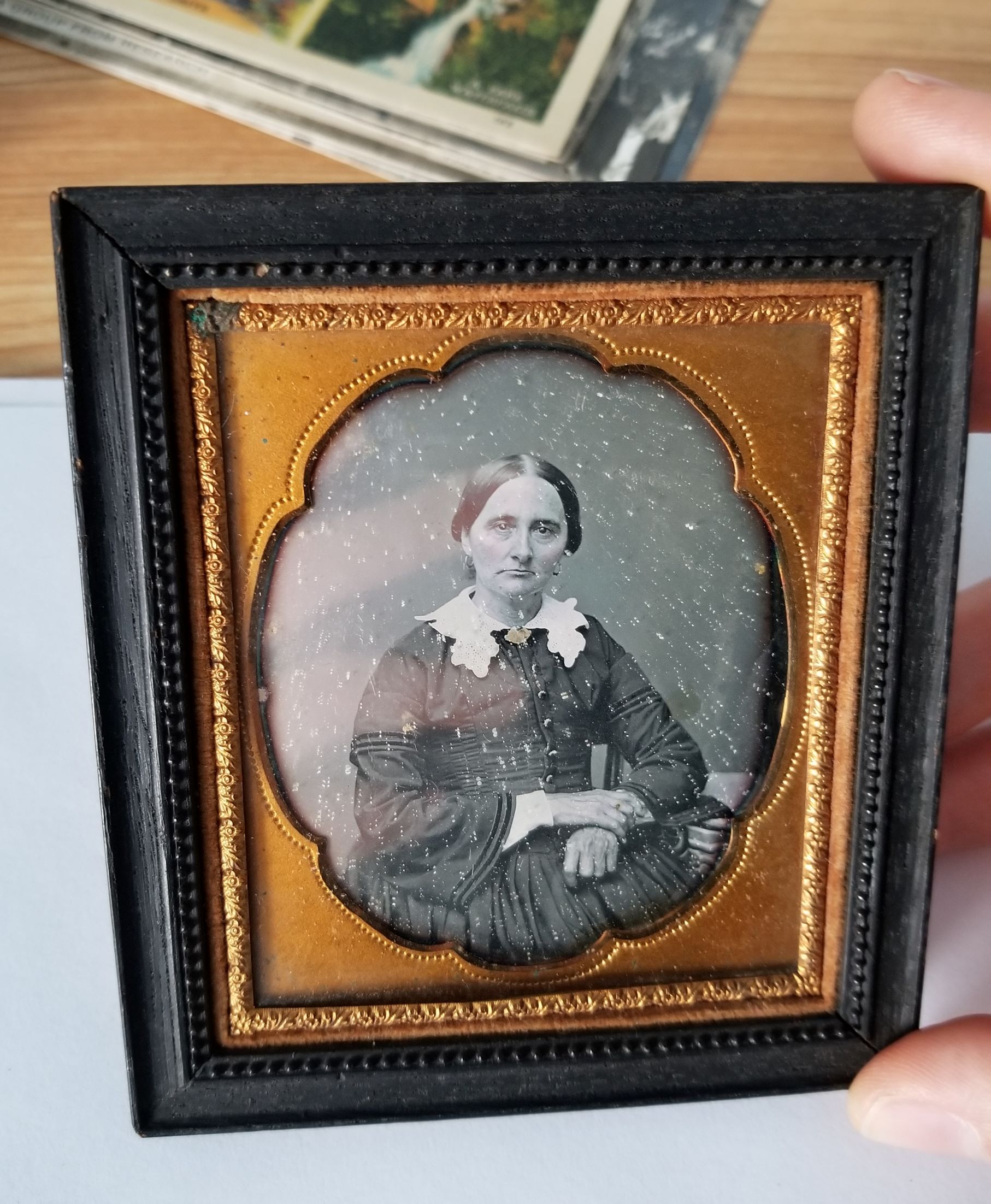
Portrait of an unknown woman, probably from the mid-1800s. This daguerreotype’s reflective qualities distinguish it from the more common ambrotypes and tintypes.
Last spring, as covid kept us in our homes, I needed a project to occupy myself. It was announced that the genealogy database Ancestry.com was expanding access to Ancestry Library Edition. I knew from my past life as a reference librarian that Ancestry Library Edition was a trove of genealogical information that can normally be used only at local libraries. But for the foreseeable future, researchers could access the database from home. I immediately took an early lunch and grabbed my archival boxes and a fresh notebook. For the first time, I had unfettered access to vital records, grave markers, and the research that other genealogists had completed. I began to fill in the bare branches. It didn’t take me long to see how the names connected, how they flowed down to me. And, curiously, how they flowed back from Lillie. A name I recognized from an 1833 birth certificate turned out to be her grandmother, my fourth-great-grandmother. More names appeared that matched the scrawled labels on the backs of photographs. Lillie had been curiously absent from those lineups of Bloss women on front porches. But it started to make sense. Someone had been holding the camera, focusing the lens, calling the relatives to attention. Someone put those photos in the black-backed scrapbook. Someone had held onto the history books. Not a Balliet, as I’d first suspected. A Bloss. Lillie was one of my collectors.
Once I made those connections, it didn’t take me long to move on to Kate E. Haines. Google had turned up nothing a year ago. This time, though, I had the full range of records from Ancestry Library Edition. I typed in “Haines, Kate E.” A few hits, but nothing that looked right. “Haines, Kate E,” and I expanded the search to look for similar names. I got thousands of hits. I gave her a birth date between 1840 and 1855, assuming that the 1866 photo album was a teenage birthday gift, or a marriage gift. I set her location to Pennsylvania. Too many results from Philadelphia, so I refined it to Lehigh County, Pennsylvania.
And then I found the death certificate for Mrs. Catherine Balliet, informed by Lillie Balliet.
1880 Census record for Ballietsville Village, North Whitewall Township, Lehigh County, Pennsylvania.
Vital records tell a story, if you know how to read them. In a census, the sudden appearance of a household member sixty years younger than the head can indicate a recently widowed daughter or son moving back with their parents, their child in tow. Inconsistent spellings of last names can point to either illiteracy or, in the case of my overwhelmingly German ancestors,* that the bearer moves between two languages. Kate’s death certificate told me that she had no remaining blood relatives.
The other records on Ancestry Library Edition confirmed my suspicion. The census entries and family trees showed her birth in 1849, and her mother’s marriage to a second husband when Kate was six years old. Her father, presumably, had died. I found a child of hers who died in infancy, a husband who died a year later. A later census places her as the wife in the household of my third-great-granduncle, a Balliet man almost forty years her senior. She is younger than the stepchildren she lives with. Before she reaches the age of 45, she will lose her mother, her second husband, her remaining daughter. She spends the rest of her years living with her unmarried, childless sisters until they, too, die. When she herself passes in 1924, it’s not her stepchildren who recount the details of her life. It’s Lillie, her niece by marriage. Lillie was only a girl when Kate was widowed a second time and her ties to the Balliet family, at least on paper, were severed.
Portrait of a young woman, possibly Kate Haines’ daughter, encased in a heart with embroidered flowers. The back reads “Handle with care – Miss Mamie Emery.”
I have no explanation for how Lillie came to know Kate, her aunt-in-law, well enough to recount her information to a medical examiner. But she did. I can imagine Lillie cleaning out Kate’s room after her death. She sees the photo album that contains the cartes de visite from decades of friends and family. She opens it up, recognizing a face here and there. She spots the second album. There’s more photos: tintypes, a daguerreotype, small keepsake hearts. She moves about the room and silently gathers them up until she holds the last traces of Kate Haines in her hands. She takes one final look around, then closes the door on the dark, still room.
Looking at the people who entered her life and left too soon, I think I understand why Kate collected so many photos. It’s why my second-great-grandmother Lillie took her albums and placed them alongside her family’s history books. She was keeping house.
The Bloss Family in the early 1900s. Lillie is at the top left.
These women that I’ve come to know through their objects and my research – women who were teachers and gifted students and descendants of prominent locals – when they married, the totality of their lives was diminished over and over again to a single line on the census: “keeping house.” And they kept house in the fullest sense of the word. Not only did they physically maintain the members of their families, their children and husbands and mothers, but they also maintained the intangible threads that held them together. They remembered the names, the stories, the histories. They kept the photos and the history books. They kept their fathers’ geography textbooks and their aunts’ albums and their grandmothers’ tiny crochet hooks and the commencement programs that listed their mothers-in-law as school valedictorians.
And I see it happening today. In my family and in so many others, the women are arranging baby showers and funerals, grocery shopping for barbecues and get-togethers, reminding everyone about upcoming birthdays and anniversaries, writing messages in cards, buying pages for scrapbooks and frames for photos, and placing their children’s school projects in a box in their closet. When the day is done, some of them are sitting down in front of computer screens and typing names of their relatives and their husbands’ relatives into genealogical databases. We all know our family histories because of the women who are keeping house. And many of us will do the same, holding our histories and passing them on to our own granddaughters and grandsons, and hoping they, in turn, will continue to keep their house.
I intend to do my part.
(Unknown portraits from the photos of Kate E. Haines.)
* When I tell non-Pennsylvanians that I’m Pennsylvania Dutch, I often get strange looks, as if they’re wondering about my Amish rumspringa. But Pennsylvania Dutch, or Pennsylvania German, refers to all German-speaking Protestants who came to Pennsylvania from the Rhineland in the 17th and 18th century. They assimilated and became farmers and wives and business owners and statesmen, and their descendants continued to speak their German dialect for hundreds of years. Insular communities like the Amish and Mennonites still speak it today, but the vast majority of PA Dutch descendants today have little to no knowledge of the dialect. My grandfather spoke it, but my grandmother knows only English, though she speaks with a strong accent. My only linguistic trace of the region is my fondness for the word “rutsch,” a verb used to describe the barely-contained energy of small children who have been sitting in one place for too long. I have yet to find a satisfying equivalent in standard English.
Life sure has changed from this time a year ago, hasn’t it? It’s still hard to wrap my head around how differently we are living our lives since the Covid-19 pandemic made its presence known. Schools and businesses have had to restructure just about everything they do. Libraries, too, have had to change the way they work, depending so much more on the Internet to connect with their patrons. Cheshire Library is constantly reviewing and adjusting our online services to bring patrons what they need. You’re probably familiar with our online programs by this time (had most of us even heard of Zoom before the pandemic?), and you may have become a pro at downloading library ebooks, but there are so many other services and resources you can avail yourself of any time, right from our website. The library is still here for you, even though how you use it these days might look a little different.
Getting books to readers: Matchbook and Grab ‘n Go services.
Remember the days when you could come into the library and leisurely browse the shelves, find a comfy place to sit and look through books or magazines before checking out your selections? While the library is now open limited hours to the public, it’s not a place to kick back and hang out these days, due to social distancing and safety precautions we’ve put into place. To help you find your next good read, we began offering a service called Matchbook. It’s a service we had tried a few years ago with limited success, but it has been booming since we brought it back in July of 2020. Fill out a quick form on our website letting us know your reading preferences, and a library staff member will hand-select several titles we think you will like, and put them aside for you, “matching” you up with some books! One Matchbook user told us it was like her birthday or Christmas every time a new selection of books was ready for her, and she discovered several new authors she loved! Books can be picked up inside the library at the Checkout Desk when they’re ready, or you can arrange a contactless pickup with our Grab ‘n Go program.
Stream away with Acorn TV and The Great Courses.
One of the first things we did when the library was shut down in the spring was figure out how to increase out digital offerings on a budget. We crunched some numbers and came up with two streaming services (available through the RBdigital app) that have proved to be user favorites. Acorn TV is a very popular streaming video platform that many people pay for, but CPL cardholders have free access to. Acorn TV brings world-class mysteries, dramas, and comedies from Britain and beyond to your Internet-ready TV or mobile device. The Great Courses is another for-pay service that CPL cardholders can use for free. The Great Courses is the leading global media brand for lifelong learning and personal enrichment, with hundreds of courses spanning thousands of in-depth video lectures on subjects like Science, Health & Wellness, History, and even Travel. Learn at your own pace, in your own time!
Dig up your ancestors.
Well, not literally. We’re talking genealogically, here. Ancestry® Library helps you research and understand your family tree with access to billions of names in thousands of genealogical databases including Census and Vital Records, birth, marriage and death notices, the Social Security Death Index, Passenger lists and naturalizations, Military and Holocaust Records, and more. Before the pandemic, Ancestry® Library was available for use inside the library only, but the company has generously extended our subscription to home users during this time of limited library use. All you need is your CPL card and a computer, and you’re ready to climb your family tree!
Keep up with the latest newspapers and magazines, digitally.
We’ve has to suspend our subscriptions to local newspapers during this time, but you’ll be happy to know that you can still access the news online though Newsbank, a news database that provides archives of media publications, and includes access to the Cheshire Herald, Meridan Record-Journal, and New Haven Register. While we still have many magazines available for checkout at the library, there are many more (over 3000 titles and up to three years of back issues!) that are available digitally through the Libby app. The great thing about digital magazines is there’s no waiting list, and back issues are available on most titles!





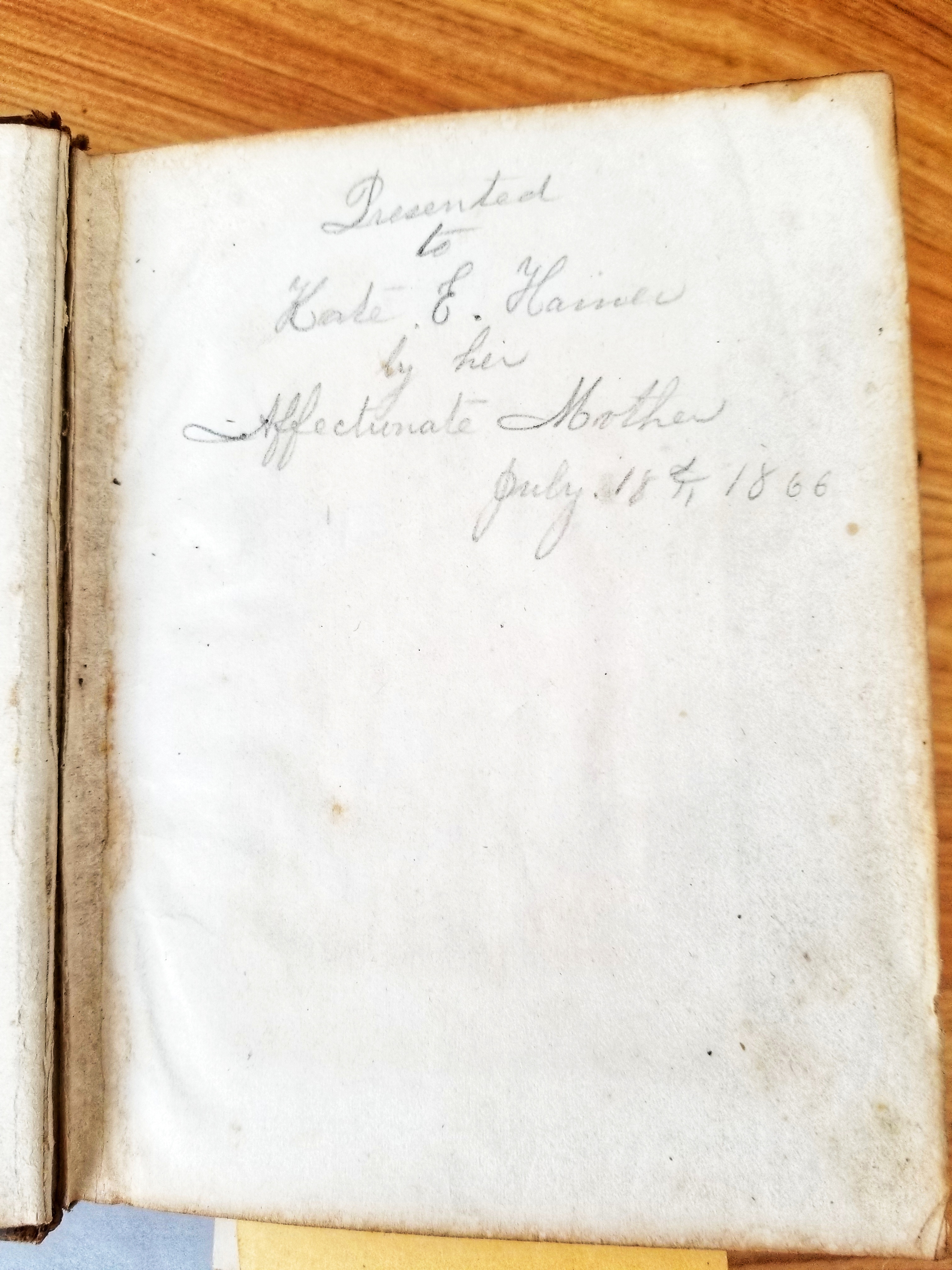 When my grandmother cleaned out her house, I inherited a collection of old photos, documents, and books. Many items were of unknown origins, collected by a long-dead relative and placed in a series of boxes and bags, which in turn was tucked into a closet until it emerged one Sunday afternoon. I was fascinated. I spent hours going through the pages of the books and turning over the photos to see the names. I grew to recognize them, even if I couldn’t exactly connect them to me. Here in this local history book is a Balliet: the name I carried for most of my life. This photo, a Bloss. Here’s a Schneider, a Kern. But nothing haunted me quite like the handwritten inscription that prefaced a photo album: “Presented to Kate E. Haines by her Affectionate Mother, July 18, 1866.”
 There were two such photo albums, small, sturdy, and so elegant they seemed out of place. Inside the albums, the trading card-sized cartes de visite showed women in dark corseted dresses and bearded men in somber coats, all sitting or standing in professional studio settings. Unlike the faces in the black-backed scrapbook, framed in glossy three-by-fives and looking out candidly from lawns and stoops, I found no familiar features in these posed men and women. They were a complete mystery. Who were they? Who was Kate? And how did my family come to possess the remnants of her life?





 Cheshire Library is constantly reviewing and adjusting our online services to bring patrons what they need. You’re probably familiar with our
  Remember the days when you could come into the library and leisurely browse the shelves, find a comfy place to sit and look through books or magazines before checking out your selections? While the library is now open limited hours to the public, it’s not a place to kick back and hang out these days, due to social distancing and safety precautions we’ve put into place. To help you find your next good read, we began offering a service called
  One of the first things we did when the library was shut down in the spring was figure out how to increase out digital offerings on a budget. We crunched some numbers and came up with two streaming services (available through the
  Well, not literally. We’re talking genealogically, here.
  We’ve has to suspend our subscriptions to local newspapers during this time, but you’ll be happy to know that you can still access the news online though
  The Cheshire Library Blog