Learn a Little, Live a Little

Do love learning? Do you dream of taking college classes, but the cost and the time is too much? Are you taking a high school or college class and struggling to understand the material?  Did you cut your cable, and can’t find anything decent to watch anymore?

Fear not! The Great Courses are here!

Cheshire Public Library has always had a handful of these delightful media, but through a generous donation, we’ve been able to greatly expand our holdings to more than 70 titles.

What are the Great Courses?  Professional college-level lectures on audiobook or DVD on a variety of topics, given by actual college professors and experts (like Neil DeGrasse Tyson!), that will give you the equivalent of an entire college class in the comfort of your car or living room. Some come with study guides and questions to think about, but you will never have a test or a grade at the end!

The Great Courses was the brainchild of Thomas M. Rollins, the former Chief Counsel of the US Senate Committee on Labor and Human Resources (1985-89). Inspired by a 10-hour video lecture series he watched as a student at Harvard Law, he set about creating his own video series under the business label The Teaching Company. He recruited professors to record lectures on topics people were interested in learning about. Because the lectures were chosen by customers, they caught on quickly. There are currently more than 900 lectures available in a wide variety of topics. Some are short – four hours – while others (like the Civil War) can run to 14 discs.

Great Courses are expensive – that Civil War set is more than $500 to purchase yourself, but in 2016 the company began a $20/month streaming service, and then in 2021 rebranded itself under the name Wondrium. Wondrium not only offers more than 280 of the Great Courses, but also content from Magellan TV, Craftsy, and Kino Lorber, which carries art films, documentaries, world cinema, and classic films (silent films like Metropolis, Charlie Chaplin, and more).

If you don’t feel like yet another subscription to a streaming service, check out the library’s offerings downstairs in the adult department. We have more than 30 titles on DVD, and more than 35 on audiobook for learning on the go. As Fat Albert used to say, “If you’re not careful, you may learn something!”

Did you know that if you’ve already studied the material, you can often exempt a college class? It’s called the CLEP program – College Level Examination Program.  Basically, if you can pass the exit exam for a class, you can get college credit for that class. Not every school offers it, not every class is covered, but if a Great Courses lecture can help, you can save several hundred dollars!

Check out these great titles and more!

Some of our Audiobook titles:

Ancient Greek Civilization

Beethoven’s Sonatas

Books that Have Made History

Broadway Musicals

The New Testament

Italian Renaissance

Native People of North America

Rise and Fall of the British Empire

Some of our DVD titles:

The American Civil War

Einstein’s Relativity

Monet to Van Gogh

When Rome Ruled

Photography

The Louvre

Geology

Human Language

The Vikings

May Is National Photography Month

national photo month

In 1987, May was recognized by Congress as National Photography Month.  The word photography comes from the Greek words ‘photos’ (light) and ‘graphein’ (to draw).  Photography has certainly evolved over the years.  This is a great opportunity to reflect on its history which is highlighted below in a very condensed timeline.

In 1827 Joseph Nicephore Niepce produced the first photographic image with a camera obscura.  His sun prints, or heliographs, allowed light to draw his pictures.  In 1829, Louis Daguerre helped Niepce improve the process and developed a method called daguerreotype.  This method ‘fixed’ images onto a sheet of silver plated copper.   It was commercially introduced in 1839.  In 1889, George Eastman invented film that had a flexible, unbreakable base.  In the 1940’s color and Polariod photographs were developed with digital and disposable cameras making their appearance in the 1980’s.

The first negative was invented by Henry Fox Talbot, an English botanist and mathematician. In 1841, he perfected the paper-negative process and called it calotypeTintypes were patented in 1856 by Hamilton Smith.  A more stable and detailed negative called wet plate negatives (Collodion process), was introduced in 1851 by Frederick Scoff Archer.  The processing of these negatives required a portable darkroom, which limited the range of photography.

By 1879, the dry plate negative was invented.  This meant no more portable darkrooms and cameras could become hand-held devices.  In 1889, George Eastman invented film that could be rolled which made the mass-produced box camera a reality.  This opened up a whole new world of photography and the evolution of cameras.

The first twin-lens-reflex camera was introduced in 1929.

Polaroid photography (instant photos) was invented by Edwin Herbert Land and first sold to the public in November 1948.

Fuji introduced the disposable camera in 1986.

Canon demonstrated the first digital camera in 1984.

And in the early 2000’s,  the first camera phone was sold in Japan.


Explore the world of photography through Cheshire Public Library’s extension collection here. 

A sampling:

history of photographyThe History of Photography – from 1839 to presentTraces the evolution of photography and offers vivid illustrations of technical innovations in this visual form of communication.
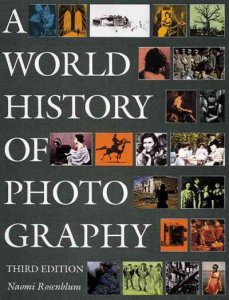
 

world history of photographyA World History of Photography – Traces photographic history both topically and chronologically, profiles key masters, explains terms and processes, and features the landmarks in the development of photography.

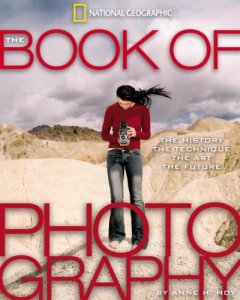
book ofThe Book of Photography – the history, the technique, the art, the future – Anne H. Hoy A reference guide to the history and production of photography provides definitions, biographies, a timeline of photographic milestones, and information on genres and technical and aesthetic achievements.

camera phoneThe Camera Phone Book: secrets to making better pictures – A compact guide to using one’s cell phone to take digital photographs demonstrates the capabilities of the latest models of camera phones, explaining how to select the right equipment, take better pictures, and store, print, and send images.
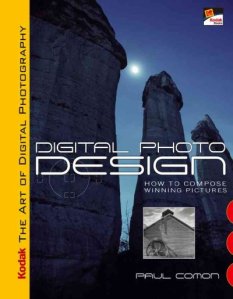
kodakKodak, the art of digital photography – The revolution in digital technology has turned us all into shutterbugs. Never before has it been so easy to snap photos and share them instantly. But what about the quality of these images? Does simply owning a digital camera make you a first-rate photographer? For those who want to take a better picture, this lavishly illustrated guide reveals the art of composing incredible photos in any scenario.

llL.L. Bean Outdoor Photography Handbook –  A beautifully illustrated in-depth guide that offers practical instruction on making the best of your outdoor shots, for beginning through intermediate photographers.


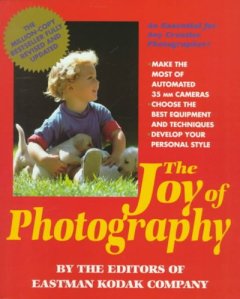
joyJoy of Photography – Provides advice on equipment and accessory selection, effective use of camera functions, basic photography techniques, techniques for a variety of subjects, and development of a personal style, and includes discussions with well-known professional photographers.

annieA Photographer’s Life –  A visual narrative offers more than three hundred images that document the photographer’s relationship with her late companion Susan Sontag, the birth of her daughters, the death of her father, and famous actors and politicians.


it'sIt’s What I Do: a photographer’s life of love and war –  A MacArthur Genius Grant and Pulitzer Prize-winning photojournalist documents her relentless pursuit of complex truths in the years after September 11, describing her witness to the American invasion of Afghanistan and the lives of people before and after Taliban reign.

We also offer two monthly magazines:   Outdoor Photographer Magazine and  Popular Photography Magazine.