As a parent of two young kids, my time away from work is a constant stream of requests and/or demands. The 4-year-old: refill my milk cup even though you’re currently buttering my toast and haven’t even made your coffee yet. The 20-month-old: read Trashy Town to me again. The 4-year-old: I just discovered My Little Pony and I love it, so now my name is Princess Twilight Sparkle and my brother is Spike. Spike: read! Twilight: you are no longer Momma, you’re now Princess Celestia. Can you talk like Princess Celestia? Spike: I will scream-cry if you don’t read to me in two seconds.
Sometimes you need a change of scenery in order to prevent your kids (or yourself) from scream-crying. For me, the library’s museum passes have been invaluable when it’s too wet to visit the playground at Bartlem Park or too cold for miniature horses at Brooksvale Park. Museum passes offer discounted or free admission for adults and kids to museums and educational attractions across Connecticut and beyond. You can reserve them up to 30 days in advance and print almost all of them from home anytime, requiring no special trip to the library. For added convenience, many museums will just scan the pass right from your phone. Here’s our young crew’s experience with the passes.
The Children’s Museum
Location: 180 Mohegan Drive, West Hartford
Pass perks: one free admission for every paid admission
Cost before perks: $15/person ages 2 and up, below 2 is free (price info)
We visited The Children’s Museum when Twilight was two years old and Spike was an unhatched egg. The museum accepted the digital pass that was sent to my phone via email, and soon we were in an indoor air-conditioned wonderland. The museum looks like a former school with one long hallway and branching classrooms that have been converted to different activity areas. I appreciated the easy navigation! The woods-themed dramatic play room was a hit, as was the craft room. The dinosaur room was another success.
There’s also a large collection of live animals spread across three rooms: snakes, chinchillas, box turtles, and more, all of whom came to the museum after being given up, injured, or confiscated. The museum has regular demonstrations where kids can meet some of the animals. Twilight wasn’t interested in petting the ball python, but there were so many other activities that kept her engaged that it wasn’t a loss.

KidsPlay Children’s Museum
Location: 61 Main St, Torrington
Pass perks: Half-price admission for up to 6 family members
Cost before perks: $14 for everyone age 1+, free under 12 months (price info)
KidsPlay has become our family’s favorite museum. There are so many rooms and activities here: play vehicles, a climbing wall, air play, a craft room, a music room with a piano, a grocery store, a pioneer cabin with dress-up clothing. We could not possibly visit every area in one trip! We were impressed not only with the breadth of activities, but how clean and well-maintained the space was. We loved this museum so much on our discounted visit that we got a year-long membership, so we’ve gotten to experience rotating play areas like kinetic sand and a hockey rink.
Street parking is a breeze in downtown Torrington, and there’s an off-street lot as well. The only drawback is its limited schedule. As with any museum, check the hours of operation before you visit!

Roaring Brook Nature Center
Location: 70 Gracey Road, Canton
Pass perks: one free admission for every paid admission
Cost before perks: $9 for adults, $7 for children 12 and under (price info)
Our Children’s Museum pass also grants discounted admission to Roaring Brook Nature Center (not to be confused with Roaring Brook Park, the not-for-the-faint-of-heart local trail). The nature center has an indoor section with taxidermy dioramas of our local habitats, live animals, play nooks, and a library, plus an outdoor area with rescued birds and turtles. Twilight enjoyed the scavenger hunt, singing lullabies to Tomasina the black vulture, and looking for turtles in the pond.
The highlight of the trip, though, was a hike along the trails next to the nature center. The trails are free to access and open from dawn to dusk, and a lot of it is hemlock forest (i.e., those really cool dark forests that make you feel like you’re a character in a fantasy book). The kids played Poohsticks from the bridge over the creek and explored a set of lean-tos while their bird nerd of a parent listened to warblers and nuthatches calling in the trees.

Connecticut Science Center
Location: 250 Columbus Blvd, Hartford
Coupon perks: 15% off up to six admissions
Cost before perks: $29 for adults, $23 for ages 3-12, plus $7 per person for butterfly encounter (price info), plus $7 per vehicle for 3 hours of parking in the adjacent garage (garage information)
Twilight loves the CT Science Center. When she was two years old, we could easily spend an hour just in the water play area. (They provide smocks, but it’s still a good idea to bring backup clothes and shoes.) There’s also live animals including a sloth, a butterfly encounter, and lots of interactive science activities that get more interesting as Twilight gets older. A glass elevator lets you look out across the whole museum, and it’s roomy enough for you to indulge in repeat rides without compromising foot traffic.
This is not a reservable pass, but a coupon that you can pick up anytime and use anytime. Even with a coupon, this is admittedly a pricier outing. But if you can swing it, it’s worth a visit.

Dinosaur State Park
Location: 400 West St, Rocky Hill
Pass perks: free admission to the exhibit center for two adults and four kids age 6-12; kids 5 and under are free
Cost before perks: $6 for ages 13+, $2 for ages 6-12, free parking and trail access
The kids recently visited 200-million-year-old dilophosaurus footprints at Dinosaur State Park, where you can visit indoor exhibits for free with the CT Parks Pass. (This is a physical pass that needs to be picked up and delivered back to the library.) The footprints are housed in a geodesic dome that also includes dino dioramas, crafts, and some live reptiles and amphibians. The adults loved it, but Twilight was a little disappointed that dinosaurs were extinct and weren’t there stomping around making the footprints.
Luckily, the nature trails outside the exhibit center are perfect for small legs, and they’re free to use without the pass. We saw a big (and completely harmless) water snake sunning itself near the marsh!

Overall, there are so many activities at each place that you really can’t go wrong with borrowing a pass. And even if your museum outing is more miss than hit, hey – at least it’s a few hours in which your kids aren’t pretending they’re Keith Moon and your living room is a Holiday Inn!
Why don’t all the passes give me free admission?
We would love to offer passes that grant free admission everywhere, but the museums set the terms for their passes and decide what they’re going to make available for libraries to purchase. Sometimes that’s free admission. Sometimes that’s just a discount. It all depends on the museum, but we always get the best discount we can!
Why doesn’t the library offer passes to Beardsley Zoo, Mystic Aquarium, or the Maritime Aquarium?
Good question! Unfortunately, the aquarium passes don’t really offer a good value for most patrons. (Think a percentage off a yearly membership, or a few dollars off if you purchase add-ons beyond general admission.) Instead of disappointing our patrons, we opt to get different passes with better discounts. As for the Beardsley Zoo, they changed their ordering process a couple years ago, and it doesn’t jive with the way we make purchases. However, we’re planning to add more animal-themed passes in 2026. Stay tuned!
What about the Peabody Museum? Why doesn’t the library offer a pass?
We don’t offer a Peabody Museum pass because it’s completely free! They gave it a major overhaul recently, and it’s a gorgeous space. Fossilized skeletons and plants are on the first floor, with minerals and animal dioramas on the third floor. Human history is exhibited on the second floor.

Want to spend more time doing free stuff in New Haven? Enjoy a drive or hike to the top of East Rock Park where you can look out over the city and Long Island Sound, or walk around the grounds of Edgerton Park, which also hosts Shakespeare performances in August and the CT Folk Fest in September. Older kids and adults will enjoy free museums such as the Yale Center for British Art, the Yale Art Gallery, and the Morris Steinert Collection of Musical Instruments (when it reopens to the public). Admission to the New Haven Museum is also free when you borrow our pass!


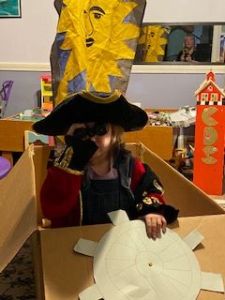 When a new dog-proof garbage can arrived in a box larger than my three year old, it became her favorite toy of the month, and for one of the weeks we turned it into a pirate ship. Anything that keeps a bored three year old busy for a week deserves to be bronzed. We hung a garden flag from a broom handle for a sail, used a brass fastener to make a spinning wheel, dug out costumes from the older kids, watched a lot of preschool pirate videos and read a lot of pirate books. I drew a simple outline map of our living room and taught her to read maps by placing candy in various places as treasure, and marking X on the map. By the third candy, she was proficient on her own. Then we built our finale.
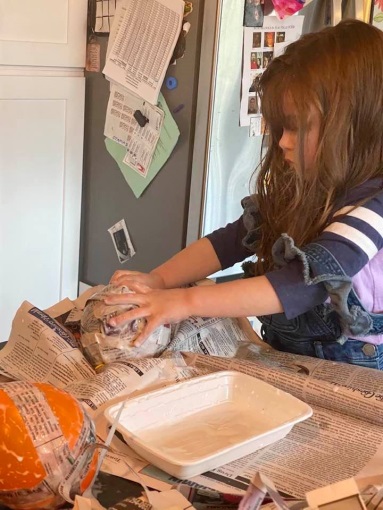 Using balloons, some Cheshire Herald strips, and a little watered down Elmer’s Glue, we made some cannon balls, and then painted them the next day. Then we built our cannon. The cannon balls were about 5 ½ inches, too big for a standard paper tube. But they worked just perfectly for a paint can! So we scavanged a paint can from the garage, which, thankfully, had only an inch of dried paint in the bottom. And these new-fangled plastic paint cans? The paint doesn’t stick! A few taps and peels, and all that dead paint came falling
  right out. A quick rinse, and we were good. I cut the bottom off with my Ginsu knife (a product that has lived up to every claim ever made on it – thirty years later it still cuts fences AND tomatoes, and plastic paint cans). I strung a piece of waistband elastic across the hole, held tight by Gorilla Tape, and we had our cannon. It was tricky getting the right angle, but pull the elastic back far enough with the cannon ball sitting on it, and we could get the ball to shoot four or five feet, which is plenty inside a house.







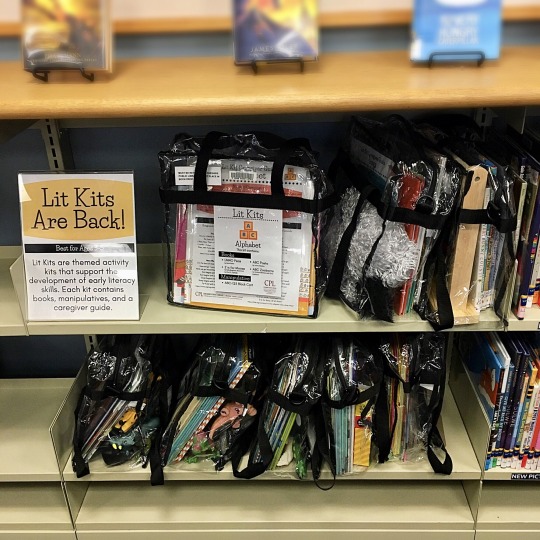 Have you ever wanted to do your own library-style Storytime at home? Well now you can! We’ve revamped our Lit Kits and they are better than ever! These Lit Kits are a great way to take storytime and learning home with you, and help support success in school by providing families with hands-on strategies for building pre-reading and literacy skills while having fun and bonding with your child. They can also help children hit important developmental milestones. Our Lit-Kits are designed for children 3-5 years old, but they can be adapted or modified for use with almost any age group!
 Stop by the Children’s Room to see the new and improved backpacks that are available for checkout. Each kit contains 3-4 books on a theme, toys or manipulatives, and a caregiver guide with suggested songs and activities. The following kits are available: Alphabet, All About Me, Numbers, Ocean, Zoo, Dogs, Things That Go, and Dinosaurs. There will be more Lit Kit topics coming soon, and be sure to be on the lookout for upcoming STEM Kits (ages 5 & up), and Early Literacy Kits (ages 0-3)!
 Early literacy programs at public libraries have changed significantly over the years. Early literacy is everything a child knows about reading and writing before he or she can read or write, typically between the ages of 0-5. Traditionally, children’s library programs focused on the education of children. Today, these programs focus on the education of the parent or caregiver. If you attend
  You can sing in the car whenever you’re traveling and you never have to worry about other people hearing your singing voice.
 Caregivers have the most important role in developing a child’s reading skills, so it is important that you practice these techniques as often as possible. I encourage you to visit the library and check out some of the early literacy programs and resources that we have. To see our full events calendar, you can go to


 And don’t forget to sign up for our summer reading program for kids and adults :
  For kids too young for Snapchat,



 Go outside for a walk! This is one of the best times of year to hang out around the canal trail, when birds who migrated south are coming back and starting to make nests for the spring. You can see turtles, beavers, and snakes at Lock 12, and in the last couple weeks I saw diving kingfishers, big herons, and colorful wood ducks in the new section of trail north of West Main Street.





 The Cheshire Library Blog