This Disc Won’t Play! Part II – Scratch That Idea

So you’ve wiped down your CD or DVD, buffed it shiny, but it still skips, chirps, freezes, and refuses even to advance to the next section.  Now you’ve got a problem. Check that mirrored side.  Chances are, it’s covered with scratches.  Small scratches, especially those on audio media like CDs and audiobooks, and those that run outward from the center to the edge of the disc, may not have any effect at all on performance.  DVDs, however, are much fussier, and a minor ding may create havoc.  Scratches that run around the disc like an old record interfere the most.
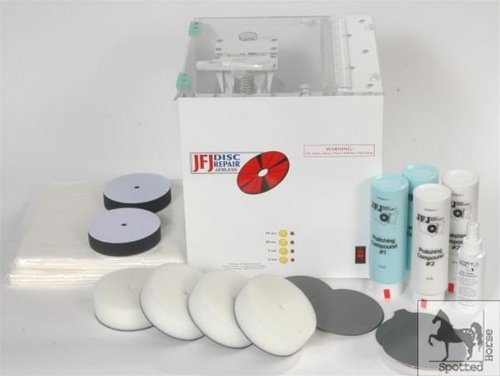
41I5j7KgWNL Cheshire Public Library has professional equipment for resurfacing media discs.  If simply washing and wiping doesn’t help, we put troubled discs through a three-step process. Seriously damaged discs are scoured smooth with fine sandpaper, then buffed back into shape at high speed, and finished off with a polishing coat of protectant. Usually this is enough to bring them back into good-as-new shape. Small, light scratches will disappear; deep gouges – the kind you can click with your fingernail – are a very bad sign and usually cannot be repaired.
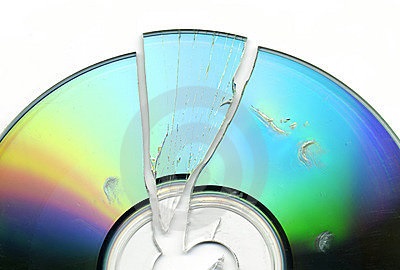
brokenSome damage cannot be fixed. Disc materials are a layer of polycarbonate, a layer of foil, and a layer of lacquer. Any damage to the foil layer, from pen marks, pavement divots, dog teeth, to separation of layers and peeling, is a death sentence for the disc. Likewise, cracks cannot be repaired, because they interfere with that all-important foil layer where the data is stored. Blu-Ray discs are generally much tougher than regular discs, which is good, because they cannot be repaired at all. Blu-Rays have a heavier coating that the cleaning machine cannot penetrate. Amazingly, despite several years of use, we have lost perhaps only two Blu-ray discs because of scratch damage.

The easiest way to keep discs working well is to be gentle with them!  Don’t wrestle them from packaging but press that center hub until the disk releases. Always handle them by the edges, and replace them in their case as soon as you are finished with them.  Make sure they click onto that hub – shaking around loose in the case will scratch them! Don’t let children play with them, and don’t leave them where your dog can chew them. Be especially careful with items you listen to in the car: the sand you carry in the carpeting of your automobile can damage a disc exceptionally fast. If a disc won’t work, let us know, so we can fix it as soon as possible – tell us which disc of a set, which scene or which track if possible.  If the case is broken and the disc is rattling inside, tell us, because those broken hubs are little scratch factories. Disc materials are an expensive part of library acquisitions, and we work hard to keep them in the best shape they can be.

This Disc Won’t Play! (part 1, Fingering the Culprit)

imagesYou’ve put in your favorite CD or DVD, and the stupid thing just won’t play!  It skips, it freezes, it pixelates into pretty colors, or the player spits it out and declares “Bad Disc!”  Your heart was set on that, and now you’re out of luck and your kids are getting cranky.

Don’t despair! The solution is often very simple. By far, the most common, annoying, easily fixable problem with disc materials is FINGERPRINTS.  Turn it over and look at the non-label side. It should look like a mirror.  Are there fingerprints?  Is coffee spilled on it? Or maple syrup (that’s happened)?  CLEAN THE DISC.

“But it’s a library disc!” you say.  “If I damage it, they’ll charge me!”  Don’t worry.  While discs are fragile, they’re more durable than you think.  Some of our discs have been used more than 150 times and still play fine. CDs and DVDs are made from polycarbonate, with a layer of foil (gold or aluminum) protected by a layer of lacquer.  That’s the same plastic as your eyeglasses!  General rule is, if it’s safe for your eyeglasses, it’s perfectly safe for a disc.  You can clean them with eyeglass cleaner, water, hand sanitizer, baby wipes, even liquid dish soap, but *make sure you clean them with a liquid*.  You can even rinse them under the tap if you must. To dry them, you can use a glass-cleaning cloth, a clean piece of flannel, or in a pinch, a clean cotton dishcloth or Tshirt.

DON’T: rub the mark with something dry, use a paper towel, newspaper, or rough cloth.  All these things will leave fine scratches on the polycarbonate.  If the laser can’t penetrate the polycarbonate layer, it can’t read your disc.  You can clean them with Windex or window cleaner, but repeated exposure to the ammonia in them can eventually dull and damage your disc. Don’t run them through the dishwasher.

cd-cleaningClean the disc, try it again.  Audio CDs (music or audiobooks) are very forgiving.  They can look scratched and still play fine. Sometimes it’s the player: what plays perfectly in your computer or your cd player won’t play right in your car. DVDs, with their video component, are much fussier, and Blu-rays the fussiest of all.  If it still won’t play right, bring it back, but stick a note on it or tell us, and we’ll give it a more thorough diagnostic.  Be especially careful with those awful double-sided DVDs – always hold them from the very edge, or you’ll be cleaning one side while dirtying the other.

With a little polish and a little luck, you’ll be singing along again in no time!

Make Tonight the Night

imagesEver notice how some people seem to have it all – talent, timing, and a killer smile?  John Barrowman has all that, and more.  Born in Scotland and raised in Illinois, Barrowman is an actor with a huge array of talents.  You may not know his name, but you may have come across his face.  He’s performed on Broadway (Anything Goes, Putting It Together), done extensive theater in London’s West End, done American TV (Titans, Central Park West, Desperate Housewives), frequently featured on BBC programs (including Any Dream Will Do and Tonight’s the Night),  appeared in feature films (The Producers, De-Lovely), and written three books. He is most well-known for the lead role of the time-hopping, immortal rascal Captain Jack Harkness on the BBC TV series Dr. Who and Torchwood. And on top of all that, Barrowman is a singer.

And an accomplished singer at that – he has more than ten albums to his credit, some of which have debuted as high as number twelve on the British album charts.  Whether he honed his voice on Broadway, or it was his voice that put him there is anyone’s guess, but he certainly has the capability to belt out a tune with the best of them.

Cheshire Library recently acquired his album, Tonight’s the Night: The Very Best of John Barrowman.[Cover] Barrowman is a showman, singing cover songs, but if you like easy listening – Barry Manilow, Neil Sedaka, Broadway singers, America’s Got Talent – give Barrowman a try! This album is nice in that it allows enough of a variety to really showcase some of his talent. My favorite tracks: You’re Just to Good to Be True and The Winner Takes It All.  Weakest: Few people should be singing The Police, outside of The Police, and his Americanized over-enunciation on She’s Always A Woman  bothers me.  Barrowman has a fantastic voice that tends to be held back by poor musical direction – slow, plodding music does him no good.  He needs those catchy all-out showtunes to really shine – and he’s one star that shines very brightly.

The Great Gig in the Sky

This month marks the 40th anniversary of one of the most seminal rock albums of all time: Pink Floyd’s Dark Side of the Moon, which was released in March of 1973.

220px-Dark_Side_of_the_MoonDark Side of the Moon, with its iconic album cover of a prism and rainbow on a black background, holds the American record for most weeks spent on the album charts – 741 weeks. That’s  more than 14 years!  Johnny Mathis had been the previous record holder, at 10 years on the charts. Most major music lists consistently place the album in the top 50 rock albums of all time.

Dark Side became Pink Floyd’s most successful album at more than 50 million copies sold, more than double their hugely successful 1979 rock opera, The Wall.  The album was Pink Floyd’s first attempt at a concept album, loosely following former bandmate Syd Barrow’s decent into mental illness, as later would The Wall.  Interspersed among the lyrical 12-string guitar solos and ethereal synthesizers are snippets of conversation, clocks, helicopters, and of course, the rhythmic banging and chiming of cash registers at the start of Money – an early melodical version of Stomp!, combined with classic rock beats and timeless lyrics.

I received my first copy of the album sometime around 1978 – so long ago I had the album on 8-track!  Now, on CD, it remains perhaps one of my top-20 favorite albums, wonderful for relaxing to or as a background music for writing or painting. My favorite way of listening to it?  With noise-canceling headphones, in total darkness, where the quadraphonic effects bounce around you out of nowhere, the music carries you away, and you lose all track of time.  If you haven’t experienced the album, give this piece of music history a try.  If you have, it’s the perfect chance to reacquaint yourself with a classic.

I Sing the Body Elektra

Did you know that March is International Women’s month?  In 1977, the United Nations declared March 8 International Women’s Day,  a day for women’s rights and world peace. This year’s theme is  “A promise is a promise: Time for action to end violence against women.”  One way to support women is through their music.

67567-004-AB9F6AADWomen have long been an important part of the music scene.  Swedish opera singer Jenny Lind, who toured with P.T. Barnum in 1850, was arguably America’s first singing superstar, performing more than 93 concerts and earning more than $350,000 – today’s equivalent of more than $10 million.

The first female Grammy winner was Ella Fitzgerald – who won in 1959, 1960, and 1961!  Ella won for Best Female Pop artist, but we file her sultry swing under Jazz. Check out Ella’s albums  Pure Ella, Ella Sings the Cole Porter Songbook, and  The Ella Fitzgerald Gold Collection.AFranklin_-_Knew_You_Were_Waiting_-_COVER-1

The first woman inducted into the Rock and Roll Hall of Fame, however, was Aretha Franklin, in 1987. Cheshire Public Library has several of Aretha’s albums, including The Great American Songbook, Jewels in the Crown, and the Very Best of Aretha Franklin.

madonna-ray-of-light-coverThe top-selling female singer of all time?  Madonna, with certified sales of more than 160 million albums.  That puts her at the fourth-highest selling performer of all time, after Elvis, the Beatles, and Michael Jackson.  Not bad company at all for a Material Girl!

Who’s YOUR favorite female vocalist or band?