One to Watch: After Earth

After Earth is a big-budget ($130 million) science-fiction adventure film starring Will Smith and his son Jayden as a father & son who crash-land on Earth a thousand years after man has abandoned it, and the adventure they have trying to escape the dangerous wild habitat the Earth has become. Smith himself came up with the basic story, and worked with screenwriter Gary Whitta to carry the idea further.  Due for release on May 31, 2013, it is expected to be a blockbuster.

Will Smith, acting as producer, hired director M. Night Shyamalan (Unbreakable, The Sixth Sense, Signs) for the film. This was the first time in twenty years that Shyamalan accepted a project based on someone else’s screenplay (the final screenplay was done by Stephen Gaghan). This would also be Shyamalan’s first digital film.

Science-fiction adventure stories come and go, but what makes After Earth a [Cover]unique film is the backstory. Normally, a film is scripted, filmed, and then if it is successful, writers are hired to create backstory, a “Bible” from which movie tie-ins, novels, short stories, and future scripts can draw material to make a unified vision of that world.  After Earth is the first film to flesh out its backstory before the scripting was even finished. Three expert writers were hired for that task: Peter David, Robert Greenberger, and Michael Jan Friedman, all of whom were well-versed in writing not only successful science-fiction and comics, but media tie-ins as well. All three collaborated in creating the “universe” in which the story takes place, the what, why, where, when and how, working on set with Smith, Shyamalan, and the scriptwriters to make the story as cohesive and believable as possible.

As told to me by Bob Greenberger, the three authors worked from the original Whitta script, taking tiny open references and creating minute details that would answer any questions the production team might have as to what cataclysms sent man from Earth, why Nova Prime, and what happened in the intervening years. Over a period of two years, this background encyclopedia grew to more than four hundred pages! If you’ve seen anything about the film in print, on the internet, or in film references, you can pretty much guarantee that information came from their work.

Of course, such detail and planning spawns stories on its own. Several novels centering around the movie are poised for release: After Earth, the novelization of the[Cover] film by Peter David, The Perfect Beast (After Earth: Ghost Stories) by Peter David, Robert Greenberger, and Michael Jan Friedman, and After Earth: United Ranger Corps Survival Manual by Robert Greenberger, as well as several short e-stories available for Kindle Purchase, with more to come in the ensuing months.

With a top-notch cast and writing crew like that, how can After Earth be anything but a hit? Check out these other books by these great authors, (or meet them in person at the Shoreleave Science Fiction Convention in Baltimore this August).

[Cover]   All Good Things...  [Cover]

Why Gone With the Wind Is My Favorite Book

On May 3rd, 1937, more than 76 years ago, Margaret Mitchell won the Pulitzer

Gone With the Wind

Prize for Fiction for her epic Gone With the Wind. 76 years later, GWTW is still a powerful book, read anew by readers young and old.

My husband had recommended for a long time that I read GWTW, and it was on my to-read list for some time. We had distractedly watched the first half of the movie sometime in spring 2010, but I did not start reading the book until April 2011 for our Classics Club here at the library.

GWTW can appear to be a daunting book for those who do not typically read lengthy tomes. But from that opening page, when we are introduced to the indomitable Scarlett, on her way to a party, and we are drawn into a world we will never want to leave, or stop reading.

Oh, Scarlett, Scarlett. Some who have read the book or seen the movie, simply “can’t stand Scarlett.” Well, that’s the point. We are not meant to like Scarlett. She’s perhaps literature’s most misunderstood character. When we first meet Scarlett, she is an impetuous 16 year old lusting after Ashley and looking for excitement. Scarlett stumbles on her journey, making terrible choices, wrong decisions, and sometimes ruining the lives of others (and sometimes purposely). She can be annoying, manipulative, and deceiving. But Scarlett at her core loves her home and her family. By the end, Scarlett has realized how her foibles have affected others. She has lost everything.

My husband has rightly pointed out that Scarlett is representative of “the Old South” before the Civil War. The South had to lose everything in the war, including some of that impetuousness like Scarlett has, before they can learn from their mistakes and rebuild. Scarlett is torn down, lost everything, just like the South was during the Civil War, but together the two can start anew.

We rewatched GWTW while I was reading it for Classics Club, and I’ll never forget the ending. I had not reached that part in the book yet, and I yelled at the tv. “What! What! This is not right! This is not how it happens in the book! It can’t be!” And I ran up the stairs, grabbed the book and read the ending. Oh my. It was how the book ended. I’m still indignant over the ending. But I have two sequels to make the story complete, in my eyes.

GWTW is, in my opinion, our American novel. It speaks to our American experience in terms of struggle, triumph, and the American dream. It’s an epic novel about a society that no longer exists, a way of life that will never be again. GWTW is about more than Scarlett, it’s about a way of life that was destroyed and a people who have to find their way in an unfamiliar world.

GWTW is one of the few books I give 5 stars.

James Cromwell films

james cromwellYou may not know his name, but chances are you know his face. James Cromwell is one of those lucky actors who never seems to want for work, with more than 163 film and television credits to his name.  At 6′ 7″, he is the tallest actor ever nominated for an Oscar. Born in 1940, educated at Middlebury College and Cal Tech, Cromwell has been cropping up everywhere since the early 1970’s, and is still going strong.  A staunch vegetarian, he was once arrested for protesting a Wendy’s in Virginia.  Total Film ranked him 56th of the Top 100 Greatest Movie Villains for his role as Captain Dudley Smith in L.A. Confidential, which many people think he should have won an Oscar for. Whether you remember him as Farmer Hoggett in Babe (his Oscar nomination), Zephraim Cochrane in Star Trek: First Contact, or Archie Bunker’s loading d0ck buddy Stretch Cunningham in All in the Family (yes, that was James Cromwell), you’ve probably seen his work. Whether funny, serious, or villainous is your style, get that popcorn going, sit back, and check out some of these great Cromwell performances!

[Cover]        [Cover]

This Disc Won’t Play! Part II – Scratch That Idea

So you’ve wiped down your CD or DVD, buffed it shiny, but it still skips, chirps, freezes, and refuses even to advance to the next section.  Now you’ve got a problem. Check that mirrored side.  Chances are, it’s covered with scratches.  Small scratches, especially those on audio media like CDs and audiobooks, and those that run outward from the center to the edge of the disc, may not have any effect at all on performance.  DVDs, however, are much fussier, and a minor ding may create havoc.  Scratches that run around the disc like an old record interfere the most.

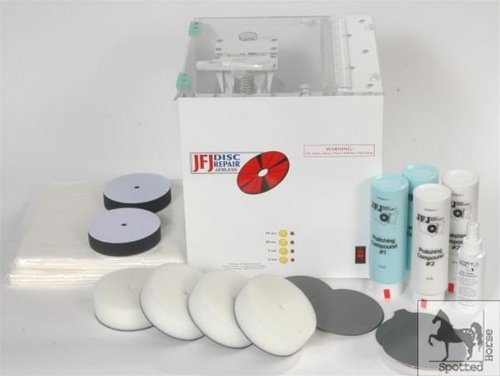
41I5j7KgWNL Cheshire Public Library has professional equipment for resurfacing media discs.  If simply washing and wiping doesn’t help, we put troubled discs through a three-step process. Seriously damaged discs are scoured smooth with fine sandpaper, then buffed back into shape at high speed, and finished off with a polishing coat of protectant. Usually this is enough to bring them back into good-as-new shape. Small, light scratches will disappear; deep gouges – the kind you can click with your fingernail – are a very bad sign and usually cannot be repaired.

brokenSome damage cannot be fixed. Disc materials are a layer of polycarbonate, a layer of foil, and a layer of lacquer. Any damage to the foil layer, from pen marks, pavement divots, dog teeth, to separation of layers and peeling, is a death sentence for the disc. Likewise, cracks cannot be repaired, because they interfere with that all-important foil layer where the data is stored. Blu-Ray discs are generally much tougher than regular discs, which is good, because they cannot be repaired at all. Blu-Rays have a heavier coating that the cleaning machine cannot penetrate. Amazingly, despite several years of use, we have lost perhaps only two Blu-ray discs because of scratch damage.

The easiest way to keep discs working well is to be gentle with them!  Don’t wrestle them from packaging but press that center hub until the disk releases. Always handle them by the edges, and replace them in their case as soon as you are finished with them.  Make sure they click onto that hub – shaking around loose in the case will scratch them! Don’t let children play with them, and don’t leave them where your dog can chew them. Be especially careful with items you listen to in the car: the sand you carry in the carpeting of your automobile can damage a disc exceptionally fast. If a disc won’t work, let us know, so we can fix it as soon as possible – tell us which disc of a set, which scene or which track if possible.  If the case is broken and the disc is rattling inside, tell us, because those broken hubs are little scratch factories. Disc materials are an expensive part of library acquisitions, and we work hard to keep them in the best shape they can be.

’42’ – A Movie About Jackie Robinson

movie 42The movie ‘42′ is set to be released Friday, April 12th.   It tells the life story of Jackie Robinson (played by Chadwick Boseman) who became the first African-American to play professional baseball.  He signed with the Brooklyn Dodgers where team executive Branch Rickey (played by Harrison Ford) guided Robinson through this momentous time.  The movie is already generating positive buzz with great reviews and high praise.

The Cheshire Library has several books about Jackie Robinson that you might want to read – for both children and adults.

Adult:

Jackie Robinson and the Integration of Baseball by Scott Simon

The Jackie Robinson Reader: perspectives on an American hero by Jackie Robinson

Jackie Robinson by Arnold Rampersad

Children:

Jackie Robinson by Tony DeMarco

Stealing Home : Jackie Robinson: Against All Odds by Robert Burleigh

Jackie Robinson and the Story of All Black Baseball – by Jim O’Connor

There are also more titles to choose from.  The Children’s Librarian or Reference Librarian can help you locate them.