One Book, One Town, One Difficult Choice!

The Cheshire Public Library is planning on hosting a One Book, One Town program in 2025. For those unfamiliar with this concept, the idea is to select a book the whole town can read “together”. The library will host a kick-off party and plan programming based on the book’s narrative and themes. We are so excited for this chance to bring the community together under one book, and we’ve been giving the selection process a lot of thought. As a fun peek behind the curtains, I would like to talk a little about the books that we thought could be potential contenders and the reasons why they weren’t selected.

The first novel we considered for this program is Overstory by Richard Powers. This is a dense novel both in size (512 pages) and in content. The story follows 9 characters spanning from the 1950s through the early 2000s as their stories overlap. It’s difficult to say exactly what Overstory is about. It’s a novel about trees, but really, it’s a novel about people, nature and how closely these two worlds overlap. It’s a novel about the importance of paying attention to nature as well as tackling questions about what we can do, both as individuals and collectively, to protect nature and each other. It is beautifully written, each character given their own story and arc. It is also a powerful love letter to trees.

Ultimately, we decided not to choose this book for our program because of its length and concerns about being able to secure the author for an author talk. Powers will be busy with press for his new book titled Playground about oceans, which I am sure is as masterfully written as Overstory. If you can carve out time to read this novel, I highly recommend it.

The second novel in the running for this program was The Great Believers by Rebecca Makkai. Like Overstory, The Great Believers also made it onto the New York Times list of the best 100 books of the 21st century. The story jumps in time; one part is set in Chicago between 1985 and 1992 and the other in Paris in 2015. The novel is about a group of friends, predominantly gay men, navigating the AIDS crisis in its early days. This is the strongest part of the novel. Makkai captures the fear, loss, and grief from this era while still managing to tell a beautiful story about love and friendship. As the reader, it is easy to fall in love with these characters and feel tremendous sadness about the senselessness of their deaths.
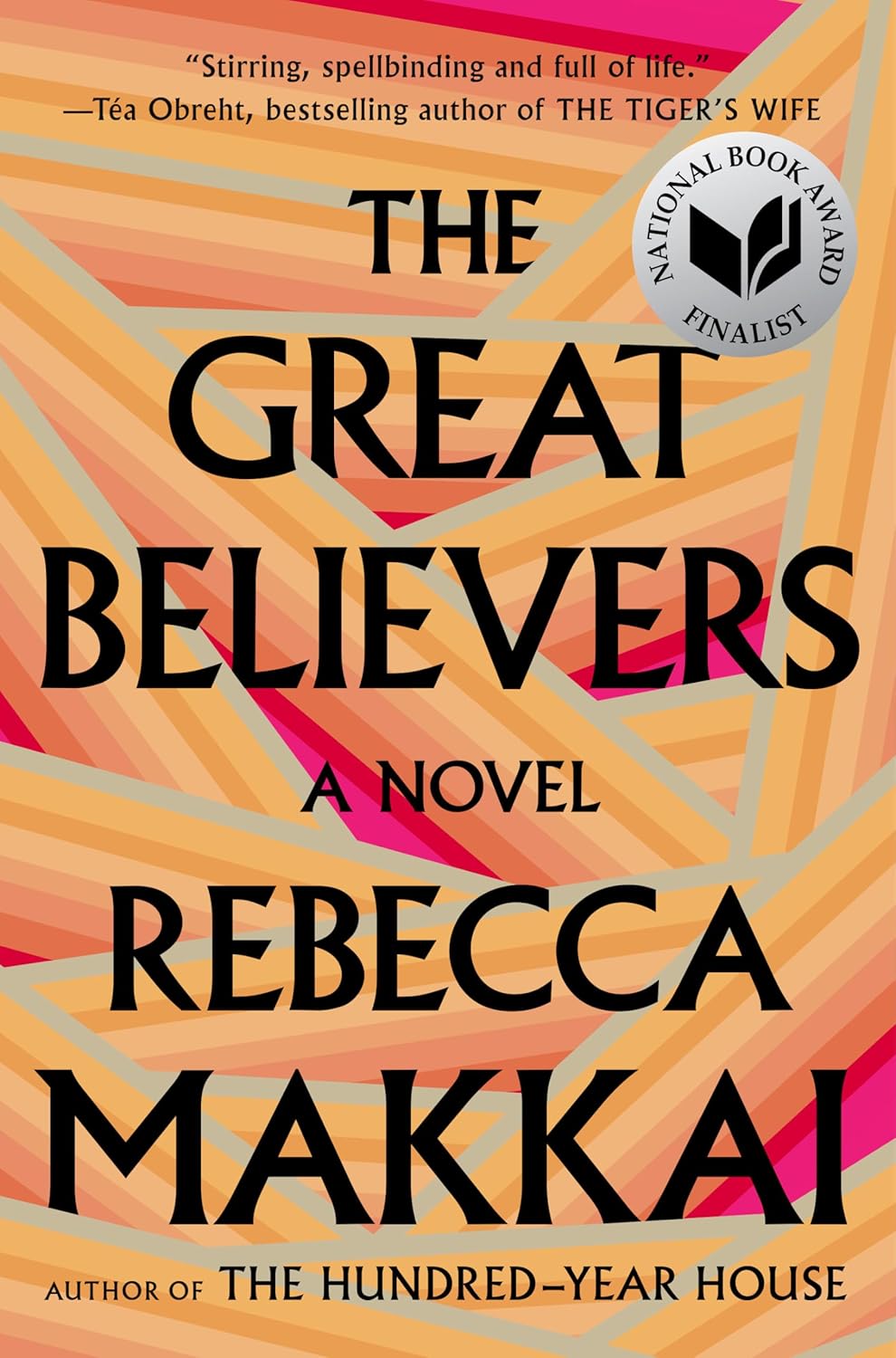
Unfortunately, the parts of the novel that take place in 2015 are less effective. Much of these chapters, which concern survivor’s guilt and lasting trauma, feel extraneous and only serve to distract from the gripping 80s narrative. We decided against this book partly because of these jarring time jumps, as well as concern about the overall heaviness of the subject matter. That being said, if you are looking for something on the power of love and friendship, please don’t hesitate to pick up this book.

The last novel strongly considered for our One Book program was The Women by Kristin Hannah. The hype around this novel has been almost as big as the number of patrons requesting it at the library. The story is about combat nurses in Vietnam and their lives after the war. It’s a difficult read, particularly in its depiction of post traumatic stress disorder. The resources for soldiers returning from the Vietnam war were abysmal and the resources for returning female combat nurses were non-existent. The novel deals with the struggles of settling back into civilian life while having your war experiences repeatedly minimized or even denied.  

This book would appeal to a wide audience, particularly those who lived during the Vietnam War, those who served in the war, or those who are interested in the history of that era. We decided against selecting this book because Kristin Hannah’s speaking fees are prohibitively expensive.

We are hoping to finalize the book selection for the program by the end of this month so be sure to keep an eye out early next year for the book unveiling as well as a list of programs. We can’t wait to read with you!

Freedom to Read

Almost every evening, my husband and I take a walk around our neighborhood in New Haven.  And stapled to almost every telephone pole, are numerous flyers in varying states of decay. Notices for tag sales, concerts, scientific studies and lost pets paper poles along our route.  Occasionally, someone uses this unofficial public forum to express their political viewpoint.  Recently I passed a flyer with language that I found offensive, and my first urge was to rip it down.  After all, technically people aren’t allowed to post flyers on telephone poles.  And there are children walking by who shouldn’t be exposed to that kind of language.  I would be doing a good thing for our neighborhood by removing the offensive poster.  And then my personal feelings took a backseat as I reminded myself we live in a society where free speech is a constitutional right.  While I may have a negative reaction to flyers or books with viewpoints that I disagree with, I prefer to live in a world where everyone is free to choose what they read or don’t read.  So, I averted my eyes and kept walking.

This week the Cheshire Public Library is celebrating Freedom to Read Week (formally known as Banned Books Week) to highlight the dangers of censorship.  This annual celebration was launched in 1982 by the American Library Association’s Office of Intellectual Freedom (OIF) in response to an increase in book challenges.  Interestingly, forty-plus years after the first Banned Books Week, the nation is again experiencing an increase in book challenges.  According to the OIF, in 2023 4,240 different titles were challenged which represents a 65% increase over 2022.  Books representing LGBTQIA+ and BIPOC individuals account for 47% of those titles targeted for removal.  According to the OIF Director, Deborah Caldwell-Stone, “This is a dangerous time for readers and the public servants who provide access to reading materials. Readers, particularly students, are losing access to critical information, and librarians and teachers are under attack for doing their jobs.”

It would be dishonest to say that librarians don’t struggle with buying books whose content they disagree with.  But providing a collection that represents diverse viewpoints is fundamental to supporting ALA’s Freedom to Read Statement which asserts that the ability to read freely is essential to our democracy.  This is not to say that everything published makes it into the collection as librarians also must be careful to curate materials based on the authority of the author, accuracy of content, and even price and format.  For a full list of the criteria used at the Cheshire Library please see our Materials Selection Policy.

As part of our celebration of Freedom to Read Week, staff have created two drop-in activities for all ages that will be available during our regular hours of operation:

Guess the Challenged Book Game where a copy of a challenged book has been shredded and placed in a jar.  Each day a new clue is added to help you solve the puzzle.

Shine a Light on Censorship Scavenger Hunt where each participant will be given a small black light to use to uncover cleverly hidden letters and solve a secret word.

Whether you stop in this week to try one of our activities or visit anytime in future, we hope you will register for a library card and borrow materials so you too can read often and read freely.

Did You Know: Lesser Known Library Materials

I was recently helping a patron at the circulation desk when someone returned a mobile hotspot. The patron I was helping was pleasantly surprised to learn that we have them available to borrow. As a result, I thought I’d write about some of the items the Cheshire Public Library has available that you may not be aware of.

We currently own six mobile hotspots you can borrow. What is a mobile hotspot? A mobile hotspot is a little box that works like a Wi-Fi router to bring you wireless internet. You power it up and can connect phones, computers, and TV streaming devices. They are great for traveling when you may not otherwise have access to the internet, and come with easy-to-follow directions on how to set them up and a number to call for help during library hours. Ask for one at the circulation desk on the main level or reserve one here.

Also great for vacation are selfie sticks! The two selfie sticks we have available use Bluetooth. You pair the selfie stick with your phone the same as other Bluetooth devices like speakers, keyboards, or Apple Watches by accessing Bluetooth settings on your phone. They are great for all kinds of situations: when no one is around to take your photo, when you want to photograph an expansive area beyond the reach of your arm, when you want everyone in your group to be in the photo, or when you’d rather not hand your smart phone to a stranger. Ask where to find them at the reference desk on the lower level or reserve one here.

Patrons are often surprised to hear we have boomboxes available to checkout. These are useful for audio books and music CDs. They can also play the radio, which is handy at the drive-in movies so your car battery doesn’t die! Ask where to find them at the reference desk on the lower level or reserve one here.

We also own three portable CD players. These include a car kit that attaches to your car stereo, making them another useful item for traveling! They are especially wonderful for listening to audio books during long drives when you don’t have a CD player in your vehicle. Like the selfie sticks and boomboxes, these can also be found on the lower level. Reserve one here.

While the games located in the Teen Room are for library use only, we do have an extensive selection of board games you can bring home to play. They are located on the main level near the Fiction books. You can find the list of what we own, and reserve one if you like, here.

Mobile hotspots and board games can be checked out for 2 weeks. Selfie sticks, boomboxes, and portable CD players can be checked out for 3 weeks. These items will automatically renew once as long as no one else has placed a hold on them.

Please note that the items listed above will be held behind the circulation desk on the main level for pick-up if you put them on hold, and not on the hold shelves at the front of the library. We ask that they all be returned to that same desk inside the library; they are all delicate, and we want to make sure they do not get damaged and are available for the next person.

The final items you can borrow for use outside the library are ones my own family has utilized throughout the years: museum passes! However, our passes are not just for museums. We also have passes for State Parks Centers, a Nature Center, and even Mystic Seaport! Look through our collection here, where you can decide whether to search by venue or date. You can reserve passes up to 30 days in advance.

Once you decide on your venue and date, simply print the pass from home*. If you don’t have a printer available, come to the library and ask to have it printed for you. Some of our passes are also available digitally and do not need to be printed at all. The printable/digital passes are good only for the date you reserve them, so no need to worry about late fees.

*While most passes can be printed out at home, the “CT State Parks Centers and Historical Buildings” pass must be picked up at our reference desk. This pass is subject to a $10 per day late fee. The “CT Science Center” coupon we offer must also be picked up at the library, but does not have any associated late fees.

The last items you may want to know about are not things to borrow, but rather things you may have left behind. The Cheshire Public Library has Lost and Found bins in both the adult and children’s areas; please ask about them next time you come in. We also keep smaller and/or more valuable items behind the circulation desk on the main level, so whether you are missing an earring, glasses, or a notebook full of all the books you’ve read, please be sure to ask.

I hope you found this information informative. If you have any other ideas for things you’d like to see The Library add to its collection, whether books or items, please let us know here. You never know, you might find it at at the library in the future!

Save Your Memories

In December of 1983, we didn’t have internet. We barely had personal computers – a 256k machine cost $500, and you had to program it yourself. You couldn’t just save to disk, you had to format the darned thing before you could even use it. Video tape machines cost $600, and DVDs were still a dream. We were on the cusp of the CD player, but the real world still ran on cassette tapes. 

I was no different, with a cassette tape built into my stereo, eagerly recording songs and programs off the radio as they played live. Yes, we still listened to live radio programs back then, whether Casey Kasem’s American Top 40 Countdown, or Radio Mystery Theater, or, on Sunday nights, Dr. Demento, the leading program for off the wall parody and novelty music.

What’s novelty music? Novelty music is a humorous song that doesn’t fit in any other category but entertainment. You know it well. Alvin and the Chipmunks is novelty music. Barnes and Barnes’ Fish Heads. The Purple People Eater. The Monster Mash. Itsy Bitsy Teeny Weeny Yellow Polka Dot Bikini. Steve Martin’s King Tut. Anything by Tom Lehrer or Weird Al Yankovic. While it’s a serious industry with all the requirements of mainstream music, and such songs can hit high on the pop charts (The Monster Mash hit #1), novelty music isn’t considered “serious” music. 

On that Sunday, it was the Christmas edition of Dr. Demento, and I threw a cassette in the player and hit record, because, back then, Grandma Got Run Over by A Reindeer was just a basement tape on Dr. Demento, it hadn’t gotten a contract yet. Weird Al wasn’t mainstream, and hadn’t gotten permission from the Kinks yet to record his Lola parody Yoda. On that tape, I happened, by luck, to record a song that in the history of radio may only have been played one time. It was a “bonus” track to fill space, and it was the only time it ever appeared on Dr. Demento. It hasn’t even been uploaded to his website. And it is one of my absolute favorites of underground tapes. In the era of the cold war, that song scared the living daylights out of me.

Cylent Night, by the Scrooge Brothers, tells a short story of the start of World War 3 to the tune of Silent Night, while air raid sirens start in the background and grow slowly louder. Off went the bomb at a quarter to three/ It’s the end of you and the end of me….  Have that hit you out of nowhere when you’re listening to the radio at 10 at night in your basement. In 40 years, I’ve never forgotten a line. And I just happen to have that song on tape. 

But cassette tapes are fragile things. They demagnetize. They fade. They tangle. My very rare basement tape has been bouncing around drawers and basements for 40 years. So what did I do? With the equipment at the Cheshire Public Library AV Studio, I very easily threw that cassette into the player and transferred that song to digital Media. Now I can store it digitally, share it with other Dementoids and Dementites who have never heard it (if you didn’t hear it live, you truly never heard it), even send it back to Dr. Demento. 

We all have those things kicking around our homes. Media changes so rapidly, from reel to reel tapes to 8 Track to cassette to CD to memory stick. We all have Grandma’s vacation slides of the Old Country, with relatives no one ever met. Dad’s wedding videos. That old LP you have that’s never been released on CD (or singles, like Rolf Harris’s Two Buffalos, which Bob Steele used to play on WTIC-AM). Your personal video of MTV’s top 100 countdown of 1985, when music videos were short stories of their own. You can transfer all of them to digital media, right here.

Beware, though – transfers occur in real-time. If you’re planning on transferring that 12-hour MTV countdown, it’s going to take 12 hours to put it onto digital. You might want to do it over a few weeks. But that LP? 40 minutes, you’ll be done.

Call (203) 272-2245 ext. 61245 to schedule an appointment at the AV Studio!

The Third Place

I am currently rewatching my favorite television series of the 1990’s, Northern Exposure. For those not familiar with this program, the show offers viewers a glimpse into the quirky lives of residents living in the small, close-knit town of Cicely, Alaska. In a recent episode, resident bush pilot, Maggie O’Connell, meets up with other locals at the town’s laundromat. Within the drab space, residents share the latest gossip as they plug coins into battered washers and dryers. Upon discovering that one of the machines has destroyed some of her clothing, Maggie decides it is time to buy her own washer and dryer. However, soon after the new set is delivered to her home, Maggie realizes it was not just about washing her clothes but the sense of connection and community the activity brought (remember, this is pre-internet and social media!). She tries calling other residents while her washer is running but they are too busy to talk on the phone. She extends invitations to friends to do their laundry at her house, but they decline. Through her experience, Maggie comes to realize the laundromat functions as the village’s “third place.”

Urban sociologist and author, Ray Oldenburg defines the concept of “third place” as distinct from a person’s “first place” which is their home and their “second place” which is work. The “third place” is defined as an informal gathering spot where members of the community can come together and exchange ideas. Traditionally, these are places such as pubs (epitomized in another great TV show, Cheers), post offices, coffee shops, barber shops or even main streets. According to Oldenberg an important facet of the “third place” is neutrality. All members are welcome to gather and freely express their viewpoints. As such, Oldenburg says “third places” are vital to the success of a democratic society.

By Oldenburg’s definition, libraries can be considered a “third place” in a community. As librarians we take great care to ensure that our buildings, services and collections are free and accessible and that all are welcome regardless of socio-economic status. While today the internet and social media allow people to connect instantaneously without leaving home, there is still a desire for people to connect with others in person.  

Library programs such as book clubs, storytimes, and educational lectures are designed to bring people together to meet and share ideas and points of view. These programs allow people to find support for their challenges from others who are going through similar situations. Throughout my career I have witnessed mothers sharing childrearing strategies in storytime, teens who feel they do not fit in finding a peer group, and adults finding hope from the experiences of others dealing with the same mental and physical health issues. 

It is a common misperception that libraries are only about books. The concept of the library as a “third place” raises the definition beyond a resource for reading or research materials. It extends the organization’s mission to be a place where those who feel excluded elsewhere can find a sense of belonging. Where those who need a respite from life’s challenges can find calm. Where those who thought they were so different from each other can find commonality and connection. It allows the library to play a key role not just, as Oldenburg says, in protecting democracy, but also in helping create a more humane society where all are treated equally and with respect. 

At the end of the episode, Maggie reports that her new washer and dryer are not working correctly and convinces the technician that they need to be sent back to the factory despite his reassurances he can fix the problem onsite. He tells her sending the machines back to the factory could mean she is without them for an extended time (it is Alaska after all) but she insists. In the final scene, Maggie is happily back in the dingy, detergent-smelling laundromat listening to the latest news and finding community with her fellow residents. If you are looking for such a place in Cheshire, I hope you will stop by the library soon and discover all this wonderful “third place” has to offer.