NOTE: This post deals with a difficult subject matter, serial killers, so if you’re easily disturbed, you might not want to read any further.
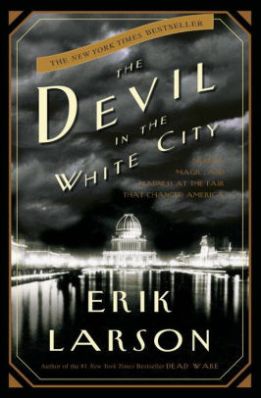 A book kept passing through my hands and it seemed intriguing – psychopath, history, award-winning – probably good, and I read it at last. The Devil in the White City by Erik Larson tells the true story of the great Chicago World’s Fair of 1893, a celebration of Columbus’s 400th anniversary of discovering the new world and an attempt to outdo the 1887 Paris World’s Fair, which amazed the world with the new Eiffel Tower, the tallest structure in the world. The fair covered more than 600 acres – almost six times the size of Disney’s Magic Kingdom – and attracted more than 27 million visitors in its 6 month-run (versus 20 million visitors to Magic Kingdom in 2016). It also chose Tesla’s AC electric current to power it because it was cheaper than Edison’s DC current, cementing the road for America’s future electrical grid.
Chicago was no charming city, known for stink (stockyards), grime (trains and soot),  crimes and vice. And in this mix lurked a serial killer, H.H. Holmes. Holmes’s background was a perfect mix of known factors of psychopathic development – strict, cold, abusive parents with severe religious obsession. By the age of 6, Holmes liked to dismember animals, and by his teens was implicated in the death of a young boy but cleared due to the pitiful state of investigations. He fled to Chicago, where he became a con artist, bilking insurance companies, furniture companies, and drug supply stores. He also charmed single ladies, killed them, reduced them to skeletons, and sold them as medical supplies. He built an elaborate hotel nicknamed “The Castle,” complete with gas jets in the rooms, soundproof rooms, and a personal crematorium in his basement. When finally cornered for killing his long-time assistant, Holmes confessed to 29 killings, though only 9 could be proven, but his total might have been as high as 200. He was hung for his crimes. Leonardo DiCaprio bought the film rights to the book, and a film is in production with Martin Scorsese as director (it had a tentative 2017 date, but is still in process).
 Serial killers – those that kill large numbers of victims over time – are rare as far as murder goes, but the extent of their crimes garners a lot of press. Connecticut has its own serial killer in Amy Archer Gilligan of Windsor, who killed as many as 48 of her nursing-home patients for insurance claims between 1885 and 1917. Some of the more notorious American serial killers include:
Jeffery Dahmer (1991), who killed (and ate) at least 16 young men and boys. Not a high count for a serial killer, it was the cannibalism that made him famous. He was beaten to death in prison not long after his conviction. Some things scare even murderers.
John Wayne Gacy (1978), who dressed as a clown for kids’ birthday parties and killed more than 33 men. Stephen King said “It” was fiction.
Charles Cullen (2003), convicted of 40 murders while he was a nurse, but possibly responsible for up to 400, making him the most prolific not only in New Jersey, but the USA. Carl Watts (1982) was also a nurse, convicted of six murders but possibly as many as 130.
Ted Bundy (1975), one of the most famous and perhaps sickest, who killed more than 30. He decapitated at least 12 victims and kept the heads in his apartment, and often performed sex acts on rotting corpses (I warned you). He was executed in Florida.
Gary Ridgeway (2001) the “Green River Killer”, with 49 proven deaths, 71 confessions, with a probable total closer to 90.
Ed Gein (1957)– Gein was convicted of only two murders, but if you’re looking at psychopaths, Gein is King. Gein had a bizarre attachment to his mother (back to that cold/abuse/super-religious thing), and would go to graves and dig up women’s bodies, skin them, and save parts attempting to wear his mother. Gein was the inspiration for Psycho, The Texas Chainsaw Massacre, and Silence of the Lambs. He was diagnosed as schizophrenic, incompetent, and died in a mental facility.
What predicts a serial killer? Most professionals look for early abuse, neglect, brutality,  bullying, and mental illness. Animal cruelty, especially in young children, is a warning sign. Killers are often charismatic (Holmes, Bundy, Jim Jones, too) and manipulative, gaining friendship and trust. Lack of empathy for their victims is always present. Some do it for attention, especially media attention. One interesting point: 70% of serial killers had experienced significant head trauma as children; with what we now know about violence among football players and boxers who receive blows to the head, could this be a risk factor?
So hug your kids. Be patient. Be kind to them and to others, and teach them to be kind as well. Take bullying and animal cruelty seriously, and report it to authorities. You don’t know how many lives you might save.




 If you’re like me, you’re cringing every time you turn on the news, ope
 ure, Clinton’s affair caused a major row, but flings among presidents are almost as common as presidents eating cheeseburgers. John F. Kennedy’s affairs were kept out of the press, but half the country was winking at his activities.
 America in 1893 was caught in a severe Panic – the pre-1930 name for a Depression. Cleveland felt that a president with a potentially life-threatening issu
 Men of power get to the top position by wielding their power, and the office of the president is no different (I suppose we could let Jimmy Carter off the hook. He’s an anomaly to the rule, and no doubt why he was a somewhat wishy-washy President and often considered not strong enough during the



 In January 1969, off the shores of
  Earth in 1970 was a very sorry place. We knew we were in trouble since Rachel Carson’s
  1972. Leaded gasoline was phased out in 1973. Lead-based household paint was banned in 1978. Flame retardants were phased out of infant clothing (because babies have such capacity to spontaneously combust after sunset). Pesticides were examined, and many were quickly banned from use. And amazingly, the Earth began to recover. Today the Bald Eagle is off the endangered species list, with more than 5,000 nesting pairs noted – I almost drove off the highway when I saw one sitting on a light post in the Catskills. A living, wild, Bald Eagle. A few California Condors have been re-released into the wild, with more than 400 individuals now living wild or in captivity. New trucks and buses have 99% fewer emissions than those in 1970. The Hudson River now has fish again.
 little things, combined, make a big impact. Recycling aluminum cans saves 95% of the energy needed to produce new ones from ore. One ton of recycled paper saves 17 trees, lessening the greenhouse effect. One ton of recycled plastic saves 16 barrels of oil – $1,000 per ton. Multiply that by all the people in your town, your state, your region – and think how that snowballs. So celebrate your cleaner environment on April 22. Plant a tree. Pick up garbage on the side of the road. Recycle your bottles. Take a walk and look at all the diversity of trees and flowers and birds around you, and breathe deep of air that doesn’t burn your nose and eyes and make you cough (does anyone else remember the stink of the





 The Cheshire Library Blog