Make Your Voice Count in the Upcoming Election

In case you haven’t noticed the candidate yard signs scattered among the scarecrow and skeleton decorations, it is voting season here in Cheshire. In a couple weeks, eligible residents will get to cast their vote on 22 positions including Town Clerk, Town Council, Planning and Zoning Commission, and the Board of Education. There are also seven referendum questions covering funding of road improvements, construction of a town splash pad, a new fire truck, and improvements at the high school. This is an excellent opportunity to get your voice heard and directly shape the community you live in!

If you’re a little confused on how, where, and when to vote, we’re here to demystify the process. 

Step 1: Make sure you can vote

Are you eligible to vote? U.S. citizens living in Connecticut who will be 18 years or older on election day (and who are not currently incarcerated on a convicted felony) are eligible to vote in the town of their residence. The CT Secretary of the State has excellent details on voter eligibility, as well as general information for voters.

Step 2: Register to vote

Not registered? you can 1) complete an application in-person at Town Hall, here at the Library, or at the DMV; 2) grab a blank application from one of those locations and mail it to Town Hall at 84 S Main St, Cheshire, CT 06410 by Friday, October 17; or 3) register online. If you need help navigating the process, don’t hesitate to call the Registrars of Voters at 203-271-6680 or stop by their office at Town Hall.

If you wait until the last minute, same-day registration is available on election day at Town Hall. The lines can get long, so it’s recommended only as a last resort.

Already registered? You can use the online Voter Registration Lookup tool at any time to check your registration status, party affiliation (if any), and your polling location.

Step 3: Find out what you’re voting on with a sample ballot

Now that you’re registered, it’s time to see what you’ll be voting on. Every address in town has an assigned voting district, and every voting district has a slightly different ballot. Find your 2025 voting district by locating your street address on this chart. According to this chart, if I lived at the library, I would be in District 7.

Now that you know your district, you can view your 2025 sample ballots on the Cheshire Elections webpage. Scroll down and click to see your full sample ballot. These are exactly the choices you’ll see when you go to vote.

Step 4: Research your ballot choices

You’ll notice from your sample ballot that there are lots of choices. How do you learn about the candidates and the issues that are important to them? A great starting place is going to the political party town committees. The Republican candidates are profiled by office on the Cheshire Republican Town Committee website, and you can get bios of the Democratic candidates on the Cheshire Democratic Town Committee website. These websites are as close to one-stop shopping as you’ll get for voting information.

You can also do an old-fashioned google search for candidates. Many of them have Facebook pages, and some have news articles or other mentions.

As for the seven referendum questions, the town put out an explanatory text so you can know a little more about what you’re voting for.

Step 5: Decide on your voting method

Now that you (hopefully) have an idea of how you’ll vote, it’s time to actually vote! You have the choice of voting on election day in-person, voting early in-person, or mailing in an absentee ballot.

To vote on election day, bring yourself and your identification to your designated polling place on Tuesday, November 4, 2025 between 6am and 8pm. As long as you’re in line by 8pm, you’re covered!

To vote early, bring yourself and your ID to the Council Chambers at Town Hall from Monday, October 20 to Sunday, November 2, 2025. Early voting hours are 10am to 6pm, with extended hours of 8am to 8pm on October 28th and 30th. Last year was the first time we Connecticans had the ability to vote early, and it’s a welcome option that’s here to stay.

Under special circumstances, you may be eligible to vote by absentee ballot. You can apply online, by mail, or in-person at the Town Clerk’s office at Town Hall.

Do you need accommodations to help you vote in-person? You have options, including using a ballot marking device, bringing or requesting an assistant, curbside voting, and having a line placeholder if you can’t stand for long periods.

Do you need transportation to your polling place? Please reach out to either the Democratic or Republican town committees. No matter your party affiliation or how you intend to vote, they will help you get to the polls!

Do you have other questions or concerns? Contact the Registrars of Voters, who oversee municipal elections and ensure the integrity of the voting process. We have two elected Registrars – one from each political party – and two deputy registrars. They would love to help you exercise your constitutional right!

With no representatives or presidents on the ballot, it may not feel like a big year, but municipal elections still have a big impact on your community. And with early voting and multiple ways to register, it’s easier than ever to get your voice heard!

Solving Cheshire Mysteries at the Library

A couple of months ago, I fielded a reference question about 1410 Highland Ave, the current location of The Butcher Bros Steakhouse. This patron wanted to know which restaurant was there about 35 years ago.

Questions like these are not uncommon, but there’s usually enough information online to find a quick answer. Searching online, I uncovered what many Cheshire-ites already know: 1410 Highland Ave became The Butcher Bros in 2023, Bone in Prime opened there in 2021, and Perfectly Prepared Catering had a run from 2018-2020, closing due to COVID-19. At some point before Perfectly Prepared, that location was Cugino’s Pizza (a fact some helpful staff members were able to help me out with). Everything before Cugino’s was a dead end, so I turned to our local history collection on the library’s lower level. It was time for some good old-fashioned research!

My reference resources of choice were the local directories. These directories were published yearly and our collection includes most editions from 1965 to 2020, covering Cheshire, Hamden, North Haven, and the entire New Haven County at various points in its publication history. These books, and our entire local history collection, are available for anyone to use in-library on the lower level.

The directories are filled with all kinds of fun information. Did you know Cheshire had 3,253 telephones in 1956? And 8,404 telephones by 1968?! Okay, maybe not the best example of how fun this information can be… Still though, quite a few telephones!

But back to the research question: What’s the history of 1410 Highland Ave? I flipped to the Cheshire section of these directories and searched by street name. I was thrown for a loop in 1984 and 1983, which is when that portion of Highland Ave was still called Milldale Rd. You’ve got to be on your toes with this kind of thing.

I narrowed my search between the years of 1983 and 1997 to get a comfortable range around the “35ish years ago” goal. Even within this 15 year period, there’s a lot of action!

I got in touch with the patron who requested this information and we decided the restaurant they remembered was likely Vigilio’s. The best kind of mysteries, however, only lead to further questions—this one is no different. What happened between 1991 and 1993 when there was no information submitted to the directory? What is Spindrift? Where is Michael Anthony now? And most importantly, what is Twilight Zone? A coworker vaguely remembers a club called Twilight Zone, but I can find no information to back that up. Whatever the case, this research shows that even the most unassuming of questions can be an adventure.

Blast from the Past: Cheshire Library Memorabilia

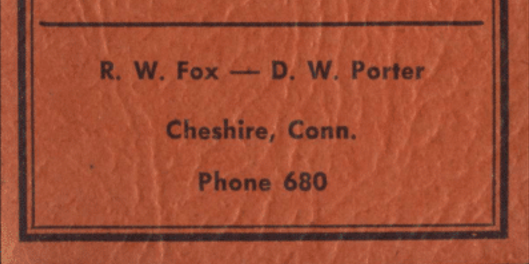
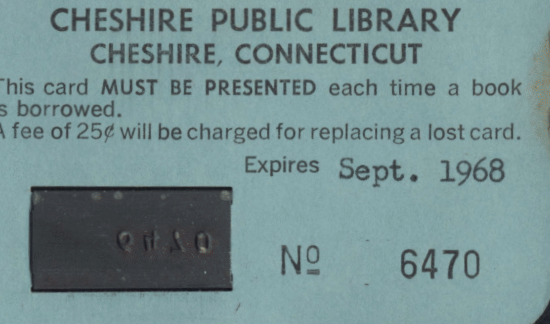
We recently uncovered some Cheshire Library memorabilia from at least 60 years ago. Though they’re regular objects you would find at any library—a bookmark, a checkout card holder, and a library card—they reveal a lot about the time they’re from and remind us of the dramatic changes that have taken place since.

First the bookmark: At the time the bookmark was printed, CPL’s hours were a bit different than they are now. They were open Monday through Friday, from 3:00 to 5:00 and 7:00 to 9:00 PM, presumably to allow for a dinner break. These days, we’re open from 9:00 AM to 8:30 PM Monday through Thursday, and 9:00 AM to 5:00 PM on Fridays. As a reminder, our summer Saturday hours for July and August are from 9:00 AM to 1:00 PM.

Maybe the most interesting part of the bookmark is the phone number for The Cheshire Insurance Agency: three digits!

The library checkout card holder is most notable for the quaint slogan of First Federal Savings and Loan Association: “You’ll find us most helpful.” The First Federal Savings and Loan Association isn’t around anymore. 218 Maple Ave changed hands several times in the late 20th century and became a branch of Naugatuck Savings Bank in 1999 (later renamed “Ion Bank” in 2013).

Lastly, the library card. Those who’ve been coming to the library for a while know our cards have gone through many iterations. I love when patrons come to the circulation desk with one of our old Cheshire Cat branded cards because it means they’ve been loyal patrons for some time. But I’ve never seen a card anywhere near as old as this one. In place of a barcode, there’s a stamped metal insert with only four digits.

Across the board, the United States has become a more expensive place to live in the last 57 years, but at least you don’t still have to pay 25¢ when you need to replace your card! (25¢ in 1968 is the equivalent of $2.32 today).

It can be easy to walk through today’s libraries and look at them as though they came into existence at that very moment. Historical artifacts like these remind us that we’re part of a long chain of library excellence—standing on the shoulders of giants, as they say.

Exploring the Rich History of Cheshire

Cheshire may be a small town, but it has an interesting and well documented history. Whether you have lived here all your life or just moved to Cheshire, you might have fun exploring the library’s local history collection.

You may be aware that the Farmington Canal ran through Cheshire and the rail trail goes right by Lock 12 park. If you have ever wanted to know more about the history of the Farmington Canal, we have the book: Reflections on the Canal in Cheshire, composed by Raimon L. Beard and published by the Cheshire Historical Society in June of 1976. This 81-page booklet gives a complete account of the inspiration, construction and usage of the Farmington Canal during a time when actual boats moved goods and people through the town of Cheshire. There are illustrations and some fun stories. It’s well worth the read and probably something to read while you’re sitting on one of the benches on the linear park.


If you’re curious about the earliest history of Cheshire, History of Cheshire Connecticut from 1694-1840, by Joseph Perkins Beach is a good one to read. It takes you from the arrival of the first ships in New Haven Harbor until 1840. The first half of the book is a historical narrative and the second half are records from various churches, tombstones, and the Town Hall, listing individuals who were born, baptized, married, and died in Cheshire.  The Cheshire Daughters of the American Revolution were responsible for getting this book finished and published. This is a good book for those who are looking for early history and it is also available for free online.

One book that I always love to read and reread is Landmarks of Old Cheshire, published by the Cheshire bicentennial committee in 1976. Landmarks is the go-to book for Cheshire history. It is logically laid out by geographical area and pulls from several historical accounts. It covers information and stories from the colonial area to the mid-20th century. Kathleen Gagnon did an incredible job providing about a hundred illustrations for this book. Even if you don’t read the book, just look at the pictures!

Glaciers to Greenhouses, the Changing Landscape of Cheshire Connecticut, from Mile-High Ice to Surburban Backyards is a recent book by local author Jeanne R. Stewart, our town historian from 2012-2019. This one takes quite a different spin on the history of the area. It begins with the ice age and the history of the Native Americans in our area, the Quinnipiac. The book includes many illustrations and is so wonderfully written that it is hard to put down.

The above are a few titles to get you started on your path to learn about Cheshire’s past. There are plenty of other very interesting books on Cheshire’s history that are available for checkout from the library. Come see us at the reference desk or give us a call at (203) 272-2245 ext. 33007 to learn more!

The Third Place

I am currently rewatching my favorite television series of the 1990’s, Northern Exposure. For those not familiar with this program, the show offers viewers a glimpse into the quirky lives of residents living in the small, close-knit town of Cicely, Alaska. In a recent episode, resident bush pilot, Maggie O’Connell, meets up with other locals at the town’s laundromat. Within the drab space, residents share the latest gossip as they plug coins into battered washers and dryers. Upon discovering that one of the machines has destroyed some of her clothing, Maggie decides it is time to buy her own washer and dryer. However, soon after the new set is delivered to her home, Maggie realizes it was not just about washing her clothes but the sense of connection and community the activity brought (remember, this is pre-internet and social media!). She tries calling other residents while her washer is running but they are too busy to talk on the phone. She extends invitations to friends to do their laundry at her house, but they decline. Through her experience, Maggie comes to realize the laundromat functions as the village’s “third place.”

Urban sociologist and author, Ray Oldenburg defines the concept of “third place” as distinct from a person’s “first place” which is their home and their “second place” which is work. The “third place” is defined as an informal gathering spot where members of the community can come together and exchange ideas. Traditionally, these are places such as pubs (epitomized in another great TV show, Cheers), post offices, coffee shops, barber shops or even main streets. According to Oldenberg an important facet of the “third place” is neutrality. All members are welcome to gather and freely express their viewpoints. As such, Oldenburg says “third places” are vital to the success of a democratic society.

By Oldenburg’s definition, libraries can be considered a “third place” in a community. As librarians we take great care to ensure that our buildings, services and collections are free and accessible and that all are welcome regardless of socio-economic status. While today the internet and social media allow people to connect instantaneously without leaving home, there is still a desire for people to connect with others in person.  

Library programs such as book clubs, storytimes, and educational lectures are designed to bring people together to meet and share ideas and points of view. These programs allow people to find support for their challenges from others who are going through similar situations. Throughout my career I have witnessed mothers sharing childrearing strategies in storytime, teens who feel they do not fit in finding a peer group, and adults finding hope from the experiences of others dealing with the same mental and physical health issues. 

It is a common misperception that libraries are only about books. The concept of the library as a “third place” raises the definition beyond a resource for reading or research materials. It extends the organization’s mission to be a place where those who feel excluded elsewhere can find a sense of belonging. Where those who need a respite from life’s challenges can find calm. Where those who thought they were so different from each other can find commonality and connection. It allows the library to play a key role not just, as Oldenburg says, in protecting democracy, but also in helping create a more humane society where all are treated equally and with respect. 

At the end of the episode, Maggie reports that her new washer and dryer are not working correctly and convinces the technician that they need to be sent back to the factory despite his reassurances he can fix the problem onsite. He tells her sending the machines back to the factory could mean she is without them for an extended time (it is Alaska after all) but she insists. In the final scene, Maggie is happily back in the dingy, detergent-smelling laundromat listening to the latest news and finding community with her fellow residents. If you are looking for such a place in Cheshire, I hope you will stop by the library soon and discover all this wonderful “third place” has to offer.