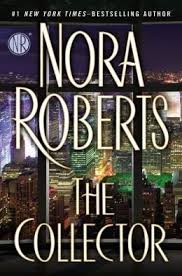
Linda Reads: The Collector by Nora Roberts

collectorAfter being disappointed in Ms. Roberts’  last book Whiskey Beach (reviewed here), I wasn’t sure what to expect from her newest, The Collector I’m happy to report I’m very pleased with this one.  It’s a bit different –  an intriguing mix of Ms. Roberts’ writing and J.D. Robb’s – making it an entertaining, edgy, romantic suspense thriller.

Lila Emerson is a quirky professional house-sitter and author of young adult werewolf books.  She enjoys living in other people’s homes and she takes great pleasure in scoping out her surroundings.  With the use of binoculars, she spies on the neighborhood and uses her vivid imagination to create stories about her neighbors.  Unfortunately, one evening she witnesses a murder.  The police conclude a boyfriend murdered his girlfriend and then took his own life.  However the boyfriend’s brother, Ashton, is sure they are wrong and enlists Lila’s help in finding out the truth.

Ashton is a famous artist and comes from a close, loving, somewhat dysfunctional family of considerable wealth – so different from Lila’s life.  Of course it’s predictable that they will fall in love, but that part of the story unfolds slowly, exquisitely, while the hunt for the truth leads to Faberge eggs, and murder.  There is a great supporting cast – Ashton’s best friend and Lila’s best friend turn out to have a history together and a lovely romance blossoms there.  The detectives working the case add some insight into the world of overworked cops with wit and humor.  We get a peak into the world of the rich and into the world of evil.  There are gruesome murders, ruthless assassins, touching love stories, great family interaction, art, antiques, cops, and humor all woven into an entertaining, engaging story.

It was fun to visit the life of a house-sitter, and an artist and learn about Faberge eggs.  Having no interest in those particular subjects, Ms. Roberts was able to keep me entertained, interested and engaged in the characters and story line.


Lets Celebrate National Adopt a Cat Month!

Did you know that June is National Adopt a Cat Month? With that little tidbit of knowledge and the bonus of June 19 being Garfield the Cat Day, I thought I would share some great books about cats. So, I have two small lists for our feline friendly readers, one for adults and one for sharing with the youngest cat lovers.

1. Dewey: The Small-Town Library Cat Who Touched the World by Vicki Myron
2. Homer’s Odyssey by Gwen Cooper
3. Old Possum’s Book of Practical Cats by T.S. Eliot
4. A Street Cat Named Bob: How One Man and His Cat Found Hope on the Streets by James Bowen
5. Making Rounds with Oscar: The Extraordinary Gift of an Ordinary Cat by David Dosa
6. Cat Daddy: What the World’s Most Incorrigible Cat Taught Me About Life, Love, and Coming Clean by Jackson Galaxy
7. Cat Sense: How the New Feline Science Can Make You a Better Friend to your Pet by John Bradshaw
8. Dewey’s Nine Lives: the Legacy of the Small-Town Library Cat Who Inspired Millions by Vicki Myron, with Bret Witter
9. Cleo: The Cat Who Mended a Family by Helen Brown

This slideshow requires JavaScript.

Looking for cat books to share with younger readers? Well then you cannot go wrong with:

1. Millions of Cats by Wanda Gág
2. Splat the Cat by Rob Scotton
3. Skippyjon Jones by Judy Schachner
4. Puss in Boots by Charles Perrault
5. Dewey: There’s a Cat in the Library! by Vicki Myron
6. Chester by Mélanie Watt
7. Kitten’s First Full Moon by Kevin Henkes
8. Won-Ton: A Cat Tale Told in Haiku by Lee Wardlaw
9. Pete the Cat: I Love My White Shoes by Eric Litwin, James Dean

This slideshow requires JavaScript.

Jenn Reads: Brave New World

Brave New World by Aldous Huxley was our April pick for the Cheshire Cats Classics Book Club.

Before there was The Hunger Games series, Maze Runner series, Legend series there was Brave New World. Huxley was one of the first authors to write a dystopian novel and all others that follow are using him as an example. He did it first and did it best. I marketed this book as the original dystopian novel, because of how popular that genre is right now. And if you want to know where these authors have likely gotten their inspiration, you need to read this book.

A few fast facts about Huxley: he taught French at Eton and George Orwell was one of his students. When Orwell published 1984, he sent a copy to his former teacher, who

Brave New World by Aldous Huxley

basically called the book garbage. Huxley died on the same day as C. S. Lewis and JFK, and both of their deaths were overshadowed by the death of the president. And he was a friend to Igor Stravinsky.

Brave New World is a book that is so similar to our own, it is scary how real this book is.

Published in 1932, Brave New World takes place almost 600 years in the future. This is a world where your future is determined at the moment of your conception. Every single child born in this world is born of the test tube and is “raised” to be one of five classes- Alpha, being the best and highest class, or Epsilon, the lowest class. You have no mother, father, and are engineered for specific tasks. You will never grow old, you will never rise above your class, and you will have no apparent free will. Life will be full of pleasurable things however- sex, drugs, mass consumption, and more.

So what makes a dystopian novel different from an utopian novel? Dystopian novels are characterized by a horrible society headed towards oblivion, while utopian novels have an ideal society. Brave New World is a utopian novel on the surface, and to those living in that society, but it’s really dystopian. There is a huge reliance on technology, instant gratification, and lots of propaganda.

Huxley was disturbed at the path the world was taking: the world had been plunged into a great economic depression, fascism and communism were taking hold across Europe, and the Industrial Revolution was continuing to change the landscape of the world. What would happen to us as a people if all of this continued? Huxley feared that we would become a people slaved to technology, conditioned for pleasure and nothing else, and drugged to reality. If you’re thinking this sounds a lot like today’s society, you would not be that far off. However, lurking on the fringes were Savage Worlds with people who had lived a much different life.

If you read Brave New World today, there are many scenes that will likely make you think twice. One for me was the scene at what I’ll call the children’s center, where children are being conditioned for certain things. This particular set of children is taught to be afraid of loud noises. What is eerie is the level of manipulation that is going on- these children have no free will. Just like our own, the world of Brave New World is a throw-away society. Something breaks, is old, is damaged, is no longer wanted- throw it away!

Huxley had supposed it would take hundreds of years for the things he wrote about to come true, but if you look hard at the world we live in today, it is a lot like the one he envisioned. Hospice, cloning/DNA/biological engineering, helicopters, and e-books were just a few of the things he prophecized for the future.

Brave New World is easy reading, but do not be fooled by the simplicity of the language or writing. Huxley has a lot to say about how we live our lives with each other, with technology, and for the future.

Rating: 3 bookmarks out of 5

See you in the stacks,

Jenn


Memoirs, Humor, and More About Fatherhood

In honor of Father’s Day, let’s take a look at some dad related humor, memoirs, and related collections of letters that can be great reads for dads new to the wonders of parenthood, those that are not quite as new to its wonders, and just about anyone.

Too Good to be True: a Memoir by Benjamin Anastas. When he was three, Anastas found himself in his mother’s fringe-therapy group in Massachusetts, a sign around his neck: Too Good to Be True. The phrase haunted him through his life. This is his deeply moving memoir of fathers and sons, crushing debt and infidelity– and the first, cautious steps taken toward piecing a life back together.

A Father First: How my Life Became Bigger than Basketball by Dwyane Wade.
NBA star Dwyane Wade discusses the rewarding responsibilities of being a single dad to his two sons, Zaire and Zion and highlights of his basketball career.

The Ticking is the Bomb: a Memoir by Nick Flynn. A dazzling, searing, and inventive memoir about becoming a father in the age of terror.

Fatherhood by Bill Cosby. A collection of ruminations, anecdotes, and vignettes based on Cosby’s experiences as a son and father.

Manhood for Amateurs by Michael Chabon. An entertaining omnibus of opinionated essays previously published mostly in Details magazine spotlights novelist Chabon’s (The Yiddish Policemen’s Union) model of being an attentive, honest father and a fairly observant Jew.

Lamentations of the Father by Ian Frazier. More serious than a “gag” writer and funnier than most essayists, Frazier has a classical originality. This collection, a companion to his previous humor collections “Dating Your Mom” and “Coyote v. Acme,” contains 33 pieces gathered from the last 13 years.

Don’t Make Me Stop this Car!: Adventures in Fatherhood by Al Roker. Al provides an unprecedented, intimate look into his experiences with infertility treatments, adoption, and the normal fears and wonders of an expecting parent. As Al manages the needs of his daughters from two marriages and the demands of a high-profile career, he is like millions of others who fantasize about the newest sport utility vehicle, struggle with a GapKids addiction, and bask in the golden moments of first steps and special Father’s Day meals. Along the way, Al comes to a deeper understanding of his parents’ love for him and a whole new appreciation of them as grandparents.

Raising Cubby: a Father and Son’s Adventures with Asperger’s, Trains, Tractors, and High Explosives  John Elder Robison. The comic memoir of an Aspergian father raising his Aspergian son, by the bestselling author of Look Me in the Eye.

As usual, I found too many great books to stop, so if you are looking for even more you might want to check out; Dad is Fat by Jim Gaffigan, The Council of Dads: My Daughters, My Illness, and the Men Who Could be Me by Bruce S. Feiler, Sh*t My Dad Says by Justin Halpern, Wisdom of our Fathers: Lessons and Letters from Daughters and Sons by Tim Russer, No Wonder my Parents Drank: Tales from a Stand-up Dad by Jay Mohr, A Promise to Ourselves: a Journey Through Fatherhood and Divorce by Alec Baldwin, The Bastard on the Couch: 27 Men Try Really Hard to Explain their Feelings about Love, Loss, Fatherhood, and Freedom edited by Daniel Jones, and Big Russ and Me: Father and Son by Tim Russert.

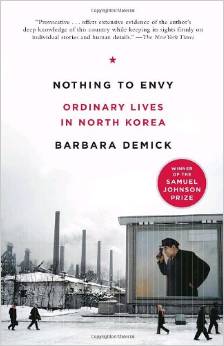
Susan Reads: Nothing to Envy

Rarely have I come across a book so haunting.

If you Google Earth for North Korea at night, you will see South Korea as brightly lit as a coast of the US. Above it is a greatC0044096-Korea_at_night,_satellite_image-SPL big blackness. This is North Korea. It is not black because they block out satellites, or by treaty.
It’s because there is no electricity.

In an entire country.

Author Barbara Dimick’s book, Nothing to Envy: Ordinary Lives in North Korea won the 2010 Samuel Booker prize, with good reason. Dimick has seen the “official” places of North Korea, but moreso spent years tracking down people who managed to escape the deadly iron fist of North Korea and interviewing them extensively. She follows several families, some of them die-hard party loyalists, through their unwavering patriotism, their questioning, their suffering, to their desperate do or die escape.

indexDimick traces some of the history, from World War II, when things started to go flaky, through the Korean conflict, when things got really wacky, to the insane tyranny of Kim Jong Il, and now Kim Jong Un. North Korea, until the 1960’s, actually had a better standard of living than South Korea, but began to fall apart in the 70’s. But, unlike Russian Communism, instead of saving itself, North Korea became even more hard-nosed, more dictatorial, more insane. By the 90’s, there were no jobs, no wages, no food, no manufacturing. People began starving to death in great masses, with children so stunted by malnutrition they barely topped 4’7” as adults. Trees died, because people stripped the bark to eat.  As many as three million people died, and there were many reports of cannibalism.

Imagine a place where radios and televisions are set by the government to one single official channel. Where the government doles out the very food you are allowed to eat, and the quantity, and the clothes you wear. Where everything is in black and white except the propaganda posters, which are in red, the only color people can look to with cheer. Where every home must display a photo of the dictator, and clean it daily with a special cloth, where the picture can be inspected at any time and you can be sent to the Gulag for disrespect. North Koreans are so isolated, so indoctrinated, so starved, so cowed, that they are not only  utterly brainwashed against the outside world, but cannot imagine what the outside world is like. After three generations of this, they’ve never known anything else.

Perhaps the saddest, most poignant moment is when the once-loyal mother makes a desperate swim across the river into China,article-north-korea-hunger crawls to the first house she sees, starved, frozen, exhausted, desperate, pushes open the garden gate, and discovers a bowl of meat and rice and  vegetables set outside waiting for her, and she is utterly amazed, not having seen meat or even rice in months. Then the family’s dog comes around the corner of the house, and the woman realizes that in China, even dogs eat better than North Koreans.

Read this. Really, read this book. It’s short. It will painlessly explain so much of the insanity, the politics, the danger that is North Korea, and will help you separate the Korean government from the Korean people, who have as much control over their situation as an ant has over an elephant. You will not forget it.