Freedom to Read

Almost every evening, my husband and I take a walk around our neighborhood in New Haven.  And stapled to almost every telephone pole, are numerous flyers in varying states of decay. Notices for tag sales, concerts, scientific studies and lost pets paper poles along our route.  Occasionally, someone uses this unofficial public forum to express their political viewpoint.  Recently I passed a flyer with language that I found offensive, and my first urge was to rip it down.  After all, technically people aren’t allowed to post flyers on telephone poles.  And there are children walking by who shouldn’t be exposed to that kind of language.  I would be doing a good thing for our neighborhood by removing the offensive poster.  And then my personal feelings took a backseat as I reminded myself we live in a society where free speech is a constitutional right.  While I may have a negative reaction to flyers or books with viewpoints that I disagree with, I prefer to live in a world where everyone is free to choose what they read or don’t read.  So, I averted my eyes and kept walking.

This week the Cheshire Public Library is celebrating Freedom to Read Week (formally known as Banned Books Week) to highlight the dangers of censorship.  This annual celebration was launched in 1982 by the American Library Association’s Office of Intellectual Freedom (OIF) in response to an increase in book challenges.  Interestingly, forty-plus years after the first Banned Books Week, the nation is again experiencing an increase in book challenges.  According to the OIF, in 2023 4,240 different titles were challenged which represents a 65% increase over 2022.  Books representing LGBTQIA+ and BIPOC individuals account for 47% of those titles targeted for removal.  According to the OIF Director, Deborah Caldwell-Stone, “This is a dangerous time for readers and the public servants who provide access to reading materials. Readers, particularly students, are losing access to critical information, and librarians and teachers are under attack for doing their jobs.”

It would be dishonest to say that librarians don’t struggle with buying books whose content they disagree with.  But providing a collection that represents diverse viewpoints is fundamental to supporting ALA’s Freedom to Read Statement which asserts that the ability to read freely is essential to our democracy.  This is not to say that everything published makes it into the collection as librarians also must be careful to curate materials based on the authority of the author, accuracy of content, and even price and format.  For a full list of the criteria used at the Cheshire Library please see our Materials Selection Policy.

As part of our celebration of Freedom to Read Week, staff have created two drop-in activities for all ages that will be available during our regular hours of operation:

Guess the Challenged Book Game where a copy of a challenged book has been shredded and placed in a jar.  Each day a new clue is added to help you solve the puzzle.

Shine a Light on Censorship Scavenger Hunt where each participant will be given a small black light to use to uncover cleverly hidden letters and solve a secret word.

Whether you stop in this week to try one of our activities or visit anytime in future, we hope you will register for a library card and borrow materials so you too can read often and read freely.

Summer Reads: Books to Beat the Heat

Whether you prefer snarky humor, historical fiction, or a nice, wholesome murder, there’s something on this list for you.

Killing Me by Michelle Gagnon

The single-line summary on the cover of some editions of this title reads, “She escaped a serial killer. Then things got weird.” I’ve loved the proliferation of murder mysteries featuring a heavy dose of dark humor that have swept publishing over the last few years, and the glitzy Las Vegas setting in Killing Me secures this as a summer read for me. The protagonist is far from perfect but you’ll still want to root for her; the supporting cast will win your heart, and the twists are just frequent and surprising enough to keep the pages turning.

Two Nights in Lisbon by Chris Pavone

A woman wakes up alone in her bed. Her husband has vanished. She’s on vacation in a strange place with no idea where her husband may have gone, and in every place she turns she finds no help- or worse, is met with suspicion. Pavone paints a beautiful picture of Lisbon; it’s an interesting juxtaposition, where the setting should make you yearn to be there, but each chapter brings new revelations and a heightened sense of dread. If you’re looking for a taut thriller to read on the beach, poolside, or on the patio, this is a great pick.

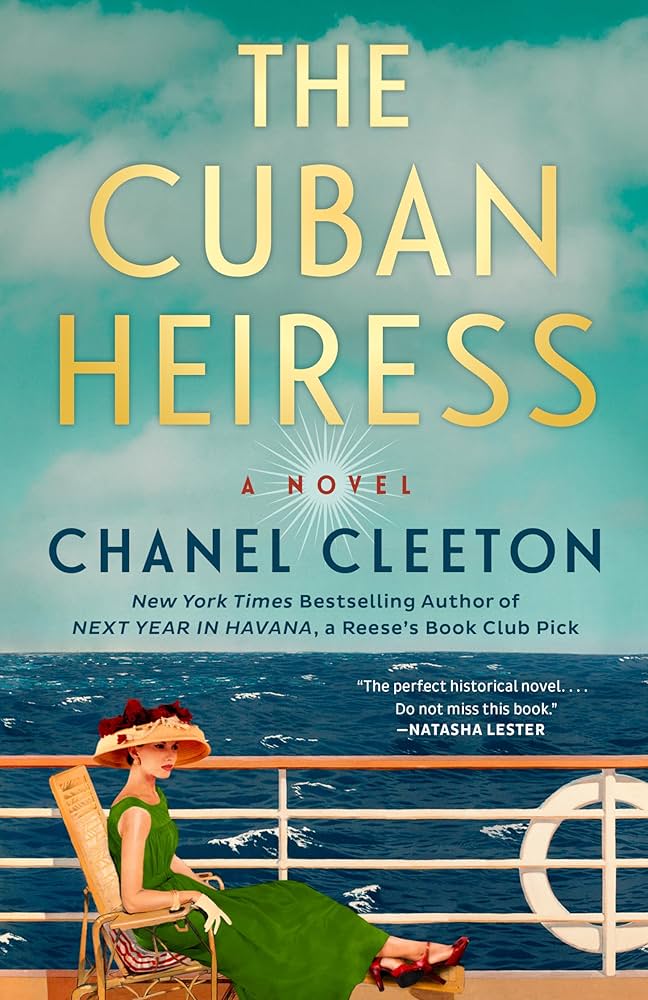
The Cuban Heiress by Chanel Cleeton

Cleeton is, to my mind, one of the most underrated authors of historical fiction writing today. Is it because she sometimes allows women’s faces to be seen on her book covers, while others in the genre stick to the “women in period costume facing away” template? Hard to say. What is clear is her talent for creating three-dimensional women characters in rich historical settings. The Cuban Heiress is a great example of Cleeton’s ability to weave the lives and storylines of disparate characters together throughout her books, generally in a tropical setting (think Florida, Cuba, or here, a luxury ship), always with an immensely satisfying ending.

I Hope This Finds You Well by Natalie Sue

This book is perfect for anyone who has wished for death over the prospect of replying to one more email. Sue skewers workplace culture and the characters she writes are laugh-out-loud funny, but be careful, those same characters develop over time and the same people you at first found annoying for microwaving popcorn in the break room or asking for help doing the same thing you’ve shown them 20 times become surprisingly relatable and even heartbreakingly vulnerable the more you learn about them. Perfect for anyone who has ever had to work with human beings, and great for summer because does anyone ever want to be at work in this season?

Sag Harbor by Colson Whitehead

This is a funny but heartfelt coming-of-age tale, set in a 1980s summer, in the Hamptons. That should be enough to place it on any summer Must-Read list, but thankfully, because it’s Colson Whitehead, it doesn’t stop there. The writing is superb and the story feels authentic; it’s based on Whitehead’s own experiences as a Black kid who went to a mostly-white Manhattan prep school but spent his summers in Sag Harbor, an enclave for Black upper class professionals. If you’ve read some of Whitehead’s other works like Underground Railroad or Nickel Boys you might think that such a premise as this will necessarily be lacking in the gravitas of those other books, but you would be wrong: although lighter in tone, there is much to be gleaned from Sag Harbor.

Starter Villain by John Scalzi

Finding out you’ve been left a life-changing inheritance from a relative to whom you have no emotional attachment is the dream, right? Our hero, Charlie, has a somewhat sad but entirely relatable life when he finds out a long-lost uncle has bequeathed him his fortune and his business. His supervillain business. Charlie must learn how to fend off rival supervillains, do right by his new employees, and survive each day in this new world.

Why is this a summer read? Much of the book is set on a tropical (okay, volcanic) island, complete with (foul-mouthed, desperate to unionize) dolphins. What’s not to love?

Tress of the Emerald Sea by Brandon Sanderson

According to the internet [so insert grain of salt here], the author was watching The Princess Bride with his family when his wife complained of Buttercup’s passivity given her circumstances. This inspired Sanderson to write Tress in secret, eventually surprising his wife with the story, who in turn urged him to publish it more widely. Tress is an appealing protagonist, the world she inhabits is wildly creative, and you’ll finish the book hoping for more adventures with Tress and crew.

A Psalm for the Wild-Built by Becky Chambers

First of all, the dedication in this book reads, “For anybody who could use a break.” Second, we have a book club here at the library whose majority is very vocal about the fact that they neither read nor care for the Science Fiction and Fantasy genres. I knew this would be a hard sell. (Overheard grumbling when I handed out copies of the book: “There’s a robot on the cover!”) But at 147 pages, I asked the participants to trust me and give it a try- even if it didn’t end up being their cup of tea, I believed they could stick it out for a book this short. Lo and behold, a month later we met again, and 18 out of 21 participants enjoyed it immensely, much to everyone’s surprise.

This book is thoughtful but soothing, with page after page of phrases you’ll want to pluck out, scribble down on an index card or in your Notes app, and reread to yourself on rough days. Oh, you wanna know what the book’s about? A garden monk living in a Utopian world has an existential crisis, becomes a tea monk, meets one of the robots who wandered off into the wilderness centuries ago, and together they attempt to answer the question, “What do people need?”

Just- trust me and give it a try.

Behind the Scenes: The Mark Twain American Voice in Literature Award

I never really need an excuse to read. It is my favorite pastime. I typically have an expanding “to be read” list and my nightstand is always covered by an unwieldy pile of books. At the start of this year, however, I was in a reading funk and couldn’t seem to finish any book I started. It was right around that time that I received an email from someone at the Mark Twain House looking for readers to help create the long list for the Mark Twain American Voice in Literature Award. The Mark Twain House has been giving the award out since 2016 to works of fiction that “speak with an American voice about American experiences.” I signed up to be a judge, hoping that this commitment to judging at least three titles on the list would motivate me to start reading again.

The list of titles to choose from was long and extensive so I decided to pick a variety of different genres. Crook Manifesto by Colson Whitehead was first on my list but to read that book, I needed to read the first in what will eventually be a three-part series, Harlem Shuffle.  Harlem Shuffle is set in Harlem from 1959-1964. For anyone who has read Colson Whitehead, it is a departure from his heavier works like The Nickel Boys. Harlem Shuffle follows the life of Ray Carney, a furniture salesman in Harlem with a dubious past, desperately trying to live a crime-free life. It is a funny, clever, and breezy crime novel, reminiscent of Chester Himes’s Harlem Detective Series.

The second in Whitehead’s series, Crook Manifesto takes place in the early 70s and the plot is centered around the protagonist, Ray Carney trying to score impossible to find Jackson 5 tickets for his daughter. Crime, violence, and comedy ensue. The two books in the series are both fun reads that give a great snapshot of New York City in the 60s and 70s. Whitehead still manages to portray issues of race, class, and police brutality, particularly during his description of the Harlem race riot of 1964 and the tension between the police and those active in the Black Power movement in the 1970s. There is no date set for the publication of the final book in the series, but I am awaiting its release to see if Ray Carney does eventually manage to stay on the straight and narrow.

The next book I read was a debut novel titled A Haunting in Hialeah Gardens, by Cuban American author Raul Palma. I was immediately intrigued by the title having grown up in Miami. The story follows Hugo Contreras who is mourning the sudden death of his wife as well as dealing with mountains of debt. Deeply immersed in the world of Santeria since he is a Babalawo, Hugo agrees to help the debt collector who has been tormenting him, who is in turn being tormented by a ghost, in exchange for clearing his debt. It is an absurd story, but also a very Miami story. The novel is a modern gothic tale, complete with hauntings, demonic possession, and highly accurate descriptions of the oppressive heat in Miami and endless rows of strip malls. It is scary at times with an ending easily left up to interpretation by the reader and a good read for anyone who wants a different kind of supernatural novel.

The last book I chose to read was Dearborn, a collection of short stories, also written by a debut author, Ghassan Zeineddine. I love short stories as a genre, so I was excited to dive into these ten stories chronicling the Arab American experience in Dearborn, Michigan. The stories were funny, sweet, poignant, and at times heartbreaking. Though focused on Arab American life, the stories often told a greater story about the immigrant experience more broadly. This was the book that I most enjoyed out of all the ones that I read and the one I chose to be considered for the prize’s long list. Zeinedine writes beautifully and I hope he chooses to publish more in the future.

The long list for the Mark Twain American Voice in Literature Award is up on their website. Unfortunately, Dearborn didn’t make the list but I am grateful for the experience of being a reader for this prize. I was able to discover novels I might not have read otherwise and it got me reading again.

The Delights of Pop Culture

It’s an awesome time to be a fan of pop culture. You can listen to podcasters going episode-by-episode through the shows you binge-watched on DVD in college. You can read delightfully bizarre theories about the characters in your preschooler’s favorite TV show. You can gather with other fans at venues like ConnectiCon. And as the main orderer of nonfiction books, I know this is an excellent time to read about pop culture, too. Here are some new and recent books to both entertain you and deepen your appreciation for your show / movie / franchise du jour. 

Did Arya, Maximus, or Chandler have the biggest surge in popularity as a baby name? How many parents start off dead in Disney movies? Is Ash Ketchum a better GM or coach? Find the answers in this book, which is a fun mix of visualized data and writing which explores how mere “entertainment” affects politics, the economy, and even shark populations. Pulitzer Prize-winning author Hickley used to be the Chief Culture Writer at FiveThirtyEight, and it shows in his love of statistics. 

The Blues Brothers: An Epic Friendship, the Rise of Improv, and the Making of an American Film Classic by Daniel DeVisé (2024) 

The saga behind The Blues Brothers is epic, encompassing the colorful childhoods of Belushi and Aykroyd, the comedic revolution sparked by Harvard’s Lampoon and Chicago’s Second City, the early years of Saturday Night Live where the Blues Brothers were born, and the indelible behind-the-scenes narrative of how the film was made. Based on original research and interviews of principals from director John Landis and producer Bob Weiss to SNL creator Lorne Michaels and Aykroyd himself, The Blues Brothers vividly portrays the creative geniuses behind modern comedy. 

On Locations: Lessons Learned from My Life On Set with The Sopranos and in the Film Industry by Mark Kamine (2024) 

Married and with a child, the author takes unpaid gigs to get a foot in the door, and eventually ends up working on all seasons of The Sopranos. The show’s setting and its creator’s insistence on accuracy placed the native New Jersey author in the right place at the right time to become part of television history, and to witness the effects of sudden fame and acclaim on the show’s principal players. Includes many stories about guest stars, as well as the cast, including new tales of James Gandolfini. 

Opposable Thumbs: How Siskel & Ebert Changed Movies Forever by Matt Singer (2023) 

Award-winning editor and film critic Matt Singer eavesdrops on the iconic balcony set of Gene Siskel and Roger Ebert, detailing their rise from making a few hundred dollars a week on local Chicago PBS to securing multimillion-dollar contracts for a syndicated series. Their partnership was cut short when Gene Siskel passed away in February of 1999, but their influence on in the way we talk about (and think about) movies continues to this day. 

I Like to Watch: Arguing My Way Through the TV Revolution by Emily Nussbaum (2019) 

In this collection, New Yorker columnist and Pulitzer Prize winner Emily Nussbaum writes about her passion for television beginning with Buffy–as she writes, a show that was so much more than its critical assessment–the evolution of female protagonists over the last decade, the complex role of sexual violence on TV, and what to do about art when the artist is revealed to be a monster. And, she also explores the links between the television antihero and the rise of Trump. The book is an argument, not a collection of reviews. Through it all, Nussbaum recounts her fervent search, over fifteen years, for a new kind of criticism that resists the false hierarchy that places one kind of culture over another. It traces her own development as she has struggled to punch through stifling notions of ‘prestige television,’ searching for a wilder and freer and more varied idea of artistic ambition. 

Best. Movie. Year. Ever.: How 1999 Blew Up the Big Screen by Brian Raftery (2019) 

In 1999, Hollywood as we know it exploded: Fight Club. The Matrix. Office Space. The Blair Witch Project. The Sixth Sense. Being John Malkovich. Star Wars: The Phantom Menace.  Those are just some of the landmark titles released in a dizzying movie year, one in which a group of daring filmmakers and performers pushed cinema to new limits—and took audiences along for the ride. Freed from the restraints of budget, technology (or even taste), they produced a slew of classics that took on every topic imaginable, from sex to violence to the end of the world. The result was a highly unruly, deeply influential set of films that would not only change filmmaking, but also give us our first glimpse of the coming twenty-first century. 

Surely You Can’t Be Serious: The True Story of Airplane! by David Zucker, Jim Abrahams, and Jerry Zucker (2023) (downloadable audiobook) 

An in-depth and hysterical look at the making of 1980s comedy classic Airplane! by the legendary writers and directors of the hit film. With anecdotes, behind the scenes trivia, and never-before-revealed factoids, these titans of comedy filmmaking unpack everything from how they persuaded Peter Graves to be in the movie after he thought the script was a piece of garbage, how Lorna Patterson auditioned for the stewardess role in the back seat of Jerry’s Volvo, and how Leslie Nielsen’s pranks got the entire crew into trouble, to who really wrote the jive talk. It also features testimonials and personal anecdotes from well-known faces in the film, television, and comedy sphere, proving how influential Airplane! has been from day one. 

Titles we don’t have but you can borrow from other libraries in our consortium: 

No Crying in Baseball: The Inside Story of A League of Their Own by Erin Carlson (2023) 

The Coen Brothers: This Book Really Ties the Films Together by Adam Nayman (2018) 

Movies (And Other Things): A Collection of Questions Asked, Answered, Illustrated by Shea Serrano, illustrated by Arturo Torres (2019) 

10 Recent Favorites From Our Staff

What was the best book you read in 2022? I recently asked staff members this question and have compiled their answers here. Interestingly, there were no duplications, everyone had a different favorite. Some books were published in 2022, some were many years older, some were fiction, some were nonfiction. Without further ado, here’s a selection of 10 recent favorites from our library staff.

Lessons in Chemistry by Bonnie Garmus. In the early 1960s, chemist and single mother Elizabeth Zott, the reluctant star of America’s most beloved cooking show due to her revolutionary skills in the kitchen, uses this opportunity to dare women to change the status quo.

Neopolitan series by Elena Ferrante. Beginning in the 1950s in a poor but vibrant neighborhood on the outskirts of Naples, Ferrante’s four-volume story spans almost sixty years, as its protagonists, Lila and Elena, become women, wives, mothers, and leaders, all the while maintaining a complex and at times conflictual friendship.

Boneshaker by Cherie Priest. Commissioned to build a machine that will promote gold-rush land-breaking efforts between Civil War-era Seattle and Alaska, inventor Leviticus Blue inadvertently triggers the release of a deadly gas that transforms people into the living dead, a situation that prompts his teenage son to restore the family reputation years later.

Summer Sons by Lee Mandelo. When his best friend dies of an apparent suicide, Andrew uncovers lies and secrets left behind by the person he trusted most, discovering a family history soaked in blood and death.

What We Wish Were True by Tallu Schuyler Quinn. A non-profit leader, humanitarian and minister, after being diagnosed with an aggressive form of terminal brain cancer, pens profound essays on what it means to live with a terminal diagnoses and still find meaning and how to discover beauty in life’s ordinary moments.

Foundryside by Robert Jackson Bennett. A thief in a city controlled by industrialized magic joins forces with a rare honest police officer to stop an ancient evil ritual that endangers thousands of lives.

Piranesi by Susanna Clarke. Living in a labyrinthine house of endless corridors, flooded staircases and thousands of statues, Piranesi assists the dreamlike dwelling’s only other resident throughout a mysterious research project before evidence emerges of an astonishing alternate world

The Book Woman of Troublesome Creek by Kim Michele Richardson. During Kentucky’s Great Depression, Pack Horse Library Project member Cussy Mary Carter, a young outcast, delivers books to the hillfolk of Troublesome Creek, hoping to spread learning in these desperate times, but not everyone is keen on her or the Library Project.

Tomorrow and Tomorrow and Tomorrow by Gabrielle Zevin. A modern love story about two childhood friends, Sam, raised by an actress mother in LA’s Koreatown, and Sadie, from the wealthy Jewish enclave of Beverly Hills, who reunite as adults to create video games, finding an intimacy in digital worlds that eludes them in their real lives.

Finding the Mother Tree by Suzanne Simard. The world’s leading forest ecologist, in her first book, draws us into the intimate world of trees where she brilliantly illuminates the fascinating and vital truth — that trees are a complex, interdependent circle of life.