Children’s books are notoriously hard to get published. Everyone has an idea for a children’s book, and almost all of them will never see a contract. More than 21,000 children’s titles are published every year in the US, by a number of publishers, which is only a dent in the number of actual submissions. Scholastic, the one who haunts school kids with that monthly flier, publishes just 600 books a year, from board books through High School. So when a children’s book is self-published, sells 7,000 copies in its first ten months and is then signed on by major publisher Harper Collins, you know there’s something really good there. And in this case, the really good is Pete the Cat .
 If you haven’t read him, Pete the Cat is a groovy large-eyed, laid-back blue/black cat who lives with his mom and dad and his tuxedo-patterned brother Bob. He has a host of friends (Grumpy Toad, Gus the Platypus, Callie, Squirrel, etc) and he loves bananas and surfing. His stories are mostly easy-readers that play to the 2-7 year old crowd, but he is infinitely more interesting than that. Pete is the kind of story you want your child to like, because you want to read more of his stories.
Pete is the creation of James Dean, whose early illustrations wound up as musically or rhythmically-oriented stories by storyteller/musician Eric Litwin. Litwin wrote four of Pete’s adventures (Pete the Cat and his Four Groovy Buttons, Rockin in my School Shoes, I Love My White Shoes, and Pete the Cat Saves Christmas). I have to admit, these early volumes are my favorites, and I cannot help but read Pete stories as if he’s a surfer dude. Groovy, man. While Litwin and Dean split in 2011, Dean and his wife Kimberly have written more than 60 Pete adventures, with more on the way. Pete’s adventures range from curing hiccups (Mom knows best!) to sleepover friends who won’t sleep, to shopping in the grocery store and scuba diving.

The actual Pete the Cat
Being an artist was not Dean’s plan. His father was an artist, and he didn’t relish reliving the struggle. While being an electrical engineer paid bills, art crept into his life more and more, until he began to pursue art full-time. When he adopted a tiny black kitten he named Pete, Pete’s antics crept into his artwork , and a legend was born.
Dean’s success is an author’s dream – self-published, picked up by a real publisher just two years later, a runaway success (more than 7 million copies sold), merchandise deals, and now a TV series on Amazon Prime, with voices by no one less than jazz singers Jason Mraz and Diana Krall (which totally fits, because Pete gives off that groovy chill of a cool jazz cat). They say self-publishing doesn’t pay, but Dean is one of those handful of lucky authors who won that lottery.
 While I find some of the titles to be uneven and lacking the lyrical qualities of the bigger titles such as Groovy Buttons, Pete remains one of my current favorite preschool titles, stories you don’t mind reading over and over again, with subtle morals (family, keeping your cool, how to be a friend, sharing, learning, etc) that won’t make you roll your eyes with saccharine. Rock on, Pete!
Cheshire Library has more than thirty Pete titles! Here are some of them:
Pete the Cat: Rockin in My School Shoes
Pete the Cat: I Love My White Shoes
Pete the Cat and His Four Groovy Buttons 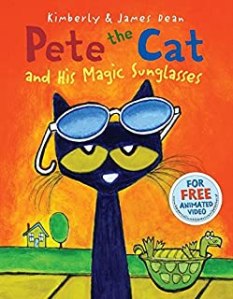
Pete at the Beach
Pete’s Big Lunch
Pete the Cat: Scuba Cat
Pete the Cat: Snow Daze
A Pet for Pete
Pete the Cat and his Magic Sunglasses
Pete the Cat and the Missing Cupcakes
Pete the Cat and the Bedtime Blues
Pete the Cat Goes Camping
Pete the Cat and the Perfect Pizza Party
Pete the Cat and the New Guy
 Several book-based series are continuing with new seasons this year: season 5 of the Starz series



 January began as one of the last months of year, not the first. The start of the Roman calendar (and the astrological one) was March. Back then there were only ten months to the year, totaling 304 days. Between was a miasmic 66 monthless days of “winter.” According to legend, Numa Pompilius, the second King of Rome (after Romulus himself), added January and February to codify that winter term (along with a catch-up month every other year of 22 days).
 to have lived somewhere between 386 CE and 620 CE (if you’re not up on your history, Common Era has replaced the Anno Domini). She takes her aging father’s place in the army, and serves for twelve years without her fellow soldiers realizing she’s a woman. Depending on the source, her name might be

 The steel-driving

 under control of the Habsburgs, a magistrate put his hat on a pole and demanded all citizens bow before it, or be imprisoned. While in town with his son, Tell refused to bow, was arrested and sentenced to death – though, since he was such a marksman, the Magistrate would let him go if he could shoot an apple off his son’s head. Tell did so, was arrested anyway, escaped, and the people rose up in rebellion, in an act considered the founding of the Swiss Confederacy, around 1307. Some historians believe Tell is merely a new twist on an old Danish fable.













 The Cheshire Library Blog