New Book Announced for Oprah’s Book Club 2.0

oprahOn December 10th, Oprah announced her latest selection for her Book Club 2.0.  It is Sue Monk Kidd’s The Invention of Wings.  This novel is a 19th century narrative featuring real and fictional characters, weaving together stories of a slave girl and a slave owner’s daughter. In a statement released December 10th, Oprah said, “These strong female characters represent the women that have shaped our history and, through Sue’s imaginative storytelling, give us a new perspective on slavery, injustice and the search for freedom.”


Reading Around the Globe – For Book Clubs

worldDo the members of your book club like to travel?  Or do they like to “travel” via books?  Here are some books that will take them on a trip around the world.

Touching the Void: The True Story of One Man’s Miraculous Survival by Joe Simpson (Biography)

Mountains Beyond Mountains: The Quest of Dr. Paul Farmer, A Man Who Would Cure the World by Tracy Kidder (Biography)

Nothing to Envy: Ordinary Lives in North Korea by Barbara Demick (Non-fiction)

The Sweet Life in Paris: Delicious Adventures in the World’s Most Glorious – and Perplexing – City by David Lebovitz (Non-fiction)

Country Driving: A Chinese Road Trip by Peter Hessler (Non-fiction)

A Beautiful Place to Die: An Emmanuel Cooper Mystery by Mall Nunn (Mystery)

Twenty Fragments of a Ravenous Youth by Xiaolu Guo (Fiction)

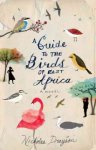
A Guide to the Birds of East Africaby Nicholas Drayson (Fiction)

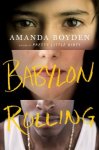
Babylon Rollingby Amanda Boyden (Fiction)

The Sound of Waterby Sanjay Bahadur (Fiction)

Jenn Reads: Main Street

I am continually awed by the power of classics, a genre so often scoffed by those who think classics have no importance or relevance in our contemporary lives.

Main Street by Sinclair Lewis

How wrong they are.

Our September pick for the Cheshire Cats Classics Club was Main Street by Sinclair Lewis, not to be confused by Upton Sinclair, who wrote The Jungle. Main Street is the story of Carol Kennicott, a city girl who dreams of making over a small town. She has high ideals, lofty thoughts, and big hopes.

She marries Will Kennicott, a small town doctor and they move to the Midwest town of Gopher Prairie, Minnesota (based on Lewis’ hometown of Sauk Center). When Carol first see Gopher Prairie, she is horrified- it’s so small town, ugly, and provincial. She immediately hates her new home.

Main Street is essentially the story of Carol and her foibles, misdoings, and failed attempts at making Gopher Prairie more modern and less offensive, in her opinion. But more than that, it is the story of one young woman and her attempts at fitting in, a task she never accomplishes. In her efforts to modernize and bring culture to Gopher Prairie, Carol offends, bulldozes, and in general doesn’t understand the ways of the town.

There is a lot to Main Street, many characters and stories, all of which are rich and full. You know these people, because these people are in your town, your city, your village. Yes, Lewis does stereotype and characterize, but stereotypes so often have truth behind them.

Lewis writes in a contemporary voice, witty, and satirical in a way that is meant to hit you at your core. Which in Gopher Prairie are you? Are you Vida? The Red Swed? Mrs. Bogart? Lewis attacks the “perfect” small town lifestyle that people told still hold dear. The ideal that everything is SO much better in suburbia, nothing bad ever happens, and everyone just loves one another. Oh, how wrong we are to still believe this falsity. Lewis cleverly attacks gender roles, government and bureaucracy, religion, friendship, marriage, and the bonds that tie us together.

Lewis made me laugh, made me rage, made me think, and came pretty darn close to making me cry, when several main characters die (small spoiler alert!).
I haven’t been touched, angered, or thought so much by a book in a while. Highly recommend.

Rating: 5 stars (and you know how stingy I am with my 5 stars!)

See you in the stacks,
Jenn

Today Show Book Club Picks Its Second Book

The Today Show announced on October 16 their new selection for their book club, Helen Fielding’s Bridget Jones: Mad About The Boy. 

In a triumphant return after fourteen years of silence, Bridget Jones: Mad About the Boy is timely, tender, touching, page-turning, witty, wise, outrageous, and bloody hilarious.  Bridget Jones stumbles through the challenges of loss, single motherhood, tweeting, texting, technology,and rediscovering her sexuality.

Helen Fielding

Helen Fielding

The “Today” selections, chosen every four to five weeks, will have stickers on their covers indicating their inclusion in the club. The books, chosen by a team of producers and the show’s co-hosts, will include both fiction and nonfiction, newly released titles and classics. Discussion groups and excerpts will be featured online.


Jenn Reads: The Turncoat

All I have to say first is: Oh my.

I needed a hot shower after reading this book.

If you’ve followed my reviews, you’ll know I typically don’t read bodice busting, Fabio-inspired books. My fare tends to include classics, mysteries, literary fiction, and chick lit. Not historical romance.

The Turncoat by Donna Thorland was a gift from my two cats (yeah, yeah) for my birthday. I had picked it out at Barnes and Noble based on the cover and synopsis on the back jacket. It did allude to some smut, but I thought, “Ehh- it’s a large paperback. It can’t be that bad.”

I chose this book for my turn for my girlfriend’s book club, thinking that it would be a lighter read and easy enough for everyone to get through in the allotted time. I warned them that there would be some smut.

I didn’t realize how much smut.

Now, I’m no prude, and wasn’t offended by the sex that was in this book or the quantity of sex. It wasn’t gratuitous and made sense in the context of the story.

And that’s all I’m saying about the smut.

The Turncoat opens with Quaker Kate Grey hosting a British general and his entourage during the American Revolution. There is an instant connection between Kate
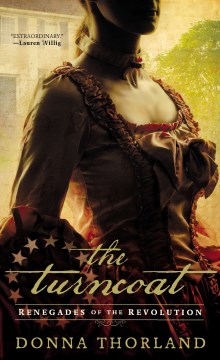
The Turncoat by Donna Thorland

and Peter Tremayne (of course). Kate’s father, Arthur, is on his way with supplies for the rebel army and she hopes to stall Peter so the British do not catch up with him. With Kate is her “Aunt”, a woman she has never met before. Tremayne ends up pilfering a letter Arthur Grey had written that would give away secrets, military strategy, etc. In an effort to retrieve the letter, Kate ends up alone with Peter in her bedroom. She does not get the letter back.

After Peter leaves, Kate and her “Aunt” end up fleeing the Grey house and traveling to see General Washington with news. Turns out “Auntie” is a spy for the rebel army. Kate decides to join Aunt Angela as a spy for the rebels and is placed in Philadelphia close to British General Howe.

There is a lot to this story besides the romance between Kate and Peter. One of the reasons I was drawn to this book was that it takes place during the American Revolution, and historical fiction in the last ten years has largely been ignored. The book, while being about a Quaker spy, is also about the British invasion of Fort Mercer in 1777, the occupation of Philadelphia, and John Andre.

Thorland packs a lot into 400 pages and overall I think you get a good idea of what went on during this period of the American Revolution. A couple of her facts are incorrect- like the number of Jaguers that are killed/wounded/captured during the assault on Fort Mercer, but it’s not enough to distract from the story.

The Turncoat was engrossing, but at about 300 pages, I was ready for the story to end. The last hundred pages could have been made into a sequel, as they deal with the turning of Benedict Arnold, and hint at the future capture and hanging (history spoiler!) of John Andre. Thorland is making this a trilogy, but not with the same characters.

Rating: 3.5 stars out of 5 (would have been 4, but it got long)

I’m looking forward to the next one!

See you in the stacks,

Jenn