Looking Back…Moving Forward

by Beth Crowley, Library Director

If you have lived through a number of decades as I have you can respond to the perennial question “Where were you when (insert significant event) happened?” For me it has been the Space Shuttle Challenger explosion, 9/11, and the Sandy Hook school shooting. We note these tragedies over other moments not just because they were horrible but because their impact left clear boundary marks dividing time into “before” and “after” the event. Often the “after” time has resulted in a reduction of our sense of peace, security and belief that life is good and things will go as planned. Two years ago this month, on March 13, 2020, I experienced another of these defining moments when we shut the Library doors to the public due to the Covid-19 pandemic.
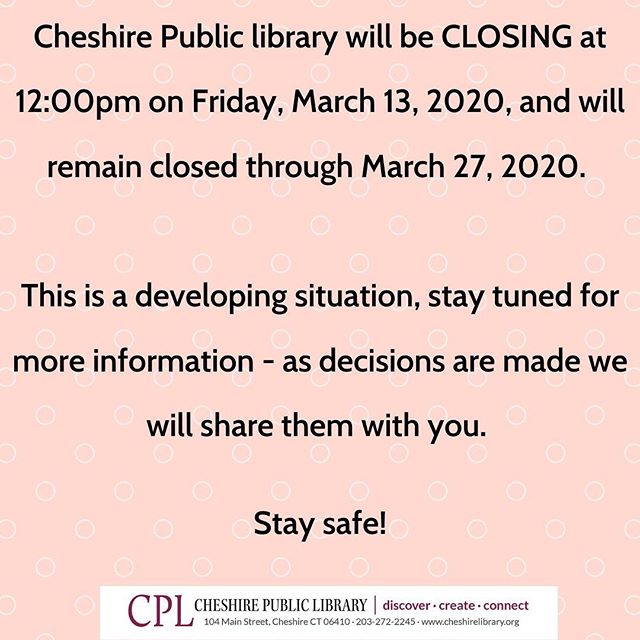
We found out on March 13 that we would be closing that same day.

Covid-19 didn’t strike in a single, sudden devastating event like the others I have mentioned but it clearly left a divider between pre- and post-pandemic life. Earlier in the week of March 13, 2020, I along with my fellow Town department heads attended a meeting with the Chesprocott Health Director, Maura Esposito and her staff. There we asked questions about precautions we should take to mitigate the spread of the virus among our employees and residents. I asked if the Library should put away the toys and craft materials in the Children’s Room. I was told there was no need and that the goal was to keep things as normal as possible for our patrons. By the end of the week, the Cheshire Public Schools sent all students home early and I got the call from the Town Manager to close the Library. Despite the sudden change in tone and urgency, we looked at the closing as a temporary measure perhaps lasting two weeks at most. None of us could have predicted the path we were about to take or where it would lead. Face masks, plexiglass barriers, social distancing, hand sanitizing stations, virtual programs, and mass vaccine clinics were still only shadows of things yet to be.

Leading an organization during the pandemic has been the biggest challenge of my 24 year career. Before Covid-19, I would try to calm stressed nerves by reminding staff that while library services are important to our customers nothing we did was in the “life or death” category. Now I was faced with making policy and procedural decisions that if wrong could result in serious illness or worse. For library employees, whose entire profession is based on access to accurate and trust-worthy information, the constantly changing messages and lack of clear guidance from national health and government leaders was frustrating. As library directors often do when struggling to solve a problem, I turned to my colleagues to compare notes. However, it soon became clear that based on varying rates of infection in different towns, conflicting guidance from health districts and that library buildings come in a wide variety of shapes and sizes it made sense to focus on what would work best for the Cheshire Public Library. I reached out again to Maura Esposito. She patiently walked me through every step I needed to consider and gave excellent and sound advice. Her guidance cut through the national noise allowing me to narrow my focus and plan for the immediate safety concerns with an eye to the future.
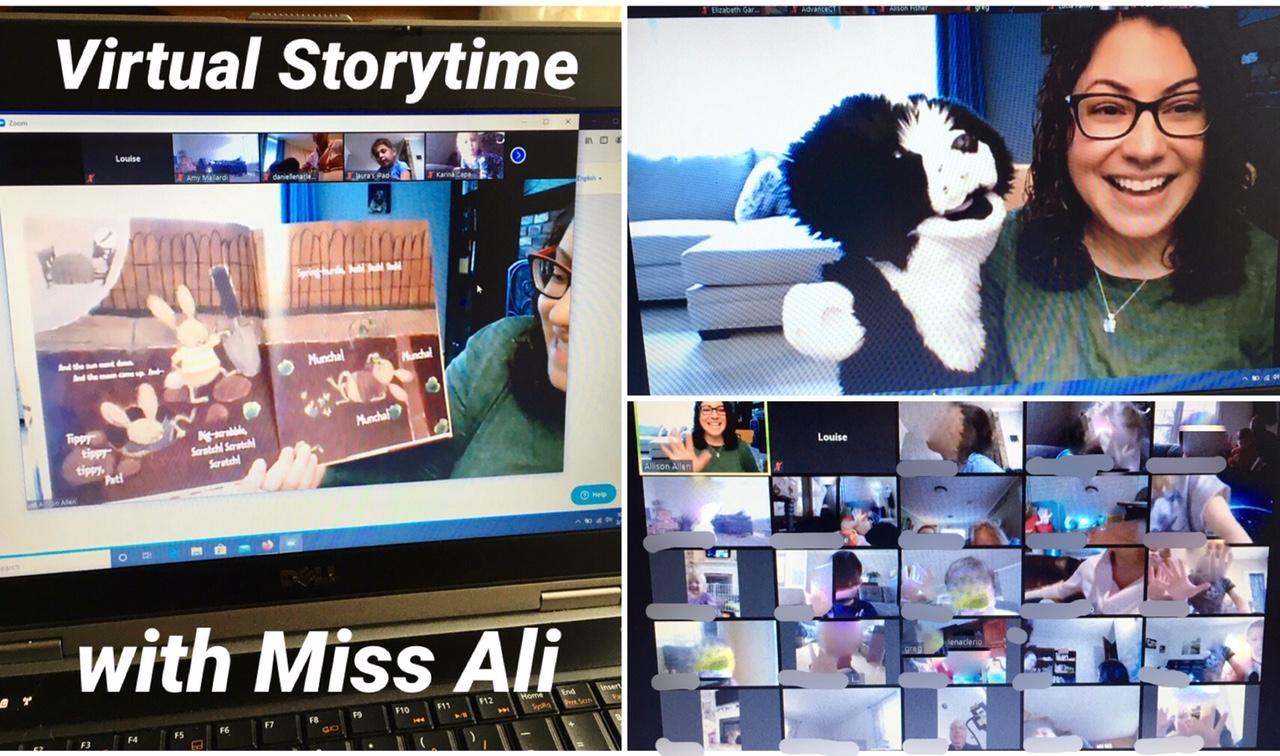
Providing library services during the pandemic was challenging but there were silver linings. Despite the disruption to my employee’s daily lives and work place, I soon discovered how resilient and innovative they could be. Faced with a closed library and working remotely, I was amazed at how my librarians quickly planned and delivered programs virtually. Until Covid-19, I thought Zoom was a TV program I watched as a kid! Our library clerks assisted with calling hundreds of Cheshire senior citizens to check on them and refer them for help if needed. To provide reading and entertainment materials for residents during the lockdown, we reallocated funds meant for buying physical items and added more digital content that users could freely access through our website. A number of patrons have told me this was the first time they tried our eBook collection and they were surprised by how much they enjoyed it. Since 2019, use of these resources has increased by 42%.

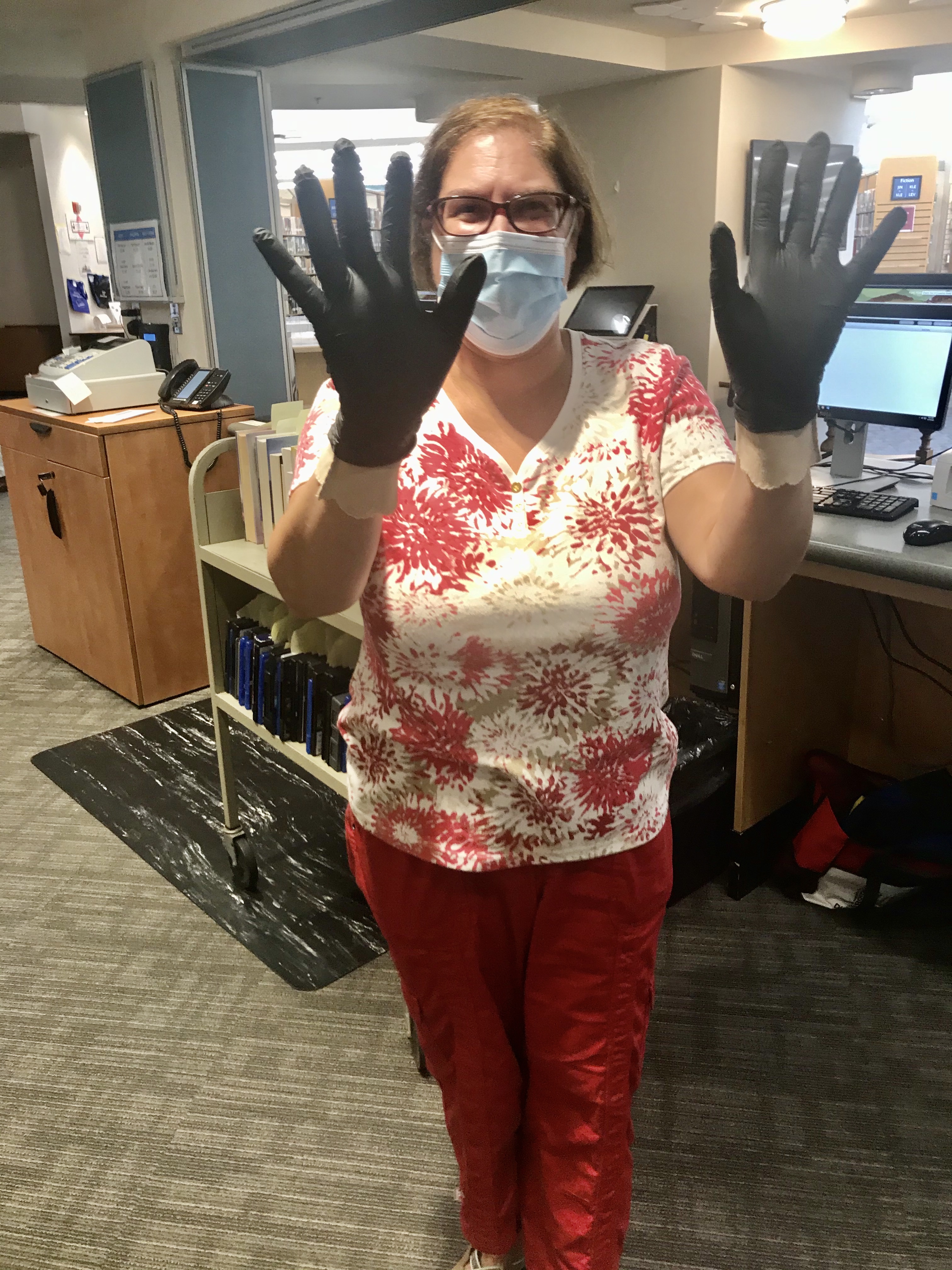
When we returned to a still closed building, staff coordinated and launched our first ever curbside “Grab and Go” service. At the program’s height we were filling an average of 60 bags with library materials every day! In order to help library users discover new materials while we were closed and browsing was impossible, we launched our Matchbook reader’s advisory program. We created an online form where patrons could tell us their reading interests and librarians would “match” them with books they may enjoy. The feedback from this program was so positive we have continued it and plan to keep it in place post-pandemic.

Now, almost two years to the day we shut down, we are finally able to relax most of our safety protocols and hopefully begin a permanent return to pre-pandemic times. But as with other life changing events, we can never truly go back to how life was before Covid-19 struck. For one the immense loss of life, at one point the equivalent of a 9/11 tragedy every day, has forever changed the lives of thousands of families. For students who graduated and began college during the pandemic, their experience of these milestone events was far from typical. How long will it be before we truly feel comfortable standing close to a stranger or giving a friend a hug?

Despite the difficulties and tragedies of the past two years, we must go forward. This month at the Library masks are now optional, we are resuming in-person programing including children’s storytimes, we’ve added back more public computers, increased capacities of our study rooms and reopened our Teen Space featuring new furniture purchased with American Rescue Plan grant funds.

No matter what life-changing events occur, the one thing I know about the role of the public library in a community is we can help our residents recover from hard times. Providing a peaceful place to read, work or relax can be a salve in scary times. Books, music and movies can be a welcome escape from the more difficult news we are bombarded with. Connecting with others to learn or discover through a program is an uplifting and renewing experience that can help buoy us after a hard day. It has been my honor to work with the amazing staff at the Cheshire Public Library during this challenging time as we tried to support and meet the needs of our residents. Since reopening our doors to the public in September of 2020 we are almost back to our pre-pandemic borrowing numbers and our library visits are continuing to increase. We hope with the return of more of our regular services and the addition of some exciting new ones (stayed tuned!) that we will be welcoming even more library users of all ages and we particularly look forward to seeing everyone’s smiles!


Meet the New Head of Adult Services!

Lauren Gledhill is the new head of Reference and Adult Services at Cheshire Public Library, following the retirement of Bill Basel last July.  Many of you may already know Lauren from the children’s department, where she’s been CPL librarian for several years, keeping watch over much of the children’s media selections. If you haven’t met Lauren before, come on downstairs to the Reference Department and get to know her!

Lauren got her Library Degree from the Dominican University in Chicago, a big change from the rural Pennsylvania area she grew up in. Cheshire certainly falls between the two!

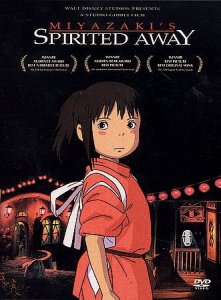
Children’s Librarian to Reference Librarian is a big change.  What does she prefer to read?  Lauren likes horror, graphic novels, and non-fiction science. Her favorite book as a child was Ferdinand the Bull. If you haven’t read it, Ferdinand is a sweet classic children’s story from 1936 about a bull who prefers to smell flowers rather than fight in the bullring – and not surprisingly was banned as subversive by both Hitler and Francisco Franco!  Today, Lauren’s favorite author is Barbara Kingsolver. Her favorite movie? She loves Spirited Away, the animated feature by noted Japanese director Hayao Miyazaki. Given the chance, she much prefers to listen to audiobooks over print. (Did you know that audiobooks alone make up almost 10% of Cheshire’s offerings?).

Librarians often get the chance to meet world-famous authors at book expos and conventions. Two authors Lauren would love to meet are Neil Gaiman, the multi-award winning author of tales such as Sandman and Coraline, as well as Hugo-award winning author Ursula Vernon, who also writes under the pen name T. Kingfisher. (I hate to mention it, Lauren, but Neil was a guest at Noreast Con 4 the year I went. If I remember right, he emceed the Costume Call.)

Lauren promises to bring new and exciting ideas to the Adult Services Department, so stay tuned and keep checking back to see what’s up!

Cheshire Library in 2019

Ever wonder how many people visit the Library each year, how many items are borrowed, or even how many items the library has altogether? Consider your questions answered, here’s a numerical look at Cheshire Library for the past year:

Why do I have to wait SO LONG for library ebooks?

Why do I have to wait SO LONG for library ebooks?

It’s been an increasing source of frustration for many library users: waiting weeks, sometimes months to get to the top of the waiting list for a popular eBook or e-Audiobook.

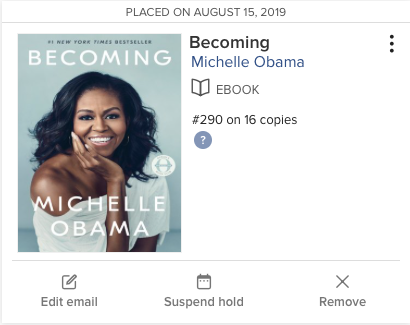
As I write this, the ebook for Michelle Obama’s 2018 memoir, Becoming,  has over 200 people waiting for their turn at one of 16 eBook copies. If each of those 16 copies is checked out for the full lending period of 21 days, well, that’s a very long wait if you’re at the bottom of the list. (Take heart, if you’re using a Cheshire library card, your wait won’t be quite as long.  We have purchased 2 additional copies for Cheshire cardholders exclusively, so CPL users will move through the hold queue a little faster).

Why does it take so long? After all, it’s not a physical object, it’s a digital file that lives in the “cloud”, why can’t multiple people access it simultaneously instead of only one at a time? Barring that, why doesn’t the library just buy more copies so that the waiting list is shorter? Getting people access to books and information is what libraries are all about, but the struggle to acquire lendable e-content is very real, and it’s getting harder all the time. Why? What’s the big hairy deal? For that answer, you have to look to the “Big 5” Publishers, who are responsible for close to 80% of trade book sales.

First, a little background. When Cheshire Library started offering eBooks to their patrons in 2006,   lending of downloadable items was in its infancy.  Publishers were extremely wary about allowing library users virtual access to their books. After all, digital copies of books never wear out or have to be replaced, and are more vulnerable to unauthorized copying (“pirating”). Publishers were afraid if they allowed libraries access to their books digitally, they would be losing money. Individual publishers came up with their own sets of rules for libraries to access their e-content, and they have been tweaked many times since 2006. The graphic to the right outlines the current purchasing & lending restrictions for libraries purchasing e-Books from the “Big 5”. Over the years, all 5 publishers have gone to a “metered access” model, meaning that titles expire after a set number of uses or months, at which time the library has to purchase the item again if they want to keep it available to their patrons.
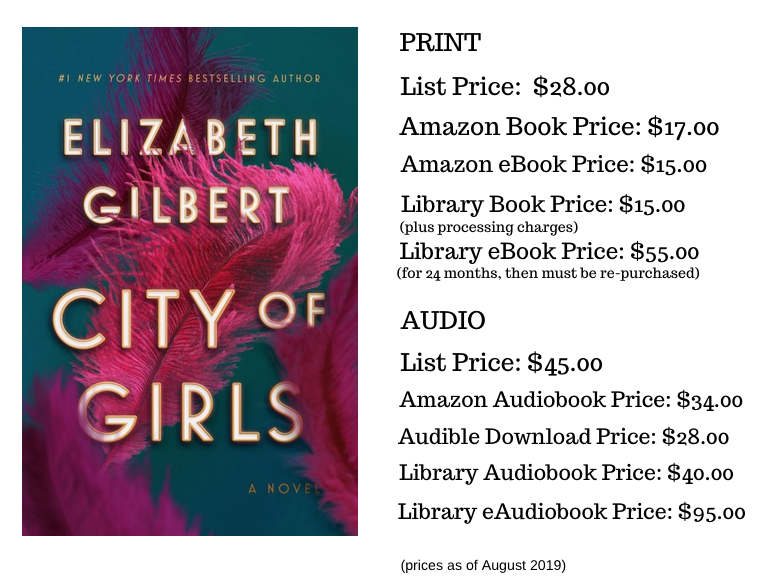
And, unfortunately, the prices libraries must pay for ebooks and e-audiobooks are very high. Libraries must pay up to 4X the retail price for digital versions of books (which only one user can have access to at a time).  Meeting the library patron’s needs for downloadable content is a very expensive enterprise, indeed! Take a look at this comparison of the prices for various versions of the same book:

e-Audiobook publishers have used a “perpetual license” model in the past, (meaning a title only needs to be purchased once, regardless of the number of uses or months) but that is starting to change. Many are converting to a “metered access” model like the eBook publishers, which will have a significant impact on how many titles a library is able to purchase.

Recently, another way for libraries to offer digital content has emerged, the “pay-per-use” model. Platforms like Hoopla, Kanopy, and Freegal, are examples. These platforms offer libraries a pre-curated collection of digital items that have no limit on how many people can check them out at the same time. Rather than buying individual titles, the library pays a fee each time an item from the collection is checked out. For a while, this sounded like a good solution to the long waiting periods users experienced on traditional platforms. The drawback? The service can become so popular that the monthly fees quickly become unmanageable. This is what happened at CPL when we tried Hoopla.  The monthly fees kept skyrocketing,  even when we lowered our checkout limit to 5 items per month. It became impossible to sustain the expense without reducing the service even further, so we discontinued Hoopla and looked for something better.

Since discontinuing Hoopla, CPL has added a platform with a new lending model for e-Audiobooks that we hope will ease some frustration. RBdigital began offering a new service with a core collection of 30,000+ audiobook titles that allow muti-user access (always available, no waiting lists), plus the ability for libraries to add newer and more in-demand titles to the collection (following the one copy/one user model). RBdigital charges libraries a flat monthly fee for the “always available” content, so the library doesn’t have to limit the amount of items patrons check out, and knows exactly how much to budget for each month. We’ll continue to look for ways to bring the most value to the library experience.

The digital media landscape for libraries is constantly changing and adjusting. Here are some articles to check out if you’re  interested in learning more on the subject:

www.cnn.com/2019/08/02/opinions/libraries-fight-publishers-over-e-books-west/index.html

www.ala.org/news/press-releases/2019/07/ala-uneasy-about-simon-schuster-digital-lending-model-changes

www.ala.org/news/press-releases/2019/06/ala-concerned-over-hachette-book-group-ebook-and-audio-book-lending-model

www.inquirer.com/news/ebooks-free-library-philadelphia-costs-budget-20190117.html

https://slate.com/business/2019/09/e-book-library-publisher-buying-controversy-petition.html

Devil in the White City

NOTE: This post deals with a difficult subject matter, serial killers, so if you’re easily disturbed, you might not want to read any further.

A book kept passing through my hands and it seemed intriguing – psychopath, history, award-winning – probably good, and I read it at last. The Devil in the White City  by Erik Larson tells the true story of the great Chicago World’s Fair of 1893, a celebration of Columbus’s 400th anniversary of discovering the new world and an attempt to outdo the 1887 Paris World’s Fair, which amazed the world with the new Eiffel Tower, the tallest structure in the world. The fair covered more than 600 acres – almost six times the size of Disney’s Magic Kingdom – and attracted more than 27 million visitors in its 6 month-run (versus 20 million visitors to Magic Kingdom in 2016). It also chose Tesla’s AC electric current to power it because it was cheaper than Edison’s DC current, cementing the road for America’s future electrical grid.

Chicago was no charming city, known for stink (stockyards), grime (trains and soot), crimes and vice. And in this mix lurked a serial killer, H.H. Holmes. Holmes’s background was a perfect mix of known factors of psychopathic development – strict, cold, abusive parents with severe religious obsession. By the age of 6, Holmes liked to dismember animals, and by his teens was implicated in the death of a young boy but cleared due to the pitiful state of investigations. He fled to Chicago, where he became a con artist, bilking insurance companies, furniture companies, and drug supply stores. He also charmed single ladies, killed them, reduced them to skeletons, and sold them as medical supplies. He built an elaborate hotel nicknamed “The Castle,” complete with gas jets in the rooms, soundproof rooms, and a personal crematorium in his basement. When finally cornered for killing his long-time assistant, Holmes confessed to 29 killings, though only 9 could be proven, but his total might have been as high as 200. He was hung for his crimes. Leonardo DiCaprio bought the film rights to the book, and a film is in production with Martin Scorsese as director (it had a tentative 2017 date, but is still in process).

Serial killers – those that kill large numbers of victims over time – are rare as far as murder goes, but the extent of their crimes garners a lot of press. Connecticut has its own serial killer in Amy Archer Gilligan of Windsor, who killed as many as 48 of her nursing-home patients for insurance claims between 1885 and 1917. Some of the more notorious American serial killers include:

Jeffery Dahmer (1991), who killed (and ate) at least 16 young men and boys. Not a high count for a serial killer,  it was the cannibalism that made him famous. He was beaten to death in prison not long after his conviction. Some things scare even murderers.

John Wayne Gacy (1978), who dressed as a clown for kids’ birthday parties and killed more than 33 men.  Stephen King said “It” was fiction.

Charles Cullen (2003), convicted of 40 murders while he was a nurse, but possibly responsible for up to 400, making him the most prolific not only in New Jersey, but the USA. Carl Watts (1982) was also a nurse, convicted of six murders but possibly as many as 130.

Ted Bundy (1975), one of the most famous and perhaps sickest, who killed more than 30. He decapitated at least 12 victims and kept the heads in his apartment, and often performed sex acts on rotting corpses (I warned you). He was executed in Florida.

Gary Ridgeway (2001)  the “Green River Killer”, with 49 proven deaths, 71 confessions, with a probable total closer to 90.

Ed Gein (1957)– Gein was convicted of only two murders, but if you’re looking at psychopaths, Gein is King. Gein had a bizarre attachment to his mother (back to that cold/abuse/super-religious thing), and would go to graves and dig up women’s bodies, skin them, and save parts attempting to wear his mother. Gein was the inspiration for Psycho, The Texas Chainsaw Massacre, and Silence of the Lambs. He was diagnosed as schizophrenic, incompetent, and died in a mental facility.

What predicts a serial killer? Most professionals look for early abuse, neglect, brutality, bullying, and mental illness. Animal cruelty, especially in young children, is a warning sign. Killers are often charismatic (Holmes, Bundy, Jim Jones, too) and manipulative, gaining friendship and trust.  Lack of empathy for their victims is  always present. Some do it for attention, especially media attention. One interesting point: 70% of serial killers had experienced significant head trauma as children; with what we now know about violence among football players and boxers who receive blows to the head, could this be a risk factor?

So hug your kids. Be patient. Be kind to them and to others, and teach them to be kind as well. Take bullying and animal cruelty seriously, and report it to authorities. You don’t know how many lives you might save.