 Icons come and icons go. Coca Cola survives, but Woolworth’s, the standard of the early 20th century, is now history. What’s popular today may not make the cut to the next generation – few kids today play with Cabbage Patch Dolls, despite the frenzied battles people had over them in the 1980’s, and all those people who sank thousands of dollars into Beanie Babies as investments now have … boxes of worthless stuffed toys.
Winnie the Pooh Endures
Winnie the Pooh is one of those who made the grade. A.A. Milne (Alan Alexander) wrote first a book of children’s poems (When We Were Very Young), then a Christmas story, and finally, in 1926, a book of stories, Winnie the Pooh, based on his son Christopher Robin and his stuffed bear Edward. A sequel, The House at Pooh Corner, followed in 1928, as well as two books of poems. Filled with charming innocence after the bloodbath of World War I, bumbling, slow-witted but kind-hearted Pooh and his friends (Tigger, Eeyore, Piglet, and Kanga and Roo) hit a needy spot in a dejected population. By 1931, Winnie the Pooh was a $50-million business, the dream-deal of every author (and that was in the middle of a depression!).
Although Milne died of a stroke in 1956, Pooh continued to expand when the film rights, among others, were sold to Disney in 1961, and the first animated cartoon released in 1966, with Sterling Holloway’s voice becoming the standard for Pooh. Today, the marketing of Winnie the Pooh is worth as much as $6 billion dollars a year, the third most valuable franchise in the world, after Star Wars and Disney Princesses (both, not surprisingly, also Disney franchises, a company with more than 92 billion dollars in assets).
Two New Films
Within the last year, another expansion on the franchise has brought out two marvelous films not necessarily aimed at children but adults who once were children: Goodbye Christopher Robin, and Christopher Robin.
 Goodbye Christopher Robin is a lovely, sweet story of Milne and his relationship to his son, and how the success of Winnie the Pooh destroyed the childhood of Christopher Robin himself. Pushed into the judgmental spotlight too young, Christopher Robin was beaten up in school because of his fame, and grew to resent his father, whom he described as very bad with children. Although eventually he reconciled with Winnie the Pooh, he never really reconciled with his parents; even on her death bed, his mother refused to see him. Goodbye Christopher Robin is a British production filled with beautiful settings and a superb performance by eight-year-old Will Tilston; it was released on DVD in January.
On August 3, Disney launched their Christopher Robin film (does someone leak news between studios? This type of inter-studio film wars has happened numerous times, most recently with Mirror, Mirror and Snow White and the Huntsman both released in 2012, and Disney’s 2016 Jungle Book with this October’s Warner Bros. coming release of Mowgli). In a plot fairly reminiscent of Hook (which was not a Disney creation), Christopher Robin is a grown-up who has lost his imagination, so enter CGI Pooh and friends to help him remember it. While the voices are so close to the cartoons you loved in the 60’s, somehow the CGI just doesn’t work as well. Kids will probably love it, grown-ups not so much, and not for lack of imagination.
Winnie the Pooh was voted an icon of England, but you can see the original Winnie and friends at their permanent home at the New York Public Library here in the United States (Roo was lost in an apple orchard in 1930).

As the real Pooh turns 100 in 2021, he’s showing no signs of losing his status as a bear loved around the world. Pooh has been translated into more than 46 languages, including Latin, Mongolian, and Esperanto. If you have no child to share Winnie the Pooh with, try these “adult” Pooh books:
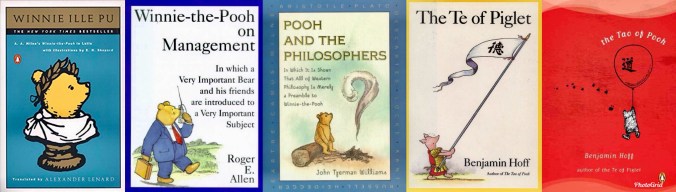
- Winnie Ille Pu (Latin ed.), by
- Winnie-the-Pooh on Management by Roger E. Allen
- Pooh and the Philosophers by John Tyerman Williams
- The Te of Piglet by Benjamin Hoff
- The Tao of Pooh by Benjamin Hoff

 Sometimes a literary character – and an author – just doesn’t quit, staying popular generation after generation. Sometimes we call that a classic – Scarlett O’Hara, Oliver Twist, Jane Eyre, Robin Hood and Maid Marian. Sometimes we call that Hercule Poirot.
 Marple), a retired Belgian police officer with peculiarly meticulous habits and a brilliant mind for solving crimes, well-known for his thick black curling mustache – the only fictional character to ever have an obituary on the front of the New York Times. Poirot first appears in
  Numerous film and television adaptions of both Orient Express and
  screen on November 10, 2017, with a – dare I say it? – killer cast. Kenneth Branagh, British superstar of myriad films including


 Not to mention the online project that started it all, a little something called
  Add in that he has two young childen, and one can see that it might have been challenging to find the time to write recently. About his new book, he’s said: “This is my first attempt to write directly about the kind of mental illness that has affected my life since childhood, so while the story is fictional, it is also quite personal”. Green has talked about dealing with OCD and anxiety in his own life, and in the new book , 16-year-old Aza Holmes grapples with mental illness as she investigates the disappearance of a billionaire.

 America to pad out their colonies? Who would not be missed from the overcrowded prisons and cities? Not the landed gentry, but those persons who for whatever reason did not fit into society and were unsuccessful at supporting themselves. The Virginia Colony had to go so far as to set a death sentence for people who did not work and did not attend church on Sundays. Starvation was so bad that people resorted to
  son (the first person running for President who lost despite getting the most popular votes

 The Cheshire Library Blog